

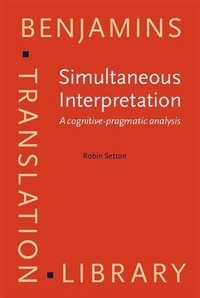
Simultaneous Interpretation
A cognitive-pragmatic analysis
1st Edition
Published on 15. May 1999
XV, 397 pages
978-90-272-8547-8 (ISBN)
Description

Simultaneous interpretation is among the most complex of human cognitive/linguistic activities. This study, which will interest practitioners and trainers as well as linguists, draws more on linguistics-based theories of cognition in communication (cognitive semantics and pragmatics) than on the traditional information-processing approaches of cognitive psychology, and shows SI to be a valuable source of data on language and cognition.Starting from semantic representations of input and output in samples of professional SI from Chinese and German into English, the analysis explains the classic phenomena - anticipation, restoration of the implicit-explicit balance, and communicative re-packaging ('re-ostension') of the discourse - in terms of an intermediate cognitive model in working memory, allowing a more unitary view of resource management in the SI task. Relevance-theoretic analysis of the input discourse reveals rich pragmatic information guiding the construction of the appropriate contexts and the speaker's underlying intentionalities. The course of meaning assembly is reconstructed in annotated synchronised transcripts.
More details
Other editions
Additional editions
Book
05/1999
John Benjamins Publishing Co
€137.80
Shipment within 10-15 days
Content
- SIMULTANEOUS INTERPRETATION A COGNITIVE-PRAGMATIC ANALYSIS
- Editorial page
- Title page
- Copyright page
- Table of contents
- Abbreviations and Symbols
- Preface
- Acknowledgments
- Chapter 1. Introduction
- 1 Simultaneous conference interpretation
- 2 The cognitive-pragmatic approach
- 3 The theoretical framework
- 3.1 Relevance theory
- 3.2 Cognitive semantics
- 3.3 Mental models
- 3.4 Speech-act theory
- 4 The phenomenology of discourse
- 5 Outline and scope of the study
- Chapter 2. SI Research
- 1 Historical background
- 2 Temporal and surface variables
- 2.1 Measuring synchronicity
- 2.2 Ear-voice span (EVS) or 'lag'
- 2.3 Segmentation and processing units
- 2.4 Speech rates
- 2.5 Error analysis
- 3 A computational linguistics approach
- 4 Information-processing models of SI
- 5 The Effort Model: a processing capacity account
- 6 The Interpretive Theory of translation (IT) (théoriedu sens)
- 7 SI in Allgemeine Translationstheorie (ATT) ('General Translation Theory')
- 8 SI research: evaluation and prospects
- 8.1 Methodology in SI research
- 8.2 Outstanding issues and controversies
- 8.2.1 Intermediate representation
- 8.2.2 SI skills and strategies
- 8.2.3 Language-specific factors
- 9 Old and new concepts in T & I research
- Chapter 3. An Outline Model for SI
- 1 Introduction
- 2 Sources for the model
- 3 Basic assumptions about cognitive function
- 3.1 The representational hypothesis
- 3.2 The Modularity Hypothesis (MH)
- 4 Inputs to discourse comprehension
- 4.1 Audiovisual input
- 4.2. Speech processing in psycholinguistics
- 4.3 Word recognition
- 4.4 The (multilingual) lexicon
- 5 Assembly: syntax, lexicon and context
- 6 The mental model
- 7 Contextualisation for SI
- 8 The language of representation
- 9 The Executive
- 10 Speech production in SI
- 11 Processing capacity and coordination
- Chapter 4. Research Issues, Corpus, and Methodology
- 1 Research issues
- 2 The corpus
- 2.1 German-English: Würzburg'
- 2.2 Chinese-English: 'Taipei'
- 2.3 Supplementary Chinese-English corpus
- 2.4 Comparison of SI corpora
- 2.5 Equipment, recording, timing and transcription
- 2.6 Segmentation of the transcripts for analysis
- 2.7 Linguistic descriptions
- 2.8 English gloss
- 3 Methodology
- Chapter 5. Structures and Strategies
- 1 Introduction to the corpus analysis
- 2 SL-TL asymmetry in SI: obstacle or epiphenomenon?
- 3 Word order
- 4 Word order asymmetry and indeterminacy
- 4.1 German-English
- 4.1.1 Autonomous syntax
- 4.1.2 German-English SI structural patterns: summary
- 4.2 Chinese-English
- 4.2.1 Parsing Chinese
- 4.2.2 Left-branching structures in Chinese-English SI
- 4.2.3 Subjects
- 4.2.4 Asymmetries and moot constituency in Chinese-English SI: Summary
- 4.3 Left-branching Noun Phrases
- 5 SL-TL compatible structures: paraphrase and re-ordering
- 6 Simplification of semantic structure
- 7 Marked subordinate and non-declarative structures
- 8 Discussion
- Chapter 6. The Pragmatics of Interpretation
- 1 Contexts
- 2 'Frame' effects
- 3 Situation and scripts
- 4 Inference
- 5 Inferred referential features
- 5.1 Boundedness and set-membership
- 5.2 Anaphora and deixis
- 5.3 Tense, Aspect and realis/irrealis
- 6 SI strategies or natural inference products?
- 6.1 Anticipation
- 6.1.1 Anticipation from a propositional attitude
- 6.1.2 Anticipation from pragmatic principles
- 6.1.3 Long-range deductive anticipation
- 7 Contextual sources: summary
- 8 The discourse model: entities, properties and relations (epr)
- 9 Secondary pragmatic processing and communicative intent
- 10 Processing instructions and procedural encoding
- 10.1 Uses and distribution of modals and connectives: contrastive differences
- 10.2 German-English
- 10.3 Chinese-English
- 11 A vocabulary of representation (and presentation)
- 12 Microanalysis
- Chapter 7. Judgment, Compensation and Coordination
- 1 Introduction
- 2 Judgment
- 3 Late elements and afterthoughts
- 4 Compensation
- 5 Pragmatic fidelity
- 6 Coordination and attention in SI
- 6.1 Hesitancy and delivery patterns
- 7 Executive and secondary pragmatic processing
- 7.1 Cognitive management and difficulty in SI
- 8 Failure in SI
- 8.1 Problems in primary assembly
- 9 Processing breakdown and compound errors
- 9.1 Failure in SI from recited written text
- 9.2 Pragmatic failure
- 9.3 Causes of failure in SI
- 10 Summary
- Chapter 8. Summary and Conclusions
- Appendices
- Appendix A Parsing theory
- Appendix B Sample of conference discourse unsuited to analysis
- Appendix W1 'Würzburg' SI in a live conference situation: input and interpreter WL (analytic transcript)
- Appendix W2 'Würzburg' SI in a live conference situation: input and interpreter WL (synchronised transcript)
- Appendix W3 'Würzburg' SI in mock session: input and interpreters WA and WB (analytic transcript)
- Appendix W4 'Würzburg' Interpreters' versions transcribed as fluent text
- Appendix T1 'Taipei' Chinese source discourse
- Appendix T2-A Taipei: Romanised transcript with gloss and analysis, interpreters TA, TB
- Appendix T2-B Taipei Segments 11-28: Input with gloss, interpreters TA, TB
- Appendix T3 Taipei: Recited discourse (S29-39) and interpreters TA, TB (synchronised transcript)
- Notes to Chapters
- Chapter 1 Introduction
- Chapter 2 SI Research
- Chapter 3 An Outline Model for SI
- Chapter 4 Research Issues, Corpus and Methodology
- Chapter 5 Strategies and Structures
- Chapter 6 The Pragmatics of Interpretation
- Chapter 7 Judgment, Compensation and Coordination
- Chapter 8 Summary and Conclusions
- Glossary
- References
- Name index
- Subject index
- The series Benjamins Translation Library
