

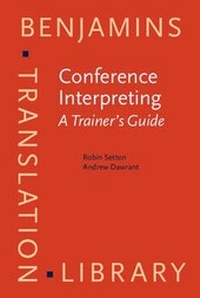
Conference Interpreting - A Trainer's Guide
A Trainer's Guide
1st Edition
Published on 15. February 2016
XXIX, 629 pages
978-90-272-6756-6 (ISBN)
Description

This companion volume to Conference Interpreting - A Complete Course provides additional recommendations and theoretical and practical discussion for instructors, course designers and administrators. Chapters mirroring the Complete Course offer supplementary exercises, tips on materials selection, classroom practice, feedback and class morale, realistic case studies from professional practice, and a detailed rationale for each stage supported by critical reviews of the literature. Dedicated chapters address the role of theory and research in interpreter training, with outline syllabi for further qualification in interpreting studies at MA or PhD level; the current state of testing and professional certification, with proposals for an overhaul; the institutional and administrative challenges of running a high-quality training course; and designs and opportunities for further and teacher training, closing with a brief speculative look at future prospects for the profession.
More details
Other editions
Additional editions
Robin Setton | Andrew Dawrant
Conference Interpreting - A Trainer's Guide
Book
06/2016
John Benjamins Publishing Co
€104.94
Shipment within 10-15 days
Persons
Content
- Intro
- Conference Interpreting A Trainer's Guide
- Editorial page
- Title page
- LCC data
- Authors' bios
- Table of contents
- List of tables and figures
- Abbreviations
- General introduction
- Acknowledgements
- 1. Introduction to the Trainer's Guide
- Professionalism: the devil is in the detail
- Revisiting testing and certification
- Theory and research
- 2. Teaching conference interpreting
- 2.1 Introduction
- 2.1.1 Overview
- 2.1.2 Key pedagogical principles and rationale
- 2.2 What makes a good instructor?
- 2.2.1 Pedagogical and class management skills
- 2.2.2 Feedback and demonstration expertise
- 2.2.3 Human qualities
- 2.2.4 Theoretical knowledge
- 2.2.5 Training the trainers
- 2.2.6 Postgraduate teaching assistants (TAs)
- 2.2.7 Other auxiliary instructors
- 2.2.8 Pedagogical coordination and cohesion
- 2.3 The student's experience
- 2.3.1 Morale and motivation
- 2.3.2 The learning curve
- 2.4 Class design and configurations
- 2.4.1 Types of class configuration
- 2.4.2 Class size, composition and duration
- 2.4.3 Diversity and class participation
- 2.4.4 Language combination of instructors
- 2.4.5 Team- or assisted teaching and 'triangular' classes
- 2.5 The interpreting skills classroom
- 2.5.1 Student-centred learning
- 2.5.2 Putting yourself in the student's place
- 2.5.3 Learning what and learning how
- 2.5.4 Teaching methods and classroom procedures
- 2.5.5 Choosing the right materials
- 2.5.5.1 Progression in materials
- 2.5.5.2 Assessing speech difficulty
- 2.5.5.3 Finding authentic speeches and maintaining a speech bank
- 2.5.6 Topic and event preparation and brainstorming
- 2.5.7 Student performance and discussion
- 2.5.7.1 Taking turns and class involvement
- 2.5.7.2 Discussion: staying focused
- 2.5.8 Feedback
- 2.5.8.1 General principles
- 2.5.8.2 Follow-up: stand-back vs. hands-on pedagogy
- 2.5.9 Explanations, theory, metaphors and models
- 2.5.10 Agreeing on terms
- 2.5.11 Instructor demonstrations
- 2.5.12 Combining teaching modes
- 2.6 Expertise and deliberate practice
- 2.6.1 Expert performance research
- 2.6.2 Deliberate practice
- 2.6.3 Private study and deliberate practice
- 2.7 Summary
- Appendix A
- 3. Curriculum and progression
- 3.1 Introduction
- 3.2 Revisiting the standard training paradigm
- 3.2.1 Origins: instinct and apprenticeship
- 3.2.2 The call for a scientific basis for training
- 3.2.3 Component-skills approaches
- 3.2.3.1 Component skills (part-task) vs. holistic training
- 3.2.3.2 Task analysis: models of interpreting
- 3.2.3.3 What kind of task is interpreting?
- 3.2.3.4 Conditions for effective part-task training
- 3.2.3.5 Incremental realism and motivation
- 3.2.4 What can be taught and how?
- 3.2.4.1 Teaching interpreting 'strategies'
- 3.2.4.2 Bridging the declarative-procedural gap
- 3.2.5 Apprenticeship, scientific teaching and student-focused learning
- 3.2.6 Individual variability and flexibility
- 3.3 Curriculum design
- 3.3.1 Curriculum components
- 3.3.2 Progression: steps to expertise
- 3.3.3 Cross-cutting skills
- 3.3.4 Bridging theory and practice
- 3.3.5 Course duration and staging
- 3.3.5.1 Why Consecutive and Sight Translation before SI?
- 3.3.5.2 Sight translation
- 3.3.5.3 Working first into A, then into B
- 3.3.6 Curriculum flexibility
- 3.4 In-course assessment
- 3.4.1 The Midpoint Exam: selection for SI training
- 3.4.1.1 Rationale, criteria and procedure
- 3.4.1.2 Test items
- 3.4.1.3 Midpoint assessment criteria
- 3.4.2 Assessment through the course: progression of constructs and criteria
- 3.4.3 Other forms of in-course assessment
- 3.4.3.1 Self- and peer-assessment
- 3.4.3.2 Student portfolios and journals
- 3.5 Pedagogy and curriculum: updating the apprenticeship model
- 3.5.1 Existing weaknesses
- 3.5.2 Summary of recommendations
- Further reading
- 4. Selection and admission
- 4.1 Introduction
- 4.2 Defining standards for admission
- 4.2.1 Language proficiency
- 4.2.2 The profile of a promising trainee: other criteria
- 4.3 Entrance examinations
- 4.3.1 General procedure and pre-screening
- 4.3.2 The written exam
- 4.3.2.1 Standardly scorable tests
- 4.3.2.2 Performance tests
- 4.3.2.3 Choice of tests and grading: the decision tree
- 4.3.3 Oral test and interview
- 4.3.3.1 Panel composition and qualifications
- 4.3.3.2 Guidelines for speeches
- 4.3.3.3 Live speech vs. video
- 4.3.3.4 Rater training and preparation
- 4.3.3.5 Oral exam procedure
- 4.3.3.6 Adapting or varying test procedure (on the fly)
- 4.3.4 Assessment, grading and deliberations
- 4.3.4.1 Scoring procedure
- 4.3.4.2 What to look for
- 4.3.4.3 Final selection
- 4.3.5 Candidate profiles
- 4.3.6 Admission exams and pedagogy
- 4.4 Research on aptitude testing: criticisms and solutions
- 4.4.1 Consensus and best practices
- 4.4.2 Criticisms of the traditional aptitude test
- 4.4.3 The search for (more) objectivity
- 4.4.3.1 An early experiment with psychometric testing
- 4.4.3.2 Staggered or extended selection procedures
- 4.4.4 Aptitude testing in practice - the challenge of feasibility
- 4.5 Summary and recommendations
- Further reading
- Appendix A
- Appendix B
- Appendix C
- 5. Initiation to interpreting
- 5.1 Introduction
- 5.2 Active Listening exercises
- 5.2.1 Idiomatic Gist
- 5.2.2 Listening Cloze
- 5.2.3 Discourse Modelling and Outlining
- 5.3 Concision and compression
- 5.4 Deverbalization and interference-busting
- 5.5 First steps in real interpreting
- 5.5.1 Short Consecutive without notes
- 5.5.2 Role and mediation: impartiality and fidelity
- 5.6 Public Speaking and Delivery Skills
- 5.7 Initiation: pedagogical notes
- 5.8 The learning curve: a novelty bonus
- 5.9 Initiation: structure and objectives
- 5.10 Some basic theory for instructors (and students)
- 5.10.1 A general theory of communication
- 5.10.2 Language, context and communicative intent
- 5.10.3 What makes a speech a speech? Function, rhetoric and genre
- 5.10.4 Meaning vs. form-based translation and the Théorie du sens (ITT)
- 5.11 Summary
- Further reading
- 6. Teaching consecutive interpreting
- 6.1 Introduction: teaching full consecutive
- 6.1.1 Note-taking: doctrine and pedagogy
- 6.1.2 Progression in consecutive
- 6.2 Orientation: Introduction to Note-taking (S1 weeks 6-9)
- 6.2.1 Student morale and the learning curve
- 6.2.2 Demonstration: notes as a help and a hindrance
- 6.2.3 The place of theory
- 6.3 Note-taking: the 'Standard Method'
- 6.3.1 Cue-words and links
- 6.3.2 Note-taking II: layout and information capture
- 6.3.3 Note-taking III: Completing the Toolkit
- 6.4 Coordination (mid- S1, weeks 10-13)
- 6.4.1 Focus and class procedure
- 6.4.2 The learning curve: getting on the bicycle
- 6.4.3 Coordination: pedagogy and feedback
- 6.4.4 The method and the individual
- 6.5 Experimentation through practice (late S1, early S2)
- 6.5.1 Focus: adaptation and flexibility
- 6.5.2 The learning curve: student and class morale
- 6.5.3 Pedagogical focus and class organization
- 6.6 Consolidation (from early/mid S2 through S3)
- 6.6.1 The learning curve: resurfacing
- 6.6.2 Consolidation: pedagogy and feedback
- 6.6.3 'At the table': adapting to setting and environment
- 6.6.4 Consecutive and new technology
- 6.7 Polishing and advanced consecutive (Year 2, S3-S4)
- 6.8 Research and modelling
- 6.8.1 Observational research: the role of notes
- 6.8.2 Consecutive and memory
- 6.8.3 Attention and processing capacity
- 6.8.3.1 The Effort Model of Consecutive Interpreting
- 6.8.3.2 Reducing cognitive load: knowledge and procedural skills
- 6.8.3.3 Distributing effort between capture and delivery
- 6.8.4 Technique, process and product in consecutive
- 6.9 Summary
- 7. Language, knowledge and working into B
- 7.1 Introduction and overview
- 7.1.1 Language and knowledge in interpreter training
- 7.1.2 The directionality debate: ideals and reality
- 7.2 Language enhancement in the curriculum
- 7.2.1 LE classes for interpreters
- 7.2.2 Feedback in interpreting skills classes
- 7.2.3 Remedial coaching in tutorial format
- 7.2.4 Independent study and practice
- 7.3 Interpreting into B: needs, challenges and strategies
- 7.3.1 Parameters for successful interpreting into B
- 7.3.1.1 Quality of the B language
- 7.3.1.2 Speech and event type
- 7.3.1.3 Finding the right balance
- 7.3.2 Timing and management of into-B training
- 7.3.3 Common into-B problems and remedies
- 7.3.4 SI into B: feedback
- 7.3.4.1 Participation of 'pure users'
- 7.3.4.2 Relay interpreting from a pivot working into B
- 7.3.5 Working into B in difficult conditions
- 7.4 Knowledge Enhancement: general and special modules
- 7.4.1 General domain modules: Law and Economics
- 7.4.2 Talking the talk: the language of research reports and presentations
- 7.4.3 Specialized knowledge and customized modules
- 7.5 Some background science
- 7.5.1 Language enhancement: the art of the possible
- 7.5.2 Implicit and explicit competence
- 7.5.3 Linguistic knowledge, pragmatic competence and motivation
- 7.5.4 Selective activation in the multilingual brain
- 7.6 Summary
- Further reading
- 8. Teaching simultaneous interpreting
- 8.1 Introduction
- 8.1.1 Prerequisites for SI training
- 8.1.2 The instructor's challenge
- 8.1.3 The learning curve: discovering SI
- 8.2 SI-Initiation
- 8.2.1 Rationale and organization
- 8.2.2 Orientation
- 8.2.3 Initiation 'Strand A': Easy SI on line (weeks 2 and 3)
- 8.2.4 Initiation 'Strand B': controlled input (classroom)
- 8.2.5 Transition to real SI: Spoonfeeding
- 8.2.6 Staffing and classroom procedure in SI-Initiation
- 8.2.7 Feedback in SI-Initiation
- 8.2.8 Variety and class momentum
- 8.3 Coordination and Control (early/mid-semester 3)
- 8.3.1 SI with help
- 8.3.2 Take-off: Real SI on fresh trainer speeches
- 8.4 Experimentation (and personal style)
- 8.4.1 The learning curve: adapting to 'natural terrain'
- 8.4.2 Where to jump in and open grammar
- 8.4.3 Time, effort and meaning
- 8.4.4 Introduction to SI-text
- 8.4.5 Practising with numbers
- 8.4.6 Experimentation: common problems, diagnosis and treatment
- 8.5 Consolidation - from basic to confident SI
- 8.5.1 The learning curve: new horizons
- 8.5.2 International community-speak: acclimatization
- 8.5.3 SI-Text (continued)
- 8.5.4 Consolidating the product
- 8.5.5 Stronger and weaker students
- 8.6 Teaching SI: themes and controversies
- 8.6.1 Modelling the SI process
- 8.6.1.1 SI and the théorie du sens (ITT)
- 8.6.1.2 The Effort Model of SI
- 8.6.2 Component skills and SI
- 8.6.3 Preparatory exercises for SI: a controversy
- 8.7 Teaching SI: summary
- Further reading
- Appendix A
- Appendix B
- 9. Reality and advanced tasks
- 9.1 Introduction
- 9.1.1 The last mile
- 9.1.2 User orientation
- 9.1.3 Complex but routine tasks vs. hazards and impossible conditions
- 9.1.4 Overview of the final semester
- 9.2 Competence for the real world: complex but routine tasks
- 9.2.1 Extending comprehension and knowledge
- 9.2.2 Completing the skill-set
- 9.2.3 Compression and Abstracting (cf. CC-9.2.4)
- 9.2.4 Pedagogy and feedback
- 9.3 Making life easier: preparation and teamwork
- 9.3.1 Conference preparation (Semesters 3 and 4)
- 9.3.2 Teamwork
- 9.4 Simulation and reality
- 9.4.1 The mock conference
- 9.4.2 Internships and on-site visits with dumb booth practice
- 9.4.3 Mentoring and apprenticeship ('Y3 and Y4')
- 9.5 Expertise and survival
- 9.5.1 Expertise in interpreting
- 9.5.2 Crisis management and coping tactics
- 9.5.3 'Tough Love' Crisis Management Drill
- 9.6 Hazards and impossible conditions
- 9.6.1 Expertise and its limits
- 9.6.2 What is difficult and why?
- 9.6.2.1 Speed and density
- 9.6.2.2 Unfamiliar or technical subject-matter
- 9.6.2.3 Register, eloquence and style
- 9.6.2.4 Linguistically deviant or incoherent speech
- 9.6.2.5 SI from recited text - but without the text
- 9.6.2.6 Multiple channels or 'mixed-media' interpreting
- 9.6.2.7 Screened-off: tele- and remote interpreting
- 9.6.2.8 SI-text from an unknown language (with the help of a translation)
- 9.7 Last-mile feedback
- 9.8 Summary
- Further reading
- Appendix
- 10. Professionalism and ethics
- 10.1 Introduction
- 10.2 Confidentiality and integrity
- 10.2.1 Confidentiality
- 10.2.2 Integrity and conflicts of interest
- 10.3 Neutrality and the interpreter's role
- 10.3.1 'Loyalty': Speaker vs. Client
- 10.3.2 The interpreter's role: scope and balance
- 10.4 Fidelity, optimization and mediation
- 10.4.1 Fidelity
- 10.4.2 Default, constrained and optimized interpreting
- 10.4.3 Interactions with setting, mode and role
- 10.4.4 Formal optimization
- 10.4.5 Content Optimization
- 10.4.5.1 Content Optimization (1): CLARIFYING by
- 10.4.5.2 Content optimization (2): CORRECTING obvious (factual) speaker errors
- 10.4.5.3 Content optimization (3): FILTERING
- 10.4.6 Optimizing the communication process
- 10.4.7 Optimization: weighing risks and benefits
- 10.5 The scope of mediation
- 10.5.1 'Strong' mediation: advocacy and arbitration
- 10.5.2 Judging our own usefulness
- 10.5.3 Knowing the audience ('audience design')
- 10.6 Summary
- Further reading
- 11. Testing and certification
- 11.1 Introduction
- 11.2 The Professional Examination in Conference Interpreting (PECI)
- 11.2.1 Current status, functions and standards
- 11.2.2 Should schools act as credentialling authorities?
- 11.2.3 How well do training programs fulfil the credentialling function?
- 11.3 Basic requirements in testing
- 11.3.1 Essential attributes of a good test
- 11.3.1.1 Reliability
- 11.3.1.2 Validity
- 11.3.1.3 Accountability, transparency, feasibility
- 11.3.2 Criterion-referenced performance tests
- 11.3.2.1 Validity in criterion-referenced performance tests
- 11.3.2.2 Reliability in criterion-referenced performance tests
- 11.3.2.3 'Open' and 'closed' skills
- 11.4 Current PECI practices and problems
- 11.4.1 Problems with PECI procedures
- 11.4.2 Discussion of main issues
- 11.4.3 Some expedients adopted in schools
- 11.5 A case-study in standardization: the FCICE
- 11.5.1 Background and description
- 11.5.2 Discussion and review
- 11.6 Applying best CRT practices to conference interpreter certification: a first attempt
- 11.6.1 The test development process
- 11.6.2 Defining the test's purpose
- 11.6.3 The test framework: delineating the domain
- 11.6.3.1 Tasks to be performed: modes and language directions
- 11.6.3.2 Input speeches: genres, subject-matter and delivery
- 11.6.3.3 Parameters of delivery
- 11.6.3.4 Covering interpreting pitfalls: known local hazards
- 11.6.3.5 Working and environmental conditions
- 11.6.3.6 Assessment criteria
- 11.6.4 Writing detailed test specifications
- 11.6.5 Reliability: scoring system and rater qualification
- 11.6.5.1 Holistic and analytic scoring
- 11.6.5.2 Assessment criteria: A closer look at Fidelity, Expression and Delivery
- 11.6.5.3 Developing scoring guides
- 11.6.5.4 Benchmark performances
- 11.6.5.5 Rater training and IRR
- 11.6.5.6 Exam administration
- 11.6.6 Scoring and reaching a final decision
- 11.6.6.1 Scoring test performances
- 11.6.6.2 Score resolution and review procedure
- 11.6.6.3 Determining PECI outcomes: applying a cut score
- 11.6.7 Exam retakers
- 11.6.8 Testing professionalism
- 11.7 Discussion
- 11.7.1 Standard-setting
- 11.7.2 A role for continuous assessment?
- 11.7.3 Analytic and holistic scoring: adapting method to purpose
- 11.7.4 Testing and task difficulty
- 11.7.5 Certification at different levels
- 11.7.6 Responsibility for credentialling
- 11.7.7 Consulting assessment experts, assessing test properties
- 11.8 Conclusion and recommendations
- 11.8.1 Short-term measures to improve school-based PECIs:
- 11.8.2 Longer-term recommendations to improve interpreter testing:
- Further reading
- 12. Theory and research in interpreter training
- 12.1 Introduction
- 12.1.1 Theory and practice in the curriculum
- 12.1.2 Theory for students
- 12.1.3 Theory for instructors and course designers
- 12.1.4 Theory for (future) researchers
- 12.2 What theory and where do we find it?
- 12.2.1 The discipline of Interpreting Studies
- 12.2.2 A general theory of communication and cognition
- 12.2.2.1 Origins and overview of Relevance Theory (RT)
- 12.2.2.2 Key RT concepts for interpreting
- 12.2.2.3 Relevance and (written) translation
- 12.2.2.4 Relevance and quality in interpreting
- 12.2.2.5 The goal of interpreting
- 12.2.3 Linguistics and translation
- 12.2.4 Functionalist approaches to translation
- 12.2.5 Models of interpreting
- 12.2.6 Language selection and interference
- 12.3 Theory and Practice: a mini-syllabus
- 12.3.1 Focus and timing
- 12.3.2 On the scene: interpreting as live situated communication
- 12.3.3 Prerequisites, constraints and potentials: what can be done and how
- 12.3.4 Modes of interpreting
- 12.3.5 Settings, situations and the interpreter's role (mediation)
- 12.3.6 The interdependence between quality and conditions
- 12.4 Postgraduate studies and research
- 12.4.1 The MA thesis
- 12.4.2 PhD-level studies
- 12.4.2.1 Institutional challenges and disciplinary positioning
- 12.4.2.2 Aims and content
- 12.4.2.3 A syllabus for a PhD in Interpreting Studies
- 12.5 Summary: theory in interpreter training
- Further reading and materials
- Appendix
- 13. Institutional issues
- 13.1 Introduction
- 13.2 Existing models and best practices
- 13.2.1 Conference interpreter training: the standard (AIIC) model
- 13.2.2 Establishment, status and autonomy
- 13.2.3 Leadership, faculty and staffing
- 13.2.4 Course design and structure
- 13.2.4.1 Relationship with other Translation specialisations
- 13.2.4.2 The curriculum for interpreter training
- 13.2.4.3 Extensions and repeat years
- 13.2.5 Student selection, testing and certification
- 13.2.5.1 Admissions procedures
- 13.2.5.2 Midpoint assessment: checking readiness for SI training
- 13.2.5.3 Degree and graduation requirements
- 13.2.6 Responsibilities of a vocational course and external relations
- 13.2.6.1 Transparency: target skillset and market demand
- 13.2.6.2 Committing to improving quality
- 13.2.6.3 Relations with the market and the profession
- 13.2.7 Best practices: summary
- 13.3 Challenges, constraints and responses
- 13.3.1 General challenges to best practices
- 13.3.2 Establishment and status - launching and maintaining a CITP
- 13.3.2.1 Emerging markets and quality standards
- 13.3.2.2 Market (mis)match
- 13.3.2.3 Establishment and autonomy: forestalling problems
- 13.3.2.4 External challenges: noise and mixed signals
- 13.3.2.5 Funding models: private vs public
- 13.3.3 Leadership, faculty and staffing
- 13.3.3.1 Faculty credentials
- 13.3.3.2 Timetable flexibility
- 13.3.4 Course design and structure
- 13.3.4.1 Relationship with other Translation specializations
- 13.3.4.2 Keeping the curriculum focused
- 13.3.5 Student selection, testing and certification
- 13.3.5.1 Admissions procedures
- 13.3.5.2 Restrictions on in-course testing
- 13.3.5.3 Streaming
- 13.3.5.4 Degree and graduation requirements
- 13.3.5.5 Pressure on selection and testing: summary
- 13.3.6 Responsibilities of a vocational training course
- 13.3.6.1 Responsibility to a sponsor or host institution
- 13.3.6.2 Responsibility to users and the profession: quality and gatekeeping
- 13.3.6.3 External relations
- 13.4 Summary
- Further reading
- 14. Lifelong and teacher training
- 14.1 Introduction
- 14.2 Initial or basic training in interpreting
- 14.2.1 Preparation for professional training
- 14.2.2 Initiation to interpreting for mature students
- 14.3 Further training: upgrades and refreshers
- 14.3.1 Adding or upgrading Skills
- 14.3.2 Adding or upgrading languages
- 14.3.2.1 Adding a C language
- 14.3.2.2 Upgrading and activating: C to B and Bcons to Bsim
- 14.3.3 Expanding or adding domain knowledge
- 14.3.4 Ancillary competencies: technology, voice, stress, career
- 14.4 Evaluating upgrade and refresher courses
- 14.4.1 'Area Studies': cultural-linguistic refreshers
- 14.4.2 Upgrades with practice and feedback
- 14.4.3 Initiation to new technology
- 14.5 Training of Trainers (ToT)
- 14.5.1 A ToT syllabus: outline and components
- 14.5.2 Methodology
- 14.6 Training interpreters for non-conference settings
- 14.6.1 Community interpreting
- 14.6.2 Interpreting in conflict situations
- 14.7 Summary and recommendations
- Further reading
- 15. Conclusions and future prospects
- The spectre of automatic translation
- Remote interpreting
- English as lingua franca
- Responses
- A stronger and more flexible (traditional) skillset
- Multiskilling
- Diversification and 'full service'
- Futurology and interpreter training
- References
- Name index
- CC-TG subject index
