

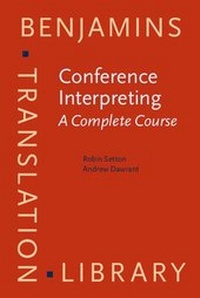
Conference Interpreting - A Complete Course
A Complete Course
1st Edition
Published on 15. February 2016
XXV, 448 pages
978-90-272-6757-3 (ISBN)
Description

The conference interpreting skillset - full consecutive and simultaneous interpreting - has long been in demand well beyond the multilateral intergovernmental organizations, notably in bilateral diplomacy, business, international tribunals and the media. This comprehensive coursebook sets out an updated step-by-step programme of training, designed to meet the increasingly challenging conditions of the 21st century, and adaptable by instructors with the appropriate specializations to cover all these different applications in contemporary practice.
After an overview of the diverse world of interpreting and the prerequisites for this demanding course of training, successive chapters take students and teachers through initiation and the progressive acquisition of the techniques, knowledge and professionalism that make up this full skillset. For each stage in the training, detailed, carefully sequenced exercises and guidance on the cognitive challenges are provided, in a spirit of transparency between students and teachers on their respective roles in the learning process. For instructors, course designers and administrators, more detailed and extensive tips on pedagogy, curriculum design and management will be found in the companion Trainer's Guide.
After an overview of the diverse world of interpreting and the prerequisites for this demanding course of training, successive chapters take students and teachers through initiation and the progressive acquisition of the techniques, knowledge and professionalism that make up this full skillset. For each stage in the training, detailed, carefully sequenced exercises and guidance on the cognitive challenges are provided, in a spirit of transparency between students and teachers on their respective roles in the learning process. For instructors, course designers and administrators, more detailed and extensive tips on pedagogy, curriculum design and management will be found in the companion Trainer's Guide.
More details
Other editions
Additional editions
Robin Setton | Andrew Dawrant
Conference Interpreting - A Complete Course
Book
06/2016
John Benjamins Publishing Co
€104.94
Shipment within 10-15 days
Persons
Content
- Intro
- Conference Interpreting A Complete Course
- Editorial page
- Title page
- LCC data
- Authors' bios
- Table of contents
- List of tables and figures
- Abbreviations
- General introduction
- Training interpreters: tradition and innovation
- Progression and incremental realism
- Full realism: going the last mile
- 'Bi-active' SI
- Teaching professionalism
- Acknowledgements
- 1. Introduction to the Complete Course
- 2. The interpreter's job
- 2.1 Introduction
- 2.1.1 Defining the task
- 2.1.2 Interpreting vs. written translation
- 2.1.3 Why is it called 'interpreting'?
- 2.1.4 How verbal communication works
- 2.1.5 Mediated communication (with a change of language)
- 2.1.6 Language: crucial but not sufficient
- 2.1.7 The interpreter as mediator
- 2.1.8 Mediation: neutral vs. affiliated roles
- 2.2 Modes of interpreting
- 2.2.1 Consecutive interpreting
- 2.2.2 Simultaneous interpreting
- 2.2.3 Sight translation
- 2.2.4 Informal and makeshift arrangements
- 2.2.4.1 Whispered interpretation ('chuchotage')
- 2.2.4.2 'Bidule' interpreting
- 2.2.5 Modes: mix and distribution
- 2.3 Diversity in interpreting
- 2.3.1 Domains and settings
- 2.3.1.1 'Natural' and improvized interpreting
- 2.3.1.2 Community-based and public-service
- 2.3.1.3 Business and in-house interpreting
- 2.3.1.4 Judicial, courtroom and legal interpreting
- 2.3.1.5 Military and conflict interpreting
- 2.3.1.6 Conference interpreting
- 2.3.1.7 Diplomatic interpreting
- 2.3.1.8 Broadcast and media interpreting
- 2.3.1.9 Tele- or remote interpreting
- 2.3.2 Sign(ed) language interpreting (SLI)
- 2.3.2.1 Modality, mode, settings and role
- 2.3.2.2 Professionalization and training
- 2.3.3 Mediation in different modes and settings
- 2.3.4 Diversity in interpreting: summary
- 2.4 Common competencies: 'LKSP'
- 2.5 Skillsets and settings
- 2.5.1 Common skills and specialization
- 2.5.2 Hierarchical classifications
- 2.5.3 Skillsets, settings and specialization - some caveats
- 2.5.4 Professionalism, personality and adaptability
- 2.5.5 Modularity and skillset-specific training
- 2.6 The interpreter's language combination
- 2.6.1 Language classification and combinations
- 2.6.2 Getting there: from novice to journeyman
- 2.7 Summary
- Further reading
- Appendix A
- Appendix B
- 3. Prerequisites and admission
- 3.1 Introduction
- 3.1.1 Who can be a conference interpreter?
- 3.1.2 The course: what to expect
- 3.2 Selection criteria
- 3.2.1 Language proficiency
- 3.2.1.1 The A language(s)
- 3.2.1.2 Comprehension of B and C languages
- 3.2.1.3 Active B language: 'Bcons' and 'Bsim'
- 3.2.2 Verbal intelligence and communicative skills
- 3.2.3 General knowledge
- 3.2.4 Personal qualities
- 3.2.5 Additional pluses
- 3.3 The admission test
- 3.4 How to prepare
- 3.4.1 Realistic self-assessment: is this for me?
- 3.4.2 General advice and information to applicants
- 3.4.3 How to prepare
- 3.4.4 Personal study: some recommendations
- 3.4.4.1 Understanding factors in comprehension difficulty
- 3.4.4.2 Working with a partner
- 3.5 Studying in the B-language country
- 3.6 Summary
- Further reading
- 4. Initiation to interpreting
- 4.1 Introduction
- 4.2 From Active Listening to Discourse Modelling
- 4.2.1 Active Listening
- 4.2.1.1 Ways of listening
- 4.2.1.2 Mobilizing relevant knowledge
- 4.2.1.3 Empathy and the speaker's communicative intent
- 4.2.1.4 Imagination
- 4.2.2 Exercises for Active Listening
- 4.2.2.1 Idiomatic Gist (B/C-into-A)
- 4.2.2.2 Listening Cloze
- 4.2.3 Discourse modelling and outlining
- Discourse outlining
- Discourse outlining: procedure
- 4.2.4 Concision, compression, summary and gisting
- 4.2.4.1 Compression exercise
- 4.2.4.2 (Optional) resequencing exercise
- 4.3 'Deverbalization' and interference-busting
- 4.3.1 Deverbalization and the Théorie du sens
- 4.3.2 Introduction to Sight Translation
- 4.4 Short Consecutive without notes
- 4.4.1 Materials and classroom procedure
- 4.4.2 Dos and don'ts: ground rules of interpreting
- 4.4.3 Role and mediation issues (impartiality and fidelity)
- 4.4.3.1 Over-translation and under-translation
- 4.4.3.2 The interpreter's role: basics
- 4.5 Public Speaking and delivery skills
- 4.5.1 Components of Public Speaking
- 4.5.1.1 Delivery ('ethos')
- 4.5.1.2 Structure and signposting ('logos')
- 4.5.1.3 Language, expression, rhetoric ('pathos')
- 4.5.2 Public Speaking: summary
- 4.6 Putting it all together: listening, capturing and speaking
- 4.6.1 Consecutive without notes: materials, procedure and feedback
- 4.6.2 Initiation: objectives
- 4.7 Self-directed learning: first steps
- 4.7.1 Independent study and practice
- 4.7.1.1 The art of oralising
- 4.7.1.2 Group practice
- 4.8 Bridging gaps: some theory for students
- 4.8.1 The triple focus of Initiation: Understanding, Mediating, Delivering
- 4.8.2 Interpreting as 'communication-plus': a model
- 4.8.3 Linguistic interference
- 4.8.4 Interpreting and transcoding: are 'ready equivalents' useful?
- 4.8.5 Knowledge: how much do we need to interpret?
- Specialized and technical knowledge and interpreting
- 4.9 Summary
- Further reading
- 5. Consecutive interpreting
- 5.1 Introduction
- 5.1.1 History and specificity
- 5.1.2 Long vs. short consecutive
- 5.1.3 How does full consecutive (with notes) work?
- Consecutive interpreting: a simple model
- 5.1.4 Overview: consecutive expertise in five stages
- 5.2 Introduction to Note-Taking (S1 weeks 5/6-9)
- 5.3 Note-taking I: Cue-words and links
- 5.3.1 Materials and classroom procedure
- 5.3.2 How to note links
- 5.3.3 Choosing the right cue-word: exercise
- 5.4 Note-taking II: the standard method
- 5.4.1 Origins and key features
- 5.4.2 Layout
- Exercise: 'Slow notes'
- 5.4.3 Information capture
- 5.4.3.1 Simplification
- 5.4.3.2 Abbreviation
- 5.4.3.3 Symbols, sketches and combinations
- 5.4.4 Note-taking III: completing the toolkit
- 5.4.5 Demonstration and practice
- 5.5 Coordination (mid-S1)
- 5.5.1 Objectives, materials and focus
- 5.5.2 Making choices in real time
- 5.5.3 The method and the individual
- 5.5.4 Group practice
- 5.6 Experimentation (late S1, early S2)
- 5.6.1 Focus: adaptation and flexibility
- 5.6.2 Materials and objectives
- 5.6.3 Time and motion: varying the 'Ear-Pen Span'
- 5.6.4 Class organization and feedback
- 5.6.5 Exercise: Real Consecutive (end of Semester 1)
- 5.6.6 Experimentation: summary
- 5.7 Consolidation (mid-S2 onwards)
- 5.7.1 Focus, objectives and materials
- 5.7.2 Coherence: leveraging the consecutive mode
- 5.7.3 Precision
- 5.8 Polishing and Advanced Consecutive (Year 2, S3-S4)
- 5.8.1 Focus, objectives and materials
- 5.8.2 Polishing the product
- 5.8.3 Coping with pressure
- 5.8.4 Optimizing communication
- 5.8.4.1 Degrees and types of optimization
- 5.8.4.2 Stronger forms of mediation
- 5.9 Summary
- Further reading
- Appendix A
- Appendix B
- Appendix C
- 6. Sight translation
- 6.1 Introduction
- 6.2 Steps to full Sight Translation
- 6.2.1 Controlled Sight Translation
- 6.2.2 Full Sight Translation
- 6.2.3 Sight Translation into B and as preparation for SI
- 6.2.4 Word order, context and 'syntacrobatics'
- 6.3 Pedagogical ST variations as preparation for SI (S2 and S3)
- 6.3.1 Pre-segmented Sight Translation: chunking and joining
- 6.3.2 Imposed starts and constructions
- 6.3.3 'Consecutive from text'
- 6.4 Summary
- Further reading
- 7. Language and knowledge enhancement
- 7.1 Introduction and overview
- 7.2 Language enhancement for interpreters: specificity and goals
- 7.2.1 Specificity of LE for interpreting
- 7.2.2 Goals of L(K)E for interpreting
- 7.2.3 Independent study and practice
- 7.3 Comprehension (B and C languages)
- 7.3.1 Objectives
- 7.3.2 Reading for language and knowledge enhancement
- 7.3.3 Listening
- 7.4 Production (A and B languages)
- 7.4.1 Enriching the A language
- 7.4.2 Strengthening the B language: exercises and activities
- 7.4.2.1 Imitation and immersion
- 7.4.2.2 Remedial linguistic polishing
- 7.4.2.3 Deverbalization and interference-proofing
- 7.4.2.4 Linguistic feedback on interpreting performance
- 7.4.2.5 Written translation into B
- 7.5 Lexical availability: managing words
- 7.5.1 Building the 'bilingual phrasebook'
- 7.5.2 How to (re-)learn words
- 7.5.3 Using advanced second-language learning textbooks or media
- Further reading
- Appendix A
- 8. Simultaneous interpreting (SI)
- 8.1 Introduction
- 8.1.1 The SI set-up
- 8.1.2 The origins and history of SI
- 8.1.3 How does SI work?
- 8.1.4 SI training in five stages: An overview
- 8.2 SI-Initiation: discovering SI
- 8.2.1 Orientation
- 8.2.1.1 Settling in: the booth, equipment and manners
- 8.2.2 Initiation 'Strand A': easy SI on line
- 8.2.3 Initiation 'Strand B': controlled input (off-line)
- 8.2.3.1 Dripfed or Scrolled ST (late S2 or early S3 [TG-3.3.2])
- 8.2.3.2 Chunk-by-chunk interpreting (oral input)
- 8.2.3.3 Circle Game (Interpreters' 'Consequences')
- 8.2.4 Transition to real SI: Spoonfeeding
- 8.3 Coordination and control (around 3-5 weeks)
- 8.3.1 Faster Spoonfeeding
- 8.3.2 SI with Training Wheels (Consecutive first)
- 8.3.3 'Simultaneous Consecutive'
- 8.3.4 Take-off: real SI on fresh trainer speeches
- 8.3.5 Coordination and control: summary
- 8.3.6 Supervision and independent practice
- 8.4 Experimentation (and personal style)
- 8.4.1 Starting and staying free: open grammar
- 8.4.2 Time, rhythm and lag
- 8.4.3 Framing and filling: using placeholders
- 8.4.4 Introduction to SI-text
- 8.4.5 Practising with numbers
- 8.4.6 Independent practice in SI
- 8.5 Consolidation: from basic to confident SI
- 8.5.1 Overview and objectives
- 8.5.2 Knowledge and preparation
- 8.5.3 International community-speak: talking the talk
- 8.5.4 SI technique and 'oral translation'
- 8.5.5 SI-Text (continued)
- 8.5.6 Consolidating the product
- 8.5.7 Consolidation: summary
- 8.6 Understanding SI: some theory
- 8.6.1 'Multitasking' and expertise
- 8.6.2 Lag (décalage, EVS)
- 8.6.3 Word-order - a problem for SI?
- 8.6.4 Anticipation
- 8.7 Summary: learning to do SI
- Further reading
- 9. Reality and advanced tasks
- 9.1 Introduction
- 9.1.1 Preparing for reality
- 9.1.2 User orientation
- 9.1.3 Advanced tasks vs. hazards and impossible conditions
- 9.1.4 Overview of the final semester
- 9.2 Competence for the real world: complex but routine tasks
- 9.2.1 Extending comprehension and knowledge
- 9.2.2 User orientation
- 9.2.3 Completing the skillset
- 9.2.3.1 Consecutive and ST: hybrids and variations
- 9.2.3.2 SI-text: speech delivered from a written text
- 9.2.3.3 Relay interpreting: giving and taking
- 9.2.4 Compression and abstracting
- 9.2.5 Making life easier: preparation and teamwork
- 9.2.5.1 Conference preparation (Semesters 3 and 4)
- 9.2.5.2 Teamwork
- 9.2.6 Simulation and reality
- 9.3 Expertise and survival
- 9.3.1 Crisis management and coping tactics
- 9.3.2 What to do if you don't know (or are unsure)
- 9.3.3 Explaining the problem: on-line disclaimers and transparency
- 9.3.4 Survival: a matter of conditions and conscience
- 9.4 Hazards and impossible conditions
- 9.4.1 Multiple channels or 'mixed-media' interpreting
- 9.4.2 Screened-off: tele- and remote interpreting
- 9.4.3 SI-text from an unknown language (with the help of a translation)
- 9.5 Summary
- Further reading
- 10. Professionalism and ethics
- 10.1 Introduction
- 10.1.1 From skills to professionalism
- 10.1.2 Professionalization and professionalism
- 10.1.2.1 Craft professionalism
- 10.1.2.2 Moral and ethical professionalism
- 10.1.2.3 Practical or 'service' professionalism
- 10.2 Working conditions and performance
- 10.2.1 The interdependence of conditions and quality
- 10.2.2 Working conditions in conference interpreting
- 10.2.3 Client relations, education and expectations
- 10.2.3.1 Guidance for event organizers, speakers and users
- 10.2.3.2 Ideal conditions and reality: room for compromise?
- 10.2.4 Professionalism: a virtuous circle
- 10.3 Professional conduct, ethics and standards
- 10.3.1 Introduction
- 10.3.2 Universal and near-universal principles
- 10.3.2.1 Confidentiality
- 10.3.2.2 Competence
- 10.3.2.3 Integrity
- 10.3.3 Neutrality and the interpreter's role
- 10.3.3.1 The shared or neutral interpreter
- 10.3.3.2 The attached or affiliated interpreter
- 10.3.3.3 Ambivalent and unstructured situations
- 10.3.3.4 The interpreter's visibility
- 10.3.4 Morality, conscience and individual preference
- 10.4 Fidelity and optimization
- 10.4.1 Fidelity
- 10.4.2 Optimization vs. 'strong mediation'
- 10.5 Summary
- Further reading
- Appendix A
- 11. Introduction to professional practice
- 11.1 Introduction
- 11.2 Organization and practice of the profession
- 11.2.1 Where does work come from?
- 11.2.1.1 Consultant interpreters
- 11.2.1.2 Colleagues
- 11.2.1.3 Agencies
- 11.2.1.4 Direct clients
- 11.2.1.5 'Co-opetition': managing business relationships with collaborators-cum-competitors
- 11.2.2 Inquiries, offers, contracts and schedule management
- 11.2.2.1 Options, firm offers, contracts
- 11.2.2.2 The contract: standard and special provisions
- 11.2.2.3 Recording of interpretation and copyright provisions
- 11.2.2.4 Accepting and refusing assignments: criteria
- 11.2.2.5 When client requests conflict with quality
- 11.2.3 Key interactions
- 11.2.3.1 Interaction with meeting organizers
- 11.2.3.2 Interaction with delegates
- 11.2.3.3 Interaction with colleagues
- 11.2.4 Freelancing as a business
- 11.2.4.1 Marketing, networking, personal branding (CVs, social media etc.)
- 11.2.4.2 Setting fees
- 11.2.4.3 Negotiating skills
- 11.2.5 Joining a secretariat, group or agency
- 11.2.6 Working for international organizations
- 11.2.7 Career paths: freelance vs. staff or in-house interpreter
- 11.3 Lifestyle and career: tips and recommendations
- 11.3.1 Stress management, health and wellbeing
- 11.3.1.1 Stress factors and health hazards
- 11.3.1.2 Vicarious trauma
- 11.3.1.3 Gender issues and harassment
- 11.3.2 Developing a specialization
- 11.3.3 Financial management
- 11.3.4 Giving back to the profession
- 11.3.5 Pro bono work
- 11.4 Concluding remarks
- Further reading
- Appendix
- References
- Name index
- CC-TG subject index
