

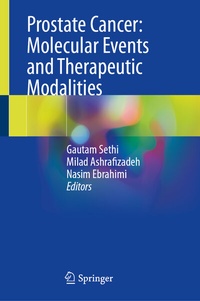
Prostate Cancer: Molecular Events and Therapeutic Modalities
Description

The book covers the various cell signaling pathways responsible for prostate cancer progression, conventional therapies used for prostate cancer treatment, new emerging therapeutics, and challenges in the treatment of cancer patients. It describes the different molecular pathways responsible for prostate cancer progression to improve readers' knowledge about the role of signaling networks, and cellular and molecular aspects of prostate cancer progression. These topics include mechanisms responsible for prostate cancer malignancy with a focus on molecular pathways. It also discusses the current challenges in prostate cancer treatment such as drug resistance and immune evasion and introduces novel therapeutics such as gene therapy and nanotherapeutics for prostate cancer.
This book is completely novel and unique and covers all aspects of prostate cancer progression and challenges in therapy while presenting solutions. Written by prestigious researchers around the world, this book will be interesting to researchers and practitioners, especially those working in urological cancers.
More details
Other editions
Additional editions
Persons
Yong Loo Lin School of Medicine, Department of Pharmacology, National University of Singapore, Singapore
Milad Ashrafizadeh
Faculty of Engineering and Natural Sciences, Sabanci University, Orta Mahalle, Üniversite Caddesi No. 27, Orhanl#, Tuzla, 34956, Istanbul, Turkey, istanbul, Turkey
Yuzhuo Wang
Department of Urological Sciences and Vancouver Prostate Centre, University of British Columbia, Vancouver, BC V6H3Z6, Canada, British Columbia, Canada
Content
Chapter 1. Anatomy and function of prostate.- Chapter 2. Epidemiology, risk factors and histopathological profile of prostate cancer.- Chapter 3. Prostate cancer and Inflammation.- Chapter 4. Prostate cancer, apoptosis, autophagy and ferroptosis: Cell death mechanisms and their crosstalk.- Chapter 5. Prostate cancer and metastasis: An emphasis on EMT mechanism.- Chapter 6. Prostate cancer and Wnt/STAT3 signaling.- Chapter 7. Prostate cancer and EZH2 signaling.- Chapter 8. Prostate cancer and PTEN/PI3K/Akt/mTOR signaling.- Chapter 9. Prostate cancer and non-coding RNAs: A focus on miRNAs, lncRNAs and circRNAs.- Chapter 10. Prostate cancer and tumor microenvironment.- Chapter 11. Chemoresistance, radioresistance and androgen-deprivation therapy resistance in prostate cancer.- Chapter 12. Plant derived-natural products in treatment of prostate cancer.- Chapter 13. Gene therapy as a new emerging strategy for prostate cancer.- Chapter 14. Nanoparticle-based therapeutic strategies in prostate cancer suppression.
