

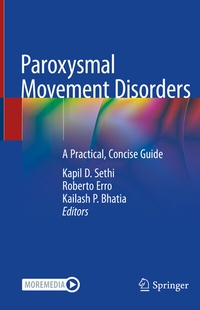
Paroxysmal Movement Disorders
Description

This book addresses the challenges in the differential diagnosis and management of paroxysmal movement disorders. It provides the latest information on the genetics and pathophysiology, neurophysiology and neuroimaging of the core group of disorders in the field, namely the paroxysmal dyskinesias (PxD).
Focused and concise, this guide features chapters that discuss other conditions that may be paroxysmal such as, episodic ataxia, startle syndromes and other more complicated groups of paroxysmal movement disorders such as ATP1A3 spectrum disorders. A chapter on secondary (acquired) paroxysmal dyskinesia highlights medical and other disorders that may result in paroxysmal dyskinesia. The book features a particularly nuanced chapter that discusses recent discoveries in the genetic aspects of PxD, relaying that paroxysmal dyskinesias are not channelpathies, but in fact are synaptophies and transportopathies. Additionally, expertly written chapters are supplemented by high qualityimages, tables, and videos.
Paroxysmal Movement Disorders: A Practical Guide
is primarily written to educate the reader on how to make a syndromic diagnosis of paroxysmal movement disorders and how to build the diagnostic work-up accordingly, as well as how to manage patients with paroxysmal movement disorders.
More details
Other editions
Additional editions
Persons
Kapil D. Sethi, MD, FRCP, FAAN
Department of Neurology
Movement Disorders Section
Augusta University
Augusta, GA
USA
Roberto Erro, MD, PhD
Center for Neurodegenerative Diseases (CEMAND)
Department of Medicine
Surgery and Dentistry "Scuola Medica Salernitana"
University of Salerno
Baronissi (SA)
Italy
Kailash P. Bhatia, MD, DM, FRCP
Department of Clinical and Movement Neurosciences,
UCL Queen Square Institute of Neurology
National Hospital for Neurology and Neurosurgery
London
UK
Content
1. Paroxysmal Dyskinesia: Definitions and Clinical Approach.-2. The Early History of Paroxysmal Dyskinesia.-3. Paroxysmal Kinesigenic Dyskinesia.- 4. Paroxysmal Non-Kinesigenic Dyskinesia.- 5. Paroxymal Exercise-Induced Dyskinesia.- 6. Acquired Paroxysmal Dyskinesia.- 7. Pathophysiology of Paroxysmal Dyskinesia.- 8. Neurophysiology of Paroxysmal Dyskinesia.- 9. Other Paroxysmal Movement Disorders.- 10. Functional Paroxysmal Movement Disorders.- 11. Episodic Ataxias.
