

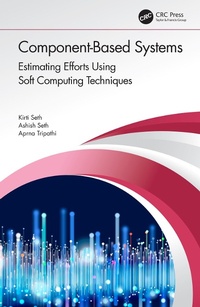
Component-Based Systems
Estimating Efforts Using Soft Computing Techniques
1st Edition
Published on 28. October 2020
112 pages
978-1-000-20916-7 (ISBN)
Description

Businesses today are faced with a highly competitive market and fast-changing technologies. In order to meet demanding customers' needs, they rely on high quality software. A new field of study, soft computing techniques, is needed to estimate the efforts invested in component-based software.
Component-Based Systems: Estimating Efforts Using Soft Computing Techniques is an important resource that uses computer-based models for estimating efforts of software. It provides an overview of component-based software engineering, while addressing uncertainty involved in effort estimation and expert opinions. This book will also instruct the reader how to develop mathematical models.
This book is an excellent source of information for students and researchers to learn soft computing models, their applications in software management, and will help software developers, managers, and those in the industry to apply soft computing techniques to estimate efforts.
Component-Based Systems: Estimating Efforts Using Soft Computing Techniques is an important resource that uses computer-based models for estimating efforts of software. It provides an overview of component-based software engineering, while addressing uncertainty involved in effort estimation and expert opinions. This book will also instruct the reader how to develop mathematical models.
This book is an excellent source of information for students and researchers to learn soft computing models, their applications in software management, and will help software developers, managers, and those in the industry to apply soft computing techniques to estimate efforts.
More details
Edition
1. Auflage
Language
English
Place of publication
London
United Kingdom
Publishing group
Taylor & Francis Ltd
Target group
Professional and scholarly
Illustrations
34 Tables, black and white; 25 Illustrations, black and white
ISBN-13
978-1-000-20916-7 (9781000209167)
Copyright in bibliographic data and cover images is held by Nielsen Book Services Limited or by the publishers or by their respective licensors: all rights reserved.
Schweitzer Classification
Other editions
Additional editions
Kirti Seth | Ashish Seth | Aprna Tripathi
Component-Based Systems
Estimating Efforts Using Soft Computing Techniques
Book
10/2020
1st Edition
CRC Press
€205.50
Shipment within 15-20 days
Kirti Seth | Ashish Seth | Aprna Tripathi
Component-Based Systems
Estimating Efforts Using Soft Computing Techniques
Book
10/2020
1st Edition
CRC Press
€78.30
Shipment within 15-20 days
Persons
Dr. Kirti Seth is researcher and acadmician. She is PhD (Computer Science and Engineering) in the area of "Component Based Systems" from Department of Computer Sciences and Engineering, from AKTU, Lucknow, INDIA in 2016. M.Tech (Computer Science), from Banasthali Vidyapeeth, Banasthali, Rajasthan, INDIA, 2009. She also holds MSc (CS) degree and has been into research and academics for last fourteen years. She has published more than 40 research papers in reputed journals like ACM, Springer and Elsevier and authored four books. She has been participating and organizing seminar, conferences, workshops, expert lecturers and technical events to share knowledge among academicians, researchers and to promote opportunities for new researchers. She has provided training programs for students and faculties on various areas of computer science including Google's techmaker event-2018. She had given keynote talk on many international conferences. Her current research interests include Service Oriented Architecture, Bio Inspired Optimizations, Neural Networks and Component Based Systems. She has been awarded "Young Scientist in Software Engineering-2017" in ARM 2017 on 11th November 2017. She also received "Most Promising Women Educationist" of the year award in India Excellence Summit 2017, on 19th August 2017.
Dr. Ashish Seth is presently working as an Associate Professor in School of Computer & Information Engineering in INHA University Tashkent, Uzbekistan since September 2016. He obtained his PhD(CS) in the year 2015 from Punjabi University, Patiala (Punjab). He also holds M.Phil(CS), M.Tech(IT), and MCA degree and has been into research and academics for last fifteen years. He has published many research papers in reputed journals and authored two books. His interest includes reading articles on emerging technologies. He has provided training programs for students and faculties on various areas of computer science. He has been associated with many research and professional societies; he is a senior member of IETI, Hong Kong, associate member of CSI, IEEE, IACSIT, IAENG, CSTA, USA.He has been a consultant for some project such as "Compendium of India's Export Portal for Asean, Korea, Singapore, Japan and top 25 countries" for Indian Institute of Foreign Trade, New Delhi, funded by Ministry of Commerce and Industry, Govt. of India. He is also a consultant for Aziksa, an USA based company to gather the teaching learning activities for its Aziksa tool. He is Consultant for UNDP Uzbekistan in a project to find out the need and subsequent steps needed in reforming the IT education in schools, colleges and Universities in Uzbekistan. For his continuous commitment in research and efforts made to improve teaching learning for the betterment of students, he has been awarded as "Most Promising Educationist -Computer Education" in India Excellence Summit 2017"
Dr. Aprna Tripathi is the assistant professor in GLA University Mathura. She received MCA and M.Tech in Software Engineering from HBTI Kanpur and Banasthali Universities in 2002 and 2009 respectively; and a Doctor of Philosophy (PhD) in Computer Science from MNNIT Allahabad in 2015. She has more than one decade experience in academics. She served as a head of department during 2015-2017. She has 34 research papers in various reputed international and national journals, book chapters and conferences. Her area of specialization is software engineering, software testing, big data and data science.
Dr. Ashish Seth is presently working as an Associate Professor in School of Computer & Information Engineering in INHA University Tashkent, Uzbekistan since September 2016. He obtained his PhD(CS) in the year 2015 from Punjabi University, Patiala (Punjab). He also holds M.Phil(CS), M.Tech(IT), and MCA degree and has been into research and academics for last fifteen years. He has published many research papers in reputed journals and authored two books. His interest includes reading articles on emerging technologies. He has provided training programs for students and faculties on various areas of computer science. He has been associated with many research and professional societies; he is a senior member of IETI, Hong Kong, associate member of CSI, IEEE, IACSIT, IAENG, CSTA, USA.He has been a consultant for some project such as "Compendium of India's Export Portal for Asean, Korea, Singapore, Japan and top 25 countries" for Indian Institute of Foreign Trade, New Delhi, funded by Ministry of Commerce and Industry, Govt. of India. He is also a consultant for Aziksa, an USA based company to gather the teaching learning activities for its Aziksa tool. He is Consultant for UNDP Uzbekistan in a project to find out the need and subsequent steps needed in reforming the IT education in schools, colleges and Universities in Uzbekistan. For his continuous commitment in research and efforts made to improve teaching learning for the betterment of students, he has been awarded as "Most Promising Educationist -Computer Education" in India Excellence Summit 2017"
Dr. Aprna Tripathi is the assistant professor in GLA University Mathura. She received MCA and M.Tech in Software Engineering from HBTI Kanpur and Banasthali Universities in 2002 and 2009 respectively; and a Doctor of Philosophy (PhD) in Computer Science from MNNIT Allahabad in 2015. She has more than one decade experience in academics. She served as a head of department during 2015-2017. She has 34 research papers in various reputed international and national journals, book chapters and conferences. Her area of specialization is software engineering, software testing, big data and data science.
Content
1. Component Based Development. 2. Component Based Software Engineering. 3. Advantages of Component Based Software Engineering. 4. Problems and Pitfalls. 5. Efforts Estimation Techniques - an Introduction and Review of Literature.
6. Traditional effort Estimation Techniques. 7. Efforts Estimation in Object Oriented Systems. 8. Efforts Estimation in Component Based Systems. 9. Fuzzy Logic. 10. Estimating Component Selection Efforts - A Fuzzy Logic Based Approach.
11. Weight Assignment Technique for Component Selection Efforts. 12. Estimating Component Integration Efforts-A Neural Network Based Approach. 13. Neural Network Architecture and MATLAB NN Toolbox. 14. Conclusion.
6. Traditional effort Estimation Techniques. 7. Efforts Estimation in Object Oriented Systems. 8. Efforts Estimation in Component Based Systems. 9. Fuzzy Logic. 10. Estimating Component Selection Efforts - A Fuzzy Logic Based Approach.
11. Weight Assignment Technique for Component Selection Efforts. 12. Estimating Component Integration Efforts-A Neural Network Based Approach. 13. Neural Network Architecture and MATLAB NN Toolbox. 14. Conclusion.
