

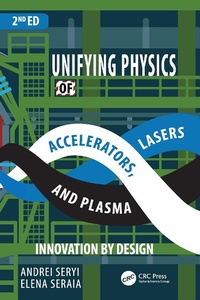
Unifying Physics of Accelerators, Lasers and Plasma
2nd Edition
Published on 13. April 2023
450 pages
978-1-000-88907-9 (ISBN)
Description

Unifying Physics of Accelerators, Lasers and Plasma introduces the physics of accelerators, lasers and plasma in tandem with the industrial methodology of inventiveness, a technique that teaches that similar problems and solutions appear again and again in seemingly dissimilar disciplines. This unique approach builds bridges and enhances connections between the three aforementioned areas of physics that are essential for developing the next generation of accelerators. A Breakthrough by Design approach, introduced in the book as an amalgam of TRIZ inventive principles and laws of technical system evolution with the art of back-of-the-envelope estimations, via numerous examples and exercises discussed in the solution manual, will make you destined to invent.
Unifying Physics of Accelerators, Lasers and Plasma outlines a path from idea to practical implementation of scientific and technological innovation. This second edition has been updated throughout, with new content on superconducting technology, energy recovery, polarization, various topics of advanced technology, etc., making it relevant for the Electron-Ion Collider project, as well as for advanced lights sources, including Free Electron Lasers with energy recovery.
The book is suitable for students at the senior undergraduate and graduate levels, as well as for scientists and engineers interested in enhancing their abilities to work successfully on the development of the next generation of facilities, devices and scientific instruments manufactured from the synergy of accelerators, lasers and plasma.
Solutions manual is included into the book.
Features
Introduces the physics of accelerators, lasers, and plasma in tandem with the industrial methodology of inventiveness
Outlines a path from idea to practical implementation of scientific and technological innovation
Contains more than 380 illustrations and numerous end-of-chapter exercises
Unifying Physics of Accelerators, Lasers and Plasma outlines a path from idea to practical implementation of scientific and technological innovation. This second edition has been updated throughout, with new content on superconducting technology, energy recovery, polarization, various topics of advanced technology, etc., making it relevant for the Electron-Ion Collider project, as well as for advanced lights sources, including Free Electron Lasers with energy recovery.
The book is suitable for students at the senior undergraduate and graduate levels, as well as for scientists and engineers interested in enhancing their abilities to work successfully on the development of the next generation of facilities, devices and scientific instruments manufactured from the synergy of accelerators, lasers and plasma.
Solutions manual is included into the book.
Features
Introduces the physics of accelerators, lasers, and plasma in tandem with the industrial methodology of inventiveness
Outlines a path from idea to practical implementation of scientific and technological innovation
Contains more than 380 illustrations and numerous end-of-chapter exercises
Reviews / Votes
Praise for the first edition"...Unifying Physics of Accelerators, Lasers and Plasma is a must-have for every student and practitioner of accelerator science. It is a quick reference guide and provides solid, intuitive discussions of what are often quite erudite concepts. I enthusiastically applaud this outstanding book."
Sekazi Mtingwa in Physics Today, August 2016 Praise for the Second Edition
"The book Unifying Physics of Accelerators, Lasers and Plasma, by Andrei Seryi and Elena Seraia, provides a comprehensive overview of the fundamental principles and physics of three distinct areas: accelerators, lasers and plasma, bridging them via inventive principles that offers readers a unified perspective. The strength of the book lies in its accessibility and clarity. Originally published in 2016, the first edition was picked up by CERN's "eBooks for all!" programme to be converted to open access. The second edition, released in April 2023, has been updated throughout to cover new and essential areas in accelerator science. The material for the book originated from lectures and courses with the aim to teach undergraduate and graduate students several physics disciplines in a coherent way, while at the same time ensuring that this training would develop and stimulate innovativeness. It is written with a fine balance between technical rigour and a conversational tone, avoiding heavy mathematics and using back-of-the-envelope-type derivations and estimations wherever possible. This makes the book inspiring for both experts seeking in-depth knowledge and curious minds looking for an introduction to the field.
With the authors' systematic approach, readers can easily follow the logical progression of ideas, facilitating comprehension and aiding future reference. They introduce the reader to the basics of accelerators and the art of inventiveness, and provide a solid foundation for understanding the key concepts of accelerators, lasers and plasma, and how they can be integrated and used together to advance scientific research.
The book includes a wide range of relevant topics such as beam dynamics, cavities, synchrotron radiation, laser and plasma physics and their role in accelerators. It then delves into advanced accelerator concepts such as radiation generation, Wakefield acceleration and laser-plasma accelerators, free-electron lasers and plasma-based light sources. The authors also weave in the historical development of accelerator, laser and plasma technologies, highlighting milestones that have shaped the scientific landscape. They also extensively explore the next generation of accelerators, cutting-edge technologies and state-of-the-art facilities employed in these fields. New chapters added to the second edition, which are crucial in the accelerator area and relevant for future projects, include topics such as superconducting technology, beam cooling, final focusing, polarisation, beam stability, energy recovery, advanced technologies and no fewer than 40 inventive principles.
Also remarkable are the more than 380 illustrative diagrams that allow the reader to visualise the content for a better understanding. In the eBook most of the pictures have been changed to even more attractive colour versions.
The authors commit to scientific integrity, reinforcing their authority in the field. In addition, their pedagogical strength and clear aim to help the reader develop a deeper understanding of the material is emphasised with numerous end-of-chapter exercises. In the second edition, the guide to the solutions has been added directly into the book.
This book is the first of its kind where the three disciplines of accelerators, lasers and plasmas are connected towards building more compact accelerators. One of the highlights is the authors' emphasis on the potential synergistic effects that can arise from integrating these three areas. With its accessible explanations, cutting-edge research coverage, and compelling arguments for interdisciplinary collaboration, this is an indispensable resource for physicists, researchers and students alike."
-Edda Gschwendtner (CERN) in CERN Courier (Nov/Dec 2023)
Praise for the first edition
"...Unifying Physics of Accelerators, Lasers and Plasma is a must-have for every student and practitioner of accelerator science. It is a quick reference guide and provides solid, intuitive discussions of what are often quite erudite concepts. I enthusiastically applaud this outstanding book."
Sekazi Mtingwa in Physics Today, August 2016
More details
Edition
2nd edition
Language
English
Place of publication
London
United Kingdom
Publishing group
Taylor & Francis Ltd
Target group
College/higher education
Professional and scholarly
Product notice
Reflowable
Illustrations
11 Tables, black and white; 365 Line drawings, black and white; 10 Halftones, black and white; 375 Illustrations, black and white
ISBN-13
978-1-000-88907-9 (9781000889079)
Copyright in bibliographic data and cover images is held by Nielsen Book Services Limited or by the publishers or by their respective licensors: all rights reserved.
Schweitzer Classification
Other editions
Additional editions
Andrei Seryi | Elena Seraia
Unifying Physics of Accelerators, Lasers and Plasma
Book
03/2023
2nd Edition
CRC Press
€233.20
Shipment within 10-20 days
Andrei Seryi | Elena Seraia
Unifying Physics of Accelerators, Lasers and Plasma
Book
03/2023
2nd Edition
CRC Press
€96.60
Shipment within 10-20 days
Persons
Andrei Seryi - Jefferson Lab Associate Director for accelerators operations and R&D, Governor's distinguished CEBAF Professor. Until 2018 served as the Director of the John Adams Institute for accelerator science in the UK and a professor at Oxford University. Prior to that worked at Stanford Linear Accelerator Center. Contributed to development of linear colliders and plasma acceleration. Fellow of the American Physical Society. His professional interests include development of accelerator technology applications to discovery science, industry, healthcare and energy; organizing of scientific research; project management; inventions and innovations; developing novel training approaches and methods.
Elena Seraia - presently a consultant, and until 2018 was working in the Medical Department of the University of Oxford, in the group of Radiation Oncology and Biology, contributing to research aimed at finding ways of comprehensive cancer treatment, and prior to that worked at the Medical Department at Stanford University, in the group which was the first one to develop the principle of contact printing of oligonucleotide DNA microarrays. Elena is the key contributor to the 1st edition of the Unifying Physics book, via creating of more than 260 illustrations, and via contributing to the chapter on the DNA effects of radiation and cancer therapy. Her ingenious illustrations of the inventive principles made, in a great extent, this second edition possible.
Elena Seraia - presently a consultant, and until 2018 was working in the Medical Department of the University of Oxford, in the group of Radiation Oncology and Biology, contributing to research aimed at finding ways of comprehensive cancer treatment, and prior to that worked at the Medical Department at Stanford University, in the group which was the first one to develop the principle of contact printing of oligonucleotide DNA microarrays. Elena is the key contributor to the 1st edition of the Unifying Physics book, via creating of more than 260 illustrations, and via contributing to the chapter on the DNA effects of radiation and cancer therapy. Her ingenious illustrations of the inventive principles made, in a great extent, this second edition possible.
Content
Chapter 1. Basics of Accelerators and the Art of Inventiveness. Chaprter 2. Transverse Dynamics. Chapter 3. Synchrotron Radiation. Chapter 4. Synergies Between Accelerators, Lasers and Plasma. Chapter 5. Conventional Acceleration. Chapter 6. Plasma Acceleration. Chapter 7. Light Sources. Chapter 8. Free Electron Lasers. Chapter 9. Proton and Ion Laser Plasma Acceleration. Chapter 10. Beam Cooling and Final Focusing. Chapter 11. Beam Stability and Energy Recovery. Chapter 12. Advanced Beam Manipulation. Chapter 13. Advanced Technologies. Chapter 14. Inventions and Innovations in Science. Chapter 15. Forty Inventive Principles. Appendix A. Bibliography.
