

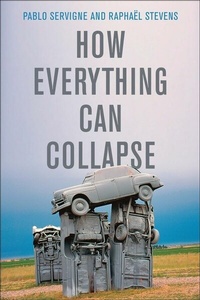
How Everything Can Collapse
Description

In this important book, Pablo Servigne and Raphaël Stevens confront these issues head-on. They examine the scientific evidence and show how its findings, often presented in a detached and abstract way, are connected to people's ordinary experiences - joining the dots, as it were, between the Anthropocene and our everyday lives. In so doing they provide a valuable guide that will help everyone make sense of the new and potentially catastrophic situation in which we now find ourselves. Today, utopia has changed sides: it is the utopians who believe that everything can continue as before, while realists put their energy into making a transition and building local resilience. Collapse is the horizon of our generation. But collapse is not the end - it's the beginning of our future. We will reinvent new ways of living in the world and being attentive to ourselves, to other human beings and to all our fellow creatures.
More details
Other editions
Additional editions
Persons
Raphaël Stevens is an eco-adviser. An expert in the resilience of socio-ecological systems, he is cofounder of the consultancy agency Greenloop.
Content
Acknowledgements
Introduction: We'll Definitely Need to Tackle the Subject One of These Days ...
Collapse?
The birth of 'collapsology'
Beware, this is a sensitive subject!
Notes
Part I The Harbingers of Collapse
1 The Accelerating Vehicle
A world of exponentials
Total acceleration
Where do the limits lie?
Notes
2 When the Engine Dies (Limits that Cannot be Crossed)
At the top of the peak, does energy starts to fall?
At the top of the peak, there is a wall!
And before the wall ... a precipice
Notes
3 Leaving the Road (Boundaries that Can be Crossed)
Global heating and cold sweats
Who will kill the last animal on the planet?
The other boundaries of the planet
What happens when we cross different Rubicons?
Notes
4 Is the Steering Locked?
How a system becomes locked in
The problem of complexity
Notes
5 Trapped in an Ever More Fragile Vehicle
Finance: feet of clay
Supply chains on the razor's edge
Infrastructures at their last gasp
What will be the spark?
Notes
Summary of Part I
An all-too-clear picture
Notes
Part II So, When's It Going to Happen:?
6 The Difficulties of Being a Futurologist
From risk assessment to intuition
The paradoxes of collapse
Notes
7 Can We Detect Warning Signs?
The 'noise' of a system about to collapse
There will always be uncertainty
Notes
8 What Do the Mathematical Models Say?
An original model: HANDY
A robust model: World3
Notes
Part III Collapsology
9 A Mosaic to Explore
What are we talking about exactly?
What do past civilizations tell us ... ?
How far are we sinking ... ?
... up to our necks?
Notes
10 And Where Do Human Beings Fit into All This?
How many of us will there be at the end of the century? The demography of collapse
Will we kill each other off? The sociology of collapse
Why do most people not believe it will happen? The psychology of collapse
Now that we believe in it, what shall we do? The politics of collapse
Notes
Conclusion: Hunger is Only the Beginning
Towards a general and applied collapsology
The 'hangover' generation
Other ways of partying
Notes
'For the Children'
Notes
Postscript
Notes
Introduction
We'll Definitely Need to Tackle the Subject One of These Days .
Crises, disasters, collapses, decline . Apocalypse can be read between the lines of the daily news from across the world. While some disasters are real enough and supply our newspapers with their news items - plane crashes, hurricanes, floods, the decline in the number of bees, slumps in the stock market, and wars - is it justifiable to suggest that our society is 'heading for disaster', to announce a 'global planetary crisis', or to point to a 'sixth mass extinction of species'?
It has become a paradox: we have to face this deluge of disasters in the media, but we're unable to talk explicitly about the really big catastrophes without being called alarmists or 'catastrophists'! Everyone, for example, knew that the IPCC had issued a new report on climate change in 2014, but did we see any real debate about these new climate scenarios and their implications in terms of social change? No, of course not. Too catastrophist.
Perhaps we're tired of bad news. And in any case, hasn't the end of the world always been looming? Isn't taking the darkest possible view of the future a typically European or western piece of narcissism? Isn't catastrophism a new opium of the people, distilled by ecological ayatollahs and scientists in need of funding? Come on, everybody, give it a bit of welly - we'll soon have put paid to the 'crisis'!
But perhaps we don't actually know how to talk about disasters - the real ones, those that last, those that don't fit into the news cycle. After all, let's admit it: we're facing some serious problems to do with the environment, energy, climate change, geopolitics, and social and economic issues, problems that are now at a point of no return. Few people say it, but all these 'crises' are interconnected, influencing and intensifying each other. We now have a huge bundle of evidence suggesting that we're up against growing systemic instabilities that pose a serious threat to the ability of several human populations - and indeed human beings as a whole - to maintain themselves in a sustainable environment.
Collapse?
It's not the end of the world, nor the Apocalypse. Nor is it a simple crisis from which we can emerge unscathed or a one-off disaster that we can forget after a few months, like a tsunami or a terrorist attack. A collapse is 'the process at the end of which basic needs (water, food, housing, clothing, energy, etc.) can no longer be provided [at a reasonable cost] to a majority of the population by services under legal supervision'.1 So it's a large-scale, irreversible process - just like the end of the world, admittedly, except that it's not the end! It looks as if the consequences will last for a long time, and we'll need to live through them. And one thing is certain: we don't have the means to know what they will consist of. On the other hand, if our 'basic needs' are affected, it is easy to imagine that the situation could become immeasurably catastrophic.
But how far will it all extend? Who will be affected? The poorest countries? France? Europe? All the rich countries? The industrialized world? Western civilization? All of humankind? Or even, as some scientists are predicting, the vast majority of living species? There are no clear answers to these questions, but one thing is certain: none of these possibilities can be ruled out. The 'crises' we are experiencing affect all these categories: for example, the end of oil concerns the whole of the industrialized world (but not the small traditional peasant societies that have been left out by globalization), whereas climate change threatens human beings as a whole, as well as a large proportion of living species.
Scientific publications that envisage global catastrophes and an increasing probability of collapse are becoming more numerous and better supported by the evidence. The Royal Society published an article by Paul and Anne Ehrlich on this subject in 2013, leaving little doubt about the outcome.2 The consequences of the global environmental changes viewed as likely in the second half of the twenty-first century are becoming all too evident in the light of ever more precise and overwhelming numerical data. The climate is heating up, biodiversity is collapsing, pollution is ubiquitous and becoming persistent, the economy risks going into cardiac arrest at every moment, social and geopolitical tensions are growing, etc. It is not unusual to see decision makers at the highest level, and official reports from major institutions (the World Bank, the armed forces, the IPCC, banks, NGOs, etc.), discussing the possibility of collapse, or what Prince Charles calls 'suicide on a grand scale'.3
More broadly, the Anthropocene is the name given to this new geological era, namely our own present.4 We - human beings - emerged from the Holocene, a time of remarkable climatic stability that lasted about twelve thousand years and allowed the emergence of agriculture and civilization. In recent decades, humans (or at least many of them, in growing numbers) have become capable of upsetting the large biogeochemical cycles of the Earth system, thereby creating a new era of profound and unpredictable change.
However, these findings and figures are 'cold'. How does all this affect our daily lives? Don't you feel that there is a huge gap that needs to be filled, a link that needs to be forged between these great scientific statements, so rigorous and all encompassing, and the everyday life that gets lost in the details, in the clutter of the unexpected and the heat of our emotions? It's precisely this gap that our book seeks to fill, drawing a connection between the Anthropocene and your gut feelings. For that purpose, we have chosen the notion of 'collapse' because it allows us to play on several registers, tackling both the rates of biodiversity decline and the emotions related to disasters, and to discuss the risk of famine. This is a concept that involves both popular images drawn from cinema (who can fail to visualize Mel Gibson out in the desert, armed with a pump shotgun?) and narrowly focused scientific reports; it allows us to approach different temporalities (from the urgency of daily life to geological time) while comfortably navigating between past and future; and it allows us to draw a connection between, for example, the Greek social and economic crisis and the large-scale disappearance of populations of birds and insects in China and Europe. In short, it is this concept that brings to tangible life the notion of the Anthropocene.
And yet, in media and intellectual circles, the question of collapse is not taken seriously. The notorious computer bug that threatened to strike in 2000, and the 'Mayan event' of 21 December 2012, put paid to the possibility of any serious and factual argument. Anyone who publicly mentions a 'collapse' is seen as announcing the Apocalypse, and relegated to the narrow category of those 'credulous believers' in the 'irrational' who have 'always existed'. End of story. Time to change the subject! The process of automatically dismissing such talk - a dismissal which, as it happens, itself appears truly irrational - has left public debate in such a state of intellectual disrepair that it is no longer possible to express oneself without adopting one of two simplistic standpoints which often border on the ridiculous. On the one hand, we are subjected to apocalyptic, survivalist or pseudo-Mayan language; on the other hand, we have to endure the 'progressive' denials of Luc Ferry, Claude Allègre, Pascal Bruckner and their ilk. These two postures, both frenziedly clinging to their respective myths (the myth of the Apocalypse vs the myth of progress), reinforce each other, view each other as a scarecrow and share a phobia for dignified and respectful debate. All of this just reinforces the attitude of uninhibited collective denial that is such a prominent feature of our times.
The birth of 'collapsology'
Despite the high quality of some of the philosophical reflections on this topic,5 the debate on collapse (or 'the end of a world') fails because of the absence of factual arguments. It is stuck in imaginary or philosophical speculation without any real factual grounding. The books dealing with collapse are usually too specialized, restricted by their point of view or discipline (archaeology, economics, ecology, etc.), while more systematic discussions are full of gaps. Jared Diamond's bestseller Collapse, for example, sticks to the archaeology, ecology and biogeography of ancient civilizations and does not address some of the essential questions of the current situation.6 As for other popular books, they usually tackle the question by adopting a survivalist position (telling you how to make bows and arrows, or how to find drinking water in a world plagued by fire and the sword), giving the reader all the thrills of watching a zombie movie.
Not only do we lack any real inventory - or better, any systematic analysis - of the planet's economic and biophysical situation, but above all we lack an overview of what a...
