

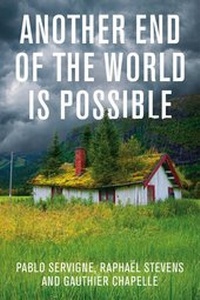
Another End of the World is Possible
Description

As individuals, we are faced with a daily deluge of bad news about the worsening situation, preparing ourselves to live with years of deep uncertainty about the future of the planet and the species that inhabit it, including our own. How can we cope? How can we project ourselves beyond the present, think bigger and find ways not just to survive the collapse but to live it?
In this book, the sequel to How Everything Can Collapse, the authors show that a change of course necessarily requires an inner journey and a radical rethinking of our vision of the world. Together these might enable us to remain standing during the coming storm, to develop a new awareness of ourselves and of the world and to imagine new ways of living in it. Perhaps then it will be possible to regenerate life from the ruins, creating new alliances in differing directions - with ourselves and our inner nature, between humans, with other living beings and with the earth on which we dwell.
More details
Other editions
Additional editions
Persons
Raphaël Stevens is an eco-adviser and co-founder of the consulting office Greenloop.
Gauthier Chapelle is an agronomist, co-founder of Greenloop and founder of Biomimicry Europa.
Content
Preface Facing the collapse of our world
Don't you think our epoch has a scent of collapse? Something has toppled over, something is dying on a grand scale. There are signs of the end of this world appearing in the speeches of Extinction Rebellion, Greta Thunberg and Antonio Gutierrez, the Secretary General of the United Nations, in conversations at Davos and in commentaries on the fires in Australia and Brazil and now on the Covid-19 pandemic.
This is no longer surprising: the idea that our world can collapse in the coming years is widespread. In February 2020, an opinion poll on 'collapsology'1 conducted by the Institut français d'opinion publique (IFOP) in five countries (France, United States, United Kingdom, Italy and Germany) found that 56 per cent of British people and 65 per cent of French think that Western civilization as we know it will soon collapse (23 per cent of British people expect it within twenty years, and 9 per cent before 2030).2
We are now beyond discussing whether the threat is real or not. Dozens, even hundreds of 'top scientists' agree that global catastrophic risks (GCRs3) need to be taken seriously. For the most sceptical readers (and it is normal to be sceptical), we have summarized the scientific works dealing with these risks in How Everything Can Collapse published by Polity in April 2020 (in French in 20154).
As we expected, everything is speeding up. Not so long ago, some scientists claimed that a global systemic collapse of our society and of the biosphere was possible in the near future, though without being able to specify a date. Today, we have gone a step further: some top scientists say this is the most likely scenario.5 The Doomsday Clock, which symbolizes the imminence of a planetary cataclysm, was brought forward in January 2020 to midnight minus 100 seconds.6 This cold and relentless statement is in line with that of wellknown authors from the English-speaking world who have inspired us, such as Donella and Dennis Meadows, Joanna Macy, Jared Diamond, John M. Greer, Richard Heinberg and Naomi Oreskes, to name a few.
In 2015, the rational and scientific approach of collapsology was considered 'pessimistic' by the political establishment and most of the mainstream media. However, the general public was already open to discuss the matter. We have seen a growing number of readers coming to our lectures who had reached similar conclusions: neither 'sustainable development', nor 'green growth', nor promises of wealth redistribution will be able stop the disasters from happening, should business-as-usual prevail. There is no doubt that humanity and the planet are heading down a catastrophic path.
Once people realize the situation, bewilderment strikes to the very roots of the soul. Then, two questions arise over and over again: How do we live through our lives with this constant flow of bad news and disasters? How can we rethink politics in the aftermath of catastrophes? In other words, which 'inner' and 'outer' paths must we explore?
The book you are holding in your hands tries to answer the first question. This is the psychological, metaphysical and spiritual question of our relationship to the world, of interdependencies between humans as well as between humans and non-humans, of meaning, of narratives, of the sacred, and so on. We wrote it during the summer of 2018, when a conjunction of events caused the theme of collapse to go viral in France: the first articles in the mass media, a particularly hot summer, the publication of a study dubbed 'Hothouse Earth' in the Proceedings of the National Academy of Sciences (PNAS), the spectacular resignation of the charismatic French Minister of the Environment, Nicolas Hulot, and fifteen days later, the publication of the IPCC's special report on the impact of global warming of 1.5°C. The following autumn saw the almost simultaneous emergence of the powerful movements of the Gilets jaunes ('Yellow Vests') in France, of Extinction Rebellion and Deep Adaptation in the UK, and of course of the Fridays for Future initiated by Greta Thunberg.
Another End of the World is Possible was published the same autumn and added a missing piece to deepen the conversation. Since then, the word 'collapsology' has become an uncontrollable media monster that has slipped away us, feeding on catastrophic news but also on criticism and praise, superficial mumbo-jumbo and scholarly analysis. It has even entered the famous French dictionary Le Petit Robert.7
The unravelling of the biosphere is bad news. So, do we need to wish for a breakdown of the current social order in order to avoid an even greater collapse of earth systems? This question becomes more relevant than ever with each passing year. The latest news on climate change and mass extinction of species is breath-taking. The European Environment Agency does not disagree with that statement. In a collection of maps published on 10 February 2020,8 this public body tries to figure out our children's and grandchildren's future in Europe at the end of the century: rising sea levels, torrential rain, droughts, mega-fires. A Hollywood movie featuring all these disasters would hardly be credible.
Since 2018, protests and rebellions have erupted across the globe. And, in the midst of the heated political debates on collapses (biodiversity, climate, geopolitics, finance, etc.), a microscopic coronavirus has unleashed a series of cascading effects: fear and entrenchment, a voluntary slowdown of economic activity, domestic political upheavals, diplomatic and geopolitical crises, shortages of medicines, masks and food, the injection of massive amounts of liquidity into the markets by central banks around the world to stabilize the financial system and avoid a major crash, and so on. Covid-19 has proved to be a huge stress-test for the globalized economy. It is also a stark reminder of what matters deeply in our daily lives, as well as a real-time dress rehearsal for future disasters and psychological mayhem, which will be much more intense. And more unexpectedly, the lockdown of half of the world's population has demonstrated the extraordinary capacity of wildlife to adapt and self-regenerate!
The Covid-19 pandemic also showed that while we have the political power to shut down non-essential businesses, it is not enough to moderate the extent of future global warming. The efforts we must make to avoid a dramatic loss of the vital earth systems that sustain life are immense and we are not yet up to the task. Nonetheless, the real-life experiment of quarantine has at least made it possible to distinguish the essential (e.g., health, food, the local economy, love, mutual aid, the living world) from the trivial (e.g., holidays on the other side of the world, extravagant gadgets, stock market speculation, trendy clothes, advertising, Formula One Grands Prix). In Western countries, it is totally feasible to considerably reduce industrial activities and stop overconsumption while meeting people's basic needs.
Unfortunately, the post-Covid era is demonstrating the inability of political and economic elites to see this health emergency as a historic opportunity to phase out fossil fuels, drastically reduce inequalities and address poverty. Instead, we have witnessed the development and implementation of non-eco-friendly recovery plans as illustrated by the billions of dollars made available to the aeronautics and automotive industries. Moreover, we must bear in mind that whatever the outcome of this crisis, extreme weather events are locked in for the next twenty to thirty years due to climate system inertia. There is a whole process of acceptance and mourning before us.
This book is dedicated to people who find themselves running on a perpetual treadmill of emotions (anger, fear, rage, sadness, grief, guilt, etc.). It may help you to keep up with the times and to transform your relationship to the world. It may provide some 'useful' tools for people who want to contribute to the emergence of new livelihoods built on the ruins of capitalism. It is not a call for an individual journey; the need is to bring people together and reclaim the commons, to imagine collective stories, so as to ride the wave of the next centuries without capsizing. In this sense, the task ahead is fundamentally political. More precisely, the political task is a precondition for devising policies of resilience that can cope with the unpredictable roller-coasters of the Anthropocene, that can manage great 'collapses' and imagine what may come 'after'.
Our generation must therefore work on three fronts simultaneously, as Rob Hopkins says, with our heads, hearts and hands: understanding what is happening (collapso-logy), imagining and believing in other worlds (collapso-sophy) and gathering the forces of life to lead the fight against destructive powers and to build alternatives (collapso-praxis).
After How Everything Can Collapse, this book lays the foundations of collapsosophy. It is a step. Everything remains to be written, to be felt, to be shared, and above all, to be done. With wisdom and compassion. With love and rage.
Pablo Servigne, Raphaël Stevens and Gauthier Chapelle
Notes
- 1. A neologism we proposed to refer to the emerging field of research in the scientific community that studies global catastrophic risks (GCRs), the category of risks...
