

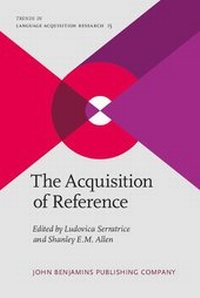
The Acquisition of Reference
1st Edition
Published on 15. November 2015
VI, 339 pages
978-90-272-6789-4 (ISBN)
Description

Referring to entities is one of the key functions of language; learning to understand and use the relevant referential expressions is one of children's major linguistic achievements. The 13 chapters of this volume bring together a wealth of information on the acquisition of referential processes in infants, pre-schoolers and school-age children drawing on data from more than 25 languages ranging from Italian to Inuktitut, and from Norwegian to Turkish. This book presents the state-of-the-art of corpus and experimental research on the acquisition of reference. The breadth of aspects of referential acquisition will make the volume appealing to a wide audience of researchers, including linguists and psycholinguists working on phonological, morpho-syntactic, and discourse-pragmatic aspects of language development. The cross-linguistic perspective adopted by several of the contributors will be of particular interest to researchers investigating the relevance of typological differences. The state-of-the-art approach makes the research accessible to specialist and non-specialist researchers alike, and will provide an invaluable resource for graduate-level courses.
More details
Other editions
Additional editions
Ludovica Serratrice | Shanley E.M. Allen
The Acquisition of Reference
Book
11/2015
John Benjamins Publishing Co
€100.70
Shipment within 10-15 days
Persons
Content
- The Acquisition of Reference
- Editorial page
- Title page
- LCC data
- Table of contents
- 1. Introduction: An overview of the acquisition of reference
- 1. Why reference?
- 2. A historical approach to argument realization in child language
- 3. Discourse-relevant influences on children's referential choice
- 4. Child-related influences on referential choice
- 5. Looking to the future
- References
- 2. The acquisition of nominal determiners: Evidence from cross-linguistic approaches
- 1. Introduction
- 2. The emergence of determiners: Cross-linguistic evidence of determiner use
- 3. Prosodic and morpho-phonological influences on determiner emergence
- 4. Lexical-semantic and discourse influences
- 5. Input influences: The relations between child speech and child-directed speech
- 6. The development of the determiner systems
- 7. Conclusion
- Acknowledgments
- References
- 3. Mapping information structure and word order: The acquisition of object placement
- 1. Introduction
- 2. Three types of object displacement phenomena
- 3. The acquisition of object placement
- 4. General discussion
- 5. Concluding remarks and future prospects
- Acknowledgments
- References
- 4. Children's use of intonation in reference and the role of input
- 1. Introduction
- 2. Relevant theoretical distinctions
- 3. Adults' use of intonation in reference
- 4. Children's use of intonation in reference
- 5. Intonation in reference in infant-directed speech
- 6. Conclusions and future research
- Acknowledgements
- References
- 5. The role of gesture in referential communication: A developmental perspective
- 1. Introduction
- 2. Pre-linguistic stage
- 3. One-word stage
- 4. Two-word stage
- 5. Later preschool stage
- 6. Middle childhood
- 7. Conclusion and future directions
- Acknowledgements
- References
- 6. The role of cognitive accessibility in children's referential choice
- 1. Introduction
- 2. Studies on children's sensitivity to accessibility in referential choice
- 3. Developmental patterns
- 4. Interplay between accessibility factors
- 5. Additional influences on children's referential choice with relation to accessibility
- 6. Explanations for sensitivity to accessibility
- 7. Conclusion and future directions
- Acknowledgements
- References
- 7. Acquisition and use of pronouns in a dialogic perspective
- 1. Introduction
- 2. First and second person pronouns in dialogue
- 3. Third person pronouns in dialogue
- 4. Conclusion
- Acknowledgements
- References
- 8. From early to late mastery of reference: Multifunctionality and linguistic diversity
- 1. Introduction
- 2. Form-function systems across languages
- 3. Early phases of child language
- 4. Later phases of child language
- 5. Crosslinguistic variation in development
- 6. Discussion and concluding remarks
- Acknowledgements
- References
- 9. Online evidence for children's interpretation of personal pronouns
- 1. Introduction
- 2. The rationale for using the VWP to study pronoun interpretation in children
- 3. Reflexives and pronouns in language acquisition research: Theoretical questions
- 4. Studies of children's online interpretation of anaphoric expressions
- 5. Closing remarks
- Acknowledgements
- References
- 10. Children's sensitivity to caregiver cues and the role of adult feedback in the development of re
- 1. Introduction
- 2. Referential adjustment to communicative partners: Verbal and non-verbal devices
- 3. Mentoring children's referential skills: Training studies
- 4. Conclusion
- Acknowledgements
- References
- 11. The cognitive underpinnings of referential abilities
- 1. Introduction
- 2. Adults' referential abilities
- 3. Prerequisites to the encoding of reference
- 4. Cognitive development
- 5. Conclusion
- Acknowledgments
- References
- 12. Production and comprehension of pronouns and reflexives in atypical populations
- 1. Introduction
- 2. Acquisition of pronouns and reflexives in typically-developing children
- 3. Acquisition of pronouns and reflexives in atypical populations
- 4. Conclusions and future directions
- Acknowledgments
- References
- 13. Referential expressions in bilingual acquisition
- 1. Introduction
- 2. Evidence for separate development in bilinguals' grammar
- 3. Language-specific use of pronominal subjects
- 4. CLI effects in pronominal argument realization: The case of subjects
- 5. How likely is CLI?
- 6. Rationale for the directionality of CLI
- 7. The role of language exposure, language dominance and input quality in the use of referential exp
- 8. Older bilingual children: Experimental evidence for the comprehension and production of referenti
- 9. CLI and direct object pronouns
- 10. Conclusion
- Acknowledgments
- References
- Language index
- Subject index
