

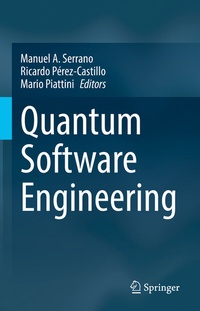
Quantum Software Engineering
Description

This book presents a set of software engineering techniques and tools to improve the productivity and assure the quality in quantum software development. Through the collaboration of the software engineering community with the quantum computing community new architectural paradigms for quantum-enabled computing systems will be anticipated and developed.
The book starts with a chapter that introduces the main concepts and general foundations related to quantum computing. This is followed by a number of chapters dealing with the quantum software engineering methods and techniques. Topics like the Talavera Manifesto for quantum software engineering, frameworks for hybrid systems, formal methods for quantum software engineering, quantum software modelling languages, and reengineering for quantum software are covered in this part. A second set of chapters then deals with quantum software environments and tools, detailing platforms like QuantumPath®, Classiq as well as quantum software frameworks for deep learning.
Overall, the book aims at academic researchers and practitioners involved in the creation of quantum information systems and software platforms. It is assumed that readers have a background in traditional software engineering and information systems.
More details
Other editions
Additional editions
Persons
Manuel A. Serrano is Associate Professor at the University of Castilla - La Mancha (Spain) since 2000. Currently, he is Vice-Dean of the Department of Technologies and Information Systems. He has participated in more than 20 research projects, has conducted several invited speeches and transfer project with companies. Manuel is a member of the aQuantum team working on quantum algorithms, quantum testing and quantum software engineering. He is also part of the Microsoft Quantum Network imparting several quantum computing seminars and workshops.
Ricardo Pérez-Castillo works at the IT & Social Sciences School of Talavera at University of Castilla-La Mancha and belongs to Alarcos Research Group. His research includes works on architecture-driven modernization, model-driven development, and business process archaeology. Ricardo is member of the aQuantum scientific research team where he works on the migration of classical and quantum systems toward hybrid informationsystems. He is the research director of some public-funding research projects about quantum software engineering, and he has also co-organized several workshops on Quantum Software Engineering.
Mario Piattini
is Director of the Alarcos Research Group at UCLM. He is among the 15 "Top scholars in the field of systems and software engineering (2004-2008)" and the 15 "Most active experienced Software Engineering researchers in top-quality journals (2010-2017)". He is the co-creator of the "aQuantum" unit, which was founded to learn about the specific problems quantum developers and scientists have to face, and which puts together industry and research. He has also co-organized several workshops on Quantum Software Engineering.
