

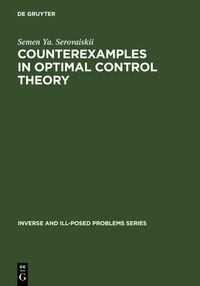
Counterexamples in Optimal Control Theory
1st Edition
Published on 1. December 2011
VII, 175 pages
978-3-11-091553-2 (ISBN)
Description

This monograph deals with cases where optimal control either does not exist or is not unique, cases where optimality conditions are insufficient of degenerate, or where extremum problems in the sense of Tikhonov and Hadamard are ill-posed, and other situations. A formal application of classical optimisation methods in such cases either leads to wrong results or has no effect. The detailed analysis of these examples should provide a better understanding of the modern theory of optimal control and the practical difficulties of solving extremum problems.
More details
Other editions
Additional editions
Serovaiskii
Counterexamples in Optimal Control Theory
Book
10/2003
1st Edition
VSP International Science Publishers
€199.95
Article exhausted; check different version
Semen Ya. Serovaiskii
Counterexamples in Optimal Control Theory
Book
01/2003
1st Edition
De Gruyter
€299.00
Article exhausted; check different version
Person
Semen Ya. Serovaiskii, Al-Farabi Kazakh National University, Almaty, Kazakhstan.
Content
- Intro
- Preface
- Introduction
- 1. Problem formulation
- 2. The maximum principle
- 3. Example
- 4. Approximate solution of the optimality conditions
- Summary
- Example 1. Insufficiency of the optimality conditions
- 1.1. Problem formulation
- 1.2. The maximum principle
- 1.3. Analysis of the optimality conditions
- 1.4. Uniqueness of the optimal control
- 1.5. Uniqueness of an optimal control in a specific example
- 1.6. Further analysis of optimality conditions
- 1.7. Sufficiency of the optimality conditions
- 1.8. Sufficiency of the optimality conditions in a specific example
- 1.9. Conclusion of the analysis of the optimality conditions
- Summary
- Example 2. The singular control
- 2.1. Problem formulation
- 2.2. The maximum principle
- 2.3. Analysis of the optimality conditions
- 2.4. Nonoptimality of singular controls
- 2.5. Uniqueness of singular controls
- 2.6. The Kelly condition
- Summary
- Example 3. Nonexistence of optimal controls
- 3.1. Problem formulation
- 3.2. The maximum principle
- 3.3. Analysis of the optimality conditions
- 3.4. Unsolvability of the optimization problem
- 3.5. Existence of optimal controls
- 3.6. The proof of the solvability of an optimization problem
- 3.7. Conclusion of the analysis
- Summary
- Example 4. Nonexistence of optimal controls (Part 2)
- 4.1. Problem formulation
- 4.2. The maximum principle for systems with fixed final state
- 4.3. Approximate solution of the optimality conditions
- 4.4. The optimality conditions for Problem 4
- 4.5. Direct investigation of Problem 4
- 4.6. Revising the problem analysis
- 4.7. Problems with unbounded set of admissible controls
- 4.8. The Cantor function
- 4.9. Further analysis of the maximum condition
- 4.10. Conclusion of the problem analysis
- Summary
- Example 5. Ill-posedness in the sense of Tikhonov
- 5.1. Problem formulation
- 5.2. Solution of the problem
- 5.3. Ill-posedness in the sense of Tikhonov
- 5.4. Analysis of well-posedness in the sense of Tikhonov
- 5.5. The well-posed optimization problem
- 5.6. Regularization of optimal control problems
- Summary
- Example 6. Ill-posedness in the sense of Hadamard
- 6.1. Problem formulation
- 6.2. Ill-posedness in the sense of Hadamard
- 6.3. Well-posedness in the sense of Hadamard
- 6.4. A well-posed optimization problem
- Summary
- Example 7. Insufficiency of the optimality conditions (Part 2)
- 7.1. Problem formulation
- 7.2. The existence of an optimal control
- 7.3. Necessary condition for an extremum
- 7.4. Transformation of the optimality conditions
- 7.5. Analysis of the boundary value problem
- 7.6. The nonlinear heat conduction equation with infinitely many equilibrium states
- 7.7. Conclusion of the analysis of the variational problem
- Summary
- Example 8. The Chafee-Infante problem
- 8.1. Problem formulation
- 8.2. The necessary condition for an extremum
- 8.3. Solvability of the Chafee-Infante problem
- 8.4. The set of solutions of the Chafee-Infante problem
- 8.5. Bifurcation points
- Summary
- Comments
- Conclusion
- Bibliography
