

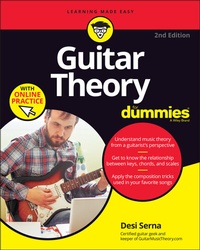
Guitar Theory For Dummies with Online Practice
2nd Edition
Published on 29. September 2021
368 pages
978-1-119-84334-4 (ISBN)
Description

Make your guitar sing with insight on music theory brings your instrument to life
There's a universe of incredible music living in your guitar. You just need to discover how to let it out. In Guitar Theory For Dummies, expert guitarist and instructor Desi Serna walks you through the music theory concepts you need to understand to expand your musical horizons. From deciphering the mysteries of the fretboard to adapting chord progressions to a song's key, you'll master techniques that will help you move past simple, three-chord songs to more complex and creative pieces.
Build on your existing knowledge of open and barre chords and simple progressions with practical instruction that demystifies scales and chord voicings and shows you how to bring them together to create impressive music. You can also jump over to dummies.com to hear audio samples of the examples featured in the book.
You'll also learn:
* How chords, keys, and scales are built and how they interact with one another
* Powerful concepts, like intervals, chord extensions, modes and modal scales, that grant access to a world of musical possibilities
* How popular songs apply elements of guitar theory and how you can apply the same techniques
Free yourself from the confines of tab sheets and simple chords and start enjoying all the musical potential of your guitar. Guitar Theory For Dummies is for anyone who wants to unlock the next stage of their musical journey.
There's a universe of incredible music living in your guitar. You just need to discover how to let it out. In Guitar Theory For Dummies, expert guitarist and instructor Desi Serna walks you through the music theory concepts you need to understand to expand your musical horizons. From deciphering the mysteries of the fretboard to adapting chord progressions to a song's key, you'll master techniques that will help you move past simple, three-chord songs to more complex and creative pieces.
Build on your existing knowledge of open and barre chords and simple progressions with practical instruction that demystifies scales and chord voicings and shows you how to bring them together to create impressive music. You can also jump over to dummies.com to hear audio samples of the examples featured in the book.
You'll also learn:
* How chords, keys, and scales are built and how they interact with one another
* Powerful concepts, like intervals, chord extensions, modes and modal scales, that grant access to a world of musical possibilities
* How popular songs apply elements of guitar theory and how you can apply the same techniques
Free yourself from the confines of tab sheets and simple chords and start enjoying all the musical potential of your guitar. Guitar Theory For Dummies is for anyone who wants to unlock the next stage of their musical journey.
More details
Other editions
Additional editions
Book
12/2021
Wiley
€26.50
Shipment within 15-20 days
Person
Desi Serna is a music instructor, author, and podcaster hailed as a "music theory expert" by Rolling Stone magazine. He is the author of several guitar instructional videos and books, including Guitar Rhythm & Technique For Dummies. Known for his hands-on approach to music theory and his emphasis on popular music, Desi offers video instruction for beginner through advanced players at his GuitarMusicTheory.com website.
Content
- Intro
- Title Page
- Copyright Page
- Table of Contents
- Introduction
- About This Book
- Foolish Assumptions
- Icons Used in This Book
- Beyond the Book
- Where to Go from Here
- Part 1 Getting Started with Guitar Theory
- Chapter 1 Guitar Theory in a Nutshell
- Why Learn Guitar Theory?
- Navigating the Fretboard
- Seeing the fretboard as a grid
- Viewing neck diagrams
- Reading guitar tablature
- Playing Scales
- Pentatonic scale
- Major scale
- Modes
- Harmonic minor scale
- Working with Chords
- CAGED chord system
- Adding chord tones and extensions
- Passing chords
- Charting chord progressions
- Testing Your Guitar Theory Knowledge
- Chapter 2 Navigating the Fretboard Like a Pro
- Tracing Everything Back to Strings 6 and 5
- Moving between pitches with whole steps and half steps
- Naming the pitches between natural notes: Sharps and flats
- Grouping notes
- Tracking Notes and Playing Songs with Octaves
- Shaping octaves with your 1st finger on strings 6 and 5
- Shaping octaves with your 1st finger on strings 4 and 3
- Shaping octaves that are three strings apart
- Repeating octaves beyond the 12th fret
- Measuring the Space between Pitches with Intervals
- Playing intervals 1 through 7
- Filling in the gaps with flats and sharps
- Part 2 Working with Chords from the Ground Up
- Chapter 3 Harmonizing the Major Scale to Form Triads and Chords
- Building Triads and Chords
- Major triad: Building from the 1st scale degree of the major scale
- Minor triad: Building from the 2nd scale degree of the major scale
- Playing through the Seven Triads of the Major Scale
- Playing the Chord Sequence of the Major Scale
- Chapter 4 Forming Chord Shapes with the CAGED System
- Making Chord Inversions and Chord Voicings
- Using the C Form
- Using the C form as a moveable barre chord
- Playing a C form arpeggio pattern
- Playing C form chord voicings
- Using the A Form
- Using the G Form
- Using the E Form
- Using the D Form
- Connecting the Five CAGED Forms
- Starting on C
- Starting on A
- Starting on G
- Starting on E
- Starting on D
- Sample CAGED Chord Changes
- Playing Minor CAGED Forms
- Playing the C minor form
- Playing the A minor form
- Playing the G minor form
- Playing the E minor form
- Playing the D minor form
- Connecting the Five Minor CAGED Forms
- Minor CAGED Chord Changes
- Chapter 5 Adding Chord Tones and Extensions to Chords
- About Chord Tones and Extensions
- Adding 7ths to the Major Scale Chords
- Playing major and minor 7th chords
- Playing dominant 7th chords
- Playing minor 7th flat 5 chords
- Working with 2nds and 9ths
- Sus2 chords
- Add9 chords
- Minor chords with 2nds and 9ths
- 9th chords
- Working with 4ths and 11ths
- Sus4 chords
- Add4 chords
- Playing 6th Chords and Using the 6th Interval
- Adding Harmony with Pedal Point
- Playing Pedal Tones with Two Guitars
- Part 3 Getting to Know Keys, Modes, and Chord Progressions
- Chapter 6 Playing Chord Progressions by Numbers
- Drawing Chord Progressions from the Major Scale
- Using Roman Numerals to Represent Chords
- Visualizing Numbers on the Fretboard
- Transposing to New Keys
- Playing Common Chord Progressions
- Playing I-IV-V chord progressions
- Playing major chord progressions
- Adding minor chords ii, iii, and vi
- Playing minor chord progressions
- Starting Numbers on the 5th String
- Playing Chord Progressions with Open Chords
- Using the Nashville Number System
- Chapter 7 Knowing Music Inside Out: Identifying Tonics, Keys, and Modes
- Understanding the Relationship between Major and Minor Scales
- Numbering the Relative Minor
- Accounting for any interval changes
- Looking at a few minor key song examples
- Identifying the Modes of the Major Scale
- Ionian (I)
- Dorian (ii)
- Phrygian (iii)
- Lydian (IV)
- Mixolydian (V)
- Aeolian (vi)
- Locrian (vii5)
- Key Signatures and Common Discrepancies
- Looking past the key signature to figure out a song's mode
- Considering some common discrepancies in music notation
- Comparing Scale Formulas and Structures
- Chapter 8 Following Key Changes
- Getting to Know Key Changes by Switching Tonics within a Scale
- Switching between relative major and minor
- Switching between other scale degrees
- Transposing a Progression
- Changing Key and Progression
- Using Modal Interchange and Borrowed Chords
- Playing modal interchanges
- Playing minor modal interchanges
- Using the Circle of 5ths for Circle Progressions
- Applying the same circle to 4ths
- Seeing circle progressions in action
- Chapter 9 Dominant Function and Voice Leading
- Chord Function and the Dominant Chord
- Leading with the leading tone
- Tension rises with a tritone
- Playing songs with dominant function
- Secondary Dominants
- Drawing attention to some common secondary dominants
- Thinking of secondary dominants as mini key changes
- Songs that use secondary dominants
- Voice Leading
- Chapter 10 Filling the Gaps with Passing Chords
- Getting to Know Chromatic Passing Chords
- Passing chords in blues
- We gonna get funky
- Chromatic ch-ch-ch-ch-changes
- Getting to Know Diminished Chords
- Fingering diminished chord shapes
- Playing diminished 7th chord inversions
- Using diminished 7ths as passing chords
- Substituting diminished 7th chords for dominant 7th chords
- Playing Augmented Chords
- Playing augmented chord inversions
- Using augmented chords for dominant function
- Using augmented chords in voice leading
- Part 4 Playing Guitar Scales
- Chapter 11 Preparing for Riffs and Solos with the Pentatonic Scale
- Getting to Know the Pentatonic Scale
- Covering the Fretboard with the Pentatonic Scale
- Starting with pattern 1
- Playing pentatonic pattern 2
- Playing pentatonic pattern 3
- Playing pentatonic pattern 4
- Finishing up with pentatonic pattern 5
- Connecting all the patterns
- Using the Pentatonic Scale as Major and Minor
- Playing the Pentatonic Scale in Other Keys
- Playing in F minor and A
- Playing in F minor and A major
- Playing in G minor and B major
- Playing in G minor and B major and other keys
- Playing in A minor and C major
- Applying the Pentatonic Scale
- Chapter 12 Playing Music's Primary Melody Maker: The Major Scale
- Getting Familiar with the Major Scale
- Playing the Major Scale as Five Smaller Patterns
- Breaking down the G major scale
- Focusing on fingering
- Connecting the five patterns to cover the whole fretboard
- Practicing the Major Scale without Getting Bored
- Playing along with accompaniment
- Adding minor notes and patterns
- Transposing the major scale to new keys
- Applying the Major Scale
- Playing Three-Notes-Per-String Patterns
- Chapter 13 Playing in Modes and Using Modal Scale Patterns
- Understanding Modes
- Knowing how modal sounds are made
- Remembering that modes are more than just patterns or starting positions
- Playing Ionian Mode
- Seeing and hearing Ionian mode in action
- Using Ionian mode with the pentatonic scale
- Playing Dorian Mode
- Getting the Dorian details
- Using Dorian mode with the pentatonic scale
- Playing Phrygian Mode
- Playing Lydian Mode
- Playing Mixolydian Mode
- Playing Aeolian Mode
- Chapter 14 Exploring New Patterns with the Harmonic Minor Scale
- Getting to Know the Harmonic Minor Scale
- Raising the 7th scale degree
- Identifying some harmonic minor chord progressions
- Using Harmonic Minor within a Pentatonic Pattern
- Adding a raised 7th to the pentatonic
- Outlining the V7 chord
- Completing the harmonic minor scale
- Covering the Fretboard with Harmonic Minor Scale Patterns
- Picking out patterns
- Focusing on fingering
- Practice, practice, practice!
- Transposing the harmonic minor scale to new keys
- Playing in a Harmonic Minor Mode
- Getting to Know the Melodic Minor Scale
- Using Harmonic Minor in Dorian Mode
- Chapter 15 Playing the Blues
- Recognizing Blues Elements in Popular Music
- Playing Over a Blues V7 Chord
- Playing the dominant scale
- Using the major and minor pentatonic
- Mixing up the scale options
- Tackling Whole Chord Progressions with the 12-Bar Blues
- Switching dominant scales
- Sticking with minor pentatonic
- Using a major pentatonic scale
- Changing pentatonic scales on each chord
- Playing the Blues Scale
- Part 5 Part of Tens
- Chapter 16 Ten Guitar Songs Worth Learning
- "Wish You Were Here" by Pink Floyd
- "La Bamba" by Los Lobos
- "Jack and Diane" by John Mellencamp
- "Brown Eyed Girl" by Van Morrison
- "With or Without You" by U2
- "Stairway to Heaven" by Led Zeppelin
- "Smooth" by Santana
- "Sunshine of Your Love" by Cream
- "Johnny B. Goode" by Chuck Berry
- "Jingle Bell Rock" by Bobby Helms
- Chapter 17 Ten Sample Scale Applications
- G-Em-C-D
- E-B-Cm-A
- E-D-A-E
- D-C-G-D
- Am-G-F
- Am-D
- Am-Bm
- Em-D-C-B7
- F-B-C
- E5-D5
- Chapter 18 Tens Ways to Put Theory into Practice
- Learn and Analyze Songs
- Play Along with Songs
- Record and Listen to Yourself
- Become a Super Looper
- Play with Others
- Play Out
- Practice a Little and Play a Lot
- Study More Music Theory Resources
- Set Reasonable, Realistic Goals
- Have a Good Time All the Time
- Appendix: Audio Tracks and Video Clips
- Index
- EULA
