

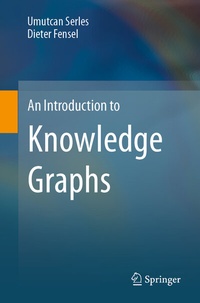
An Introduction to Knowledge Graphs
Description

This textbook introduces the theoretical foundations of technologies essential for knowledge graphs. It also covers practical examples, applications and tools. Knowledge graphs are the most recent answer to the challenge of providing explicit knowledge about entities and their relationships by potentially integrating billions of facts from heterogeneous sources.
The book is structured in four parts. For a start, Part I lays down the overall context of knowledge graph technology. Part II "Knowledge Representation" then provides a deep understanding of semantics as the technical core of knowledge graph technology. Semantics is covered from different perspectives, such as conceptual, epistemological and logical. Next, Part III "Knowledge Modelling" focuses on the building process of knowledge graphs. The book focuses on the phases of knowledge generation, knowledge hosting, knowledge assessment, knowledge cleaning, knowledge enrichment, and knowledge deployment to cover a complete life cycle for this process. Finally, Part IV (simply called "Applications") presents various application areas in detail with concrete application examples as well as an outlook on additional trends that will emphasize the need for knowledge graphs even stronger.
This textbook is intended for graduate courses covering knowledge graphs. Besides students in knowledge graph, Semantic Web, database, or information retrieval classes, also advanced software developers for Web applications or tools for Web data management will learn about the foundations and appropriate methods.
More details
Other editions
Additional editions
Persons
Umutcan Serles is a postdoctoral researcher with the Semantic Technology Institute Innsbruck at the University of Innsbruck's Department of Computer Science. He has participated in many academic and industrial research projects about semantic technologies and knowledge graphs. Since 2016, he has been teaching courses about semantic web and since 2021 also courses dedicated to knowledge graphs. He also serves as a scientific consultant for various organizations that work with knowledge graph technology.
Dieter Fensel is the chair of the Semantic Technology Institute Innsbruck at the University of Innsbruck's Department of Computer Science. He has written over 300 scientific publications, including books, journals and conference papers, and workshop contributions. As one of the pioneers of research in the Semantic Web, he co-founded major scientific events such as the Extended Semantic Web Conference (ESWC) and the International Semantic Web Conference (ISWC). His research interests currently focus on the development of knowledge graphs and various aspects of the knowledge graph lifecycle. He has successfully applied his research in industry by co-founding companies like seekda (now part of Kognitiv) and Onlim, which are active in conversational interfaces and knowledge graphs.
