

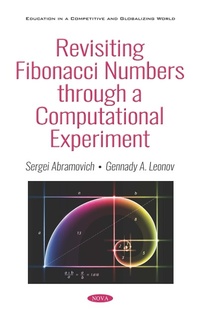
Revisiting Fibonacci Numbers through a Computational Experiment
Published on 3. January 2019
260 pages
978-1-5361-4906-7 (ISBN)
Description

The material of this book stems from the idea of integrating a classic concept of Fibonacci numbers with commonly available digital tools including a computer spreadsheet, Maple, Wolfram Alpha, and the graphing calculator. This integration made it possible to introduce a number of new concepts such as: Generalized golden ratios in the form of cycles represented by the strings of real numbers; Fibonacci-like polynomials the roots that define those cycles' dependence on a parameter; the directions of the cycles described in combinatorial terms of permutations with rises, as the parameter changes on the number line; Fibonacci sieves of order k; (r, k)-sections of Fibonacci numbers; and polynomial generalizations of Cassini's, Catalan's, and other identities for Fibonacci numbers. The development of these concepts was motivated by considering the difference equation f_(n+1)=af_n+bf_(n-1),f_0=f_1=1, and, by taking advantage of capabilities of the modern-day digital tools, exploring the behavior of the ratios f_(n+1)/f_n as n increases. The initial use of a spreadsheet can demonstrate that, depending on the values of a and b, the ratios can either be attracted by a number (known as the Golden Ratio in the case a = b = 1) or by the strings of numbers (cycles) of different lengths. In general, difference equations, both linear and non-linear ones serve as mathematical models in radio engineering, communication, and computer architecture research. In mathematics education, commonly available digital tools enable the introduction of mathematical complexity of the behavior of these models to different groups of students through the modern-day combination of argument and computation. The book promotes experimental mathematics techniques which, in the digital age, integrate intuition, insight, the development of mathematical models, conjecturing, and various ways of justification of conjectures. The notion of technology-immune/technology-enabled problem solving is introduced as an educational analogue of the notion of experimental mathematics. In the spirit of John Dewey, the book provides many collateral learning opportunities enabled by experimental mathematics techniques. Likewise, in the spirit of George Pólya, the book champions carrying out computer experimentation with mathematical concepts before offering their formal demonstration. The book can be used in secondary mathematics teacher education programs, in undergraduate mathematics courses for students majoring in mathematics, computer science, electrical and mechanical engineering, as well as in other mathematical programs that study difference equations in the broad context of discrete mathematics.
More details
Other editions
Additional editions
Sergei Abramovich | Gennady A. Leonov
Revisiting Fibonacci Numbers through a Computational Experiment
Book
03/2019
Nova Science Publishers Inc
€256.99
Shipment within 15-20 days
Content
- Intro
- Revisiting Fibonacci Numbers through a Computational Experiment
- Revisiting Fibonacci Numbers through a Computational Experiment
- Contents
- Preface
- Acknowledgments
- Chapter 1
- Theoretical Background: Fibonacci Numbers as a Framework for Information vs. Explanation Cognitive Paradigm
- 1.1. Introduction
- 1.2. Goals of the Book
- 1.3. A Pedagogy of the Book
- 1.4. Collateral Learning and Hidden Mathematics Curriculum
- 1.5. TITE Problems as a Framework for the Information vs. Explanation Paradigm
- 1.6. Summary
- Chapter 2
- From Fibonacci Numbers to Fibonacci-Like Polynomials
- 2.1. The Binary Number System and Fibonacci Numbers
- 2.2. Different Representations of Fibonacci Numbers
- 2.3. Fibonacci Numbers and Pascal's Triangle
- 2.4. Hidden Mathematics Curriculum of Pascal's Triangle
- 2.5. Binomial Coefficients and Fibonacci Numbers
- 2.6. From Pascal's Triangle to Fibonacci-Like Polynomials
- 2.7. Other Classes of Polynomials Associated with Fibonacci Numbers
- 2.8. Summary
- Chapter 3
- Different Approaches to the Development of Binet's Formulas
- 3.1. Fibonacci-Like Numbers
- 3.2. Parameterization of Fibonacci Recursion
- 3.3. Deriving Binet's Formulas for Recurrence (3.8) Using The Machinery of Matrices
- 3.4. Generating Function Approach to the Derivation of Binet's Formulas
- 3.4.1. The Case of Fibonacci Numbers
- 3.4.2. The Case of Lucas Numbers
- 3.4.3. The Case of Matijasevic Numbers
- 3.4.4. The Case of Jacobsthal Numbers
- 3.5. Characteristic Equation Approach
- 3.5.1. The Case of Fibonacci Numbers
- 3.5.2. The Case of Lucas Numbers
- 3.5.3. The Case of Matijasevic Numbers
- 3.5.4. The Case of Jacobsthal Numbers
- 3.6. Continued Fractions and the Golden Ratio
- 3.7. Leibniz Diagrams as Level Lines for Eigenvalues
- 3.8. Limiting Behavior of the Ratios , - + ./, - .
- 3.9. Summary
- Chapter 4
- Fibonacci Sieves and Their Representation through Difference Equations
- 4.1. Fibonacci Sieve of Order K and Its Difference Equation
- 4.2. Connecting Fibonacci Sieves to Modern Mathematics
- 4.3. Constructing (r, k)-Section of Fibonacci Numbers as a TITE Exploration
- 4.4. The Golden Ratio as an Invariant for Fibonacci-Like Sequences
- 4.4.1. The Case of Fibonacci and Lucas Number Sequences
- 4.4.2. The Case of Fibonacci-Like Number Sequences
- 4.5. Computational Experiments with Fibonacci-Like Sieves
- 4.6. Summary
- Chapter 5
- TITE Explorations of Generalized Golden Ratios
- 5.1. Introduction
- 5.2. Convergence to a Generalized Golden Ratio
- 5.3. Disappearance of the Golden Ratio
- 5.4. Constructing Cycles of Higher Periods
- 5.5. Summary
- Chapter 6
- Exploring Cycles Using a Combination of Digital Tools
- 6.1. Verifying Theory Through Experiment
- 6.2. Recursive Computing of Coefficients of Fibonacci-Like Polynomials
- 6.3. Generating Fibonacci-Like Polynomials Using Maple
- 6.4. On the Existence of a Cycle of an Arbitrary Large Period
- 6.5. Summary
- Chapter 7
- Method of Iterations and Fibonacci-Like Polynomials
- 7.1. Developing Iterative Formulas in the General Case
- 7.2. Connecting Iterative Formulas to Some Known Sequences of Numbers
- 7.3. Geometric Interpretation of the Method of Iterations
- 7.4. Building Connections to Other Sequences Included into the OEIS(
- 7.5. Method of Iterations in the Case of the Polynomials , - ., . and , - ., .
- 7.6. Method of Iterations in the Case of a Fibonacci-Like Polynomial of Degree Four
- 7.7. Summary
- Chapter 8
- Identities for Fibonacci-Like Polynomials
- 8.1. Introduction
- 8.2. Additive Identities Among Fibonacci-Like Polynomials
- 8.3. Multiplicative Identities Among Fibonacci-Like Polynomials
- 8.4. Polynomial Generalizations of Cassini's Identity
- 8.5. Conjecturing Polynomial Forms of Catalan's Identity
- 8.6. Summary
- Chapter 9
- Uncovering Hidden Patterns in the Oscillations of Generalized Golden Ratios
- 9.1. On The Roots of Fibonacci-Like Polynomials
- 9.2. Permutations with Rises/Falls and the Directions of Cycles
- 9.3. Recognizing the Nature of Permutations of the Elements of a Three-Cycle
- 9.4. Permutations of the Elements of a Four-Cycle
- 9.5. Permutations of the Elements of a Five-Cycle
- 9.6. Generalizing from Observations
- 9.7. Proof of Proposition 9.3
- 9.8. Circular Diagrams and Oscillations Associated with the Largest Root
- 9.9. Summary
- References
- About the Authors
- Index
- Blank Page
- Blank Page
