

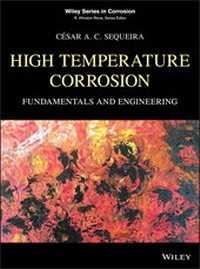
High Temperature Corrosion
Description

High-temperature corrosion (HTC) is a widespread problem in an array of industries, including power generation, aerospace, automotive, and mineral and chemical processing, to name a few. This book provides engineers, physicists, and chemists with a balanced presentation of all relevant basic science and engineering aspects of high-temperature corrosion. It covers most HTC types, including oxidation, sulfidation, nitridation, molten salts, fuel-ash corrosion, H2S/H2 corrosion, molten fluoride/HF corrosion, and carburization. It also provides corrosion data essential for making the appropriate choices of candidate materials for high-temperature service in process conditions.
A form of corrosion that does not require the presence of liquids, high-temperature corrosion occurs due to the interaction at high temperatures of gases, liquids, or solids with materials. HTC is a subject is of increasing importance in many areas of science and engineering, and students, researchers, and engineers need to be aware of the nature of the processes that occur in high-temperature materials and equipment in common use today, especially in the chemical, gas, petroleum, electric power, metal manufacturing, automotive, and nuclear industries.
* Provides engineers and scientists with the essential data needed to make the most informed decisions on materials selection
* Includes up-to-date information accompanied by more than 1,000 references, 80% of which from within the past fifteen years
* Includes details on systems of critical engineering importance, especially the corrosion induced by low-energy radionuclides
* Includes practical guidelines for testing and research in HTC, along with both the European and International Standards for high-temperature corrosion engineering
Offering balanced, in-depth coverage of the fundamental science behind and engineering of HTC, High Temperature Corrosion: Fundamentals and Engineering is a valuable resource for academic researchers, students, and professionals in the material sciences, solid state physics, solid state chemistry, electrochemistry, metallurgy, and mechanical, chemical, and structural engineers.
More details
Other editions
Additional editions
Person
CÉSAR A. C. SEQUEIRA, PHD, has been a member of the faculty staff of Instituto Superior Técnico (Univ. of Lisbon), maintaining his academic career in fundamental and technological electrochemistry for more than 40 years. He is the author/co-author of over 250 professional papers, 500 scientific communications, 20 book chapters, and 12 books in the areas of corrosion science and technology, electrochemistry, and materials science. He has directed numerous workshops, including three on Microbial Corrosion of the European Federation of Corrosion. He is a Fellow of the Royal Society of Chemistry (U.K.) and of the Institute of Materials (U.K.), and is an Active Member of the Electrochemical Society. Currently, he is the Senior Research Leader on Electrochemistry of Materials at CeFEMA (Center of Physics and Engineering of Advanced Materials) in Lisbon.
Content
Preface xi
Acknowledgments xvii
1 Introduction 1
1.1 Definition of High Temperature Corrosion 1
1.2 Historical Development 1
1.3 High Temperature Corrosion Phenomena 3
1.4 High Temperature Materials 3
1.5 Corrosive Environments 27
1.6 Films and Scales 31
1.7 Academic Impact of High Temperature Corrosion 33
1.8 Industrial Impact of High Temperature Corrosion 38
1.9 Questions 46
References 46
Further Reading 47
2 Metallurgical Structure and Metals 48
2.1 Imperfections in an Essentially Perfect Structure 48
2.2 Solidification 56
2.3 Alloys 62
2.4 Iron and Steel 72
2.5 Deformation and Recrystallization 79
2.6 Fracture and Fatigue 91
2.7 Questions and Problems 97
References 98
Further Reading 99
3 High Temperature Equilibria 100
3.1 Introduction 100
3.2 Thermochemical Analysis 100
3.3 Electrochemical Analysis 119
References 128
Further Reading 129
4 Lattice Defects in Metal Compounds 130
4.1 Introduction 130
4.2 Defect Reactions 133
4.3 Defect Equilibria 135
4.4 Equilibrium Constants 141
4.5 Questions 144
References 144
Further Reading 145
5 Diffusion in Solid-State Systems 146
5.1 Introduction 146
5.2 General Theory of Diffusion 146
5.3 Diffusion Coefficients 150
5.4 Matano-Boltzmann Analysis 153
5.5 Kirkendall Effect 154
5.6 Darken Analysis 155
5.7 Factors Influencing Diffusion 156
5.8 Impurity Diffusion in Metals 158
5.9 Grain Boundary Diffusion in Metals 158
5.10 Diffusion in Solid Oxides 160
5.11 Morphology of Reaction Products 163
5.12 Measurement of Diffusion Parameters 164
5.13 Questions and Problems 168
References 168
Further Reading 169
6 High Temperature Electrochemistry 171
6.1 Introduction 171
6.2 Electrochemical Nature of Molten Salt Corrosion 171
6.3 The Single Potential of an Electrode 172
6.4 Equilibrium Diagrams 173
6.5 The Tafel Relationship 173
6.6 Corrosion Potential-pO2-Relationship 175
6.7 Electrochemical Polarization and Monitoring 177
6.8 Electrochemical Nature of Metal Oxidation 179
6.9 Usefulness of Electrochemical Cells 181
6.10 Current-Potential Measurements on Solid Electrodes 182
6.11 Simple Concepts of Oxide Semiconductors 183
6.12 Conduction Processes in Ionic Oxides 186
6.13 Common Solid-State Electrochemical Situations 190
References 194
Further Reading 195
7 Oxidation 196
7.1 Introduction 196
7.2 Thermodynamic Considerations 197
7.3 Kinetic Considerations 199
7.4 Defect Structures 201
7.5 Compact Scale Growth 208
7.6 Multilayered Scale Growth 212
7.7 Oxidation Resistance 214
7.8 Oxidation of Engineering Materials 224
7.9 Conclusions 228
7.10 Questions 229
References 229
Further Reading 231
8 Sulfidation 233
8.1 Introduction 233
8.2 The Process of Sulfidation 233
8.3 Sulfidation Kinetics 235
8.4 Sulfidation of Selected Materials 236
8.5 Defect Structures of Metal Sulfides 240
8.6 Questions 243
References 243
Further Reading 244
9 Carburization and Metal Dusting 245
9.1 Introduction 245
9.2 Carburization 245
9.3 Alloy Resistance to Carburization 251
9.4 Metal Dusting Problem 255
9.5 Metal Dusting Mechanisms 256
9.6 Alloy Resistance to Metal Dusting 260
References 262
Further Reading 263
10 Nitridation 264
10.1 Introduction 264
10.2 Nitridation Mechanisms 264
10.3 Nitridation in Industrial Media 265
10.4 Questions and Problems 273
References 274
Further Reading 275
11 Halogenation 276
11.1 Introduction 276
11.2 Metal-Halogen Reactions 277
11.3 Alloy-Halogen Reactions 279
11.4 Laboratory Studies 280
11.5 Conclusions 282
11.6 Questions 282
References 282
Further Reading 283
12 Corrosion by Hydrogen and Water Vapor 284
12.1 Introduction 284
12.2 Corrosion by Hydrogen 284
12.3 Corrosion by Water Vapor 290
12.4 Conclusions 293
References 294
Further Reading 295
13 Corrosion in Molten Salts 296
13.1 Introduction 296
13.2 Corrosion Process 296
13.3 Thermodynamic Diagrams 298
13.4 Corrosion Rate Measurements 299
13.5 Test Methods 299
13.6 Fluorides 303
13.7 Chlorides 304
13.8 Nitrates/nitrites 305
13.9 Hydroxides 309
13.10 Carbonates 309
13.11 Vanadates 312
13.12 Sulfates 314
13.13 Prevention of Molten Salt Corrosion 321
13.14 Summary 321
References 322
Further Reading 324
14 Corrosion in Molten Metals 325
14.1 Introduction 325
14.2 Corrosive Processes 326
14.3 Industrial Liquid Metals 332
14.4 Conclusions 338
References 339
Further Reading 339
15 Hot Corrosion 340
15.1 Introduction 340
15.2 Engine Description and Materials 340
15.3 Early Studies 341
15.4 Mechanisms of Hot Corrosion 349
15.5 Hot Corrosion of Gas Turbine Alloys 351
15.6 Methods of Evaluating Hot Corrosion 354
15.7 Prevention of Corrosion 356
15.8 Conclusions 358
15.9 Questions 358
References 359
Further Reading 360
16 Fireside Corrosion 361
16.1 Introduction 361
16.2 Coal-Fired Boilers 362
16.3 Coal-ash Corrosion 371
16.4 Oil-Fired Boilers 373
16.5 Corrosion in Waste Incinerators 379
16.6 Plant Experience with Fireside Corrosion 380
16.7 Conclusions 388
References 389
Further Reading 389
17 Testing and Evaluation 391
17.1 Introduction 391
17.2 Testing Equipment and Monitoring 392
17.3 Optical Microscopy 394
17.4 Thermogravimetry 395
17.5 Spectroscopy 398
17.6 Diffraction Techniques 402
17.7 Electron Microscopy 409
17.8 Electron Spectroscopy and Ion Scattering 416
17.9 Surface Microscopy 424
17.10 Optical Spectroscopy 428
17.11 Nondestructive Inspection Techniques 439
17.12 Traditional Electrochemical Methods 445
17.13 Nontraditional Electrochemical Methods 453
17.14 Combined Electrochemical Methods 459
References 472
Further Reading 475
18 Protective Coatings 477
18.1 Introduction 477
18.2 Coating Systems 477
18.3 Coating Processes 480
18.4 Coating Degradation 496
18.5 Summary and Future Trends 499
18.6 Questions 500
References 500
Further Reading 501
19 Examples of Engineering Importance 502
19.1 Introduction 502
19.2 Molten Carbonate Fuel Cells 504
19.3 Solid Oxide Fuel Cells 516
19.4 Direct Carbon Fuel Cells 524
19.5 Nuclear Power Plants 531
References 546
Further Reading 549
20 Case Studies 551
20.1 Making Stainless Steels 551
20.2 Corrosion Protection of Turbine Blades 551
20.3 Oxidation of Silicides for VLSI Applications 556
20.4 Naphthenic Acid Corrosion in Petrochemical Plants 560
20.5 Oxidation of Ceramic Matrix Composites 562
20.6 Shell Corrosion of Rotary Cement Kilns 563
20.7 Corrosion of Steels in a Linear ¿¿¿¿Olefin Plant 564
References 565
Further Reading 565
Appendix A 566
List of Acronyms 591
Glossary of Selected Terms Used in High Temperature Corrosion 596
Author Index 615
Subject Index 629
Preface
The science and engineering of gas-solid, liquid-solid, and solid-solid processes, which can involve high temperature reactions with oxygen, sulfur, nitrogen, carbon dioxide, water vapor, molten sulfates, chlorides, carbonates, vanadates, fluorides, etc., has evolved greatly over the past 50-60 years. Numerous symposia and colloquia have been held on the subject and have been widely attended by researchers from all over the world. One of the many factors enabling advancement of our understanding of the field is the creation and evolution of new, sophisticated instruments and techniques that allow a better analysis of scale compositions and structures.
The numerous details of high temperature corrosion () have led to thousands of publications over the years and to the writing of only relatively few books on the subject. Moreover, the early books suffered from lack of extensive data on various metals and alloys, the nonexistence of good experimental equipment, and an emphasis on materials that were important in the era in which the books were written. Many universities now have courses on oxidation and other forms of HTC, but the availability of texts continues to be limited. The following books have been very useful:
- N. Birks, G.H. Meier, and F.S. Pettit, Introduction to the High-Temperature Oxidation of Metals, Cambridge University Press, Cambridge, UK (2006).
- E. Fromm, Kinetics of Metal-Gas Interactions at Low Temperature - Hydriding, Oxidation, Poisoning, Springer-Verlag, Berlin, Germany (1998).
- A.S. Khanna, High Temperature Oxidation and Corrosion, ASM International, Materials Park, Ohio, USA (2002).
- P. Kofstad, High Temperature Oxidation of Metals, John Wiley, New York, USA (1966).
- P. Kofstad, High Temperature Corrosion, Elsevier, London, UK (1988).
- G.Y. Lai, High-Temperature Corrosion and Materials Applications, ASM International, Materials Park, Ohio, USA (2007).
- S. Mrowec, Defect and Diffusion in Solids, Elsevier Science Publications, London, UK (1980).
- M. Schütze, Protective Oxide Scales and Their Breakdown, The Institute of Corrosion, John Wiley, Chichester, UK (1997).
- M. Schütze and H.J. Grabke, eds., Metal Dusting, Carburization and Nitridation, EFC 41, Woodhead Publishing Ltd., Cambridge, UK (2006).
The main differences between the present book and the competitive books listed above are:
- None of them cover most of the HTC types (e.g. oxidation, sulfidation, nitridation, molten salts, fuel-ash corrosion, H2S/H2 corrosion, molten fluoride/HF corrosion, carburization).
- Many books on HTC concern fundamental studies of material-gas processes. In other words, aspects related to diffusion in HTC oxidation are well treated, but the books provide little engineering data to help engineers make informed material selection decisions.
- The present book covers fundamental science and engineering of HTC, in a balanced way, so that an academic researcher or PhD student or an engineer in industry will find it of interest.
- The present book includes up-to-date information accompanied by more than 1500 references, 80% of which cover the last 25 years.
- The present book includes details on systems of particular engineering importance at this time, namely, on the corrosion of high temperature fuel cells, and nuclear power plants.
- The present book includes an up-to-date summary of experimental methods, many of which have not been covered in earlier books.
The current book has 20 chapters, whose contents are briefly described hereafter.
The first chapter begins to examine historical aspects of the development of HTC. Then, the three key components of the corrosion phenomena frequently encountered in high temperature industrial processes are summarized. In the following sections, materials and their design for use at high temperatures, common and not so common hostile environments at high temperature, and the barriers (films, scales) that separate the material and environment and that, in many situations, are necessary to develop the desired corrosion resistance are presented. HTC occurs behind walls as high temperature processes are usually shielded from their environment. However, it can be lifetime and performance determining in a number of everyday examples, its minimization requiring a proper understanding of the underlying principles of corrosion, which involve plant engineering, metallurgy, chemistry, materials science, system design, or failure analysis. So, the academic and industrial impacts of HTC form the themes of the following sections. In this context, corrosion economics, safety, environment damage, and corrosion management are aspects of particular concern.
Basic high temperature phenomena that require attention are changes in dimensions, microstructures, mechanical properties, and other topics under the heading of physical metallurgy. It is no longer possible to neglect the metallurgical aspects of the corrosion problem. Imperfections in an essentially perfect structure, solidification, alloys, iron and steel, deformation and recrystallization, and fracture and fatigue are described in Chapter 2. It is expected to provide an introduction to physical metallurgy primarily intended for undergraduate students at universities and polytechnics, but, additionally, industrial technicians or engineers will be aided in identifying their in-plant corrosion problems. Seventy-three figures fully support the text, illustrating the fundamental points.
An important tool analysis of HTC problems is equilibrium thermochemistry, which, although not predictive of kinetics, allows to ascertain which reaction products are possible, whether or not significant evaporation or condensation of a given species is possible, the conditions under which a given reaction product can react with a condensed deposit, etc. This standard method of thermochemical analysis is commonly used in metallurgical equilibria involving reactions between a gas and a solid as a function of temperature, and the complexity of the ambivalent oxidation usually dictates that the thermochemical analysis be represented in graphical form. Chapter 3 deals with six types of thermochemical diagrams: Ellingham diagrams, integral free energy-concentration diagrams, vapor species diagrams, stability diagrams for one metal/two nonmetals, 2D stability diagrams for two metals/one nonmetal, and phase stability diagrams for two or more metals. The subject of thermodynamics (or phase equilibria) of metal-fused salt systems in high temperature corrosive environments has been treated in a manner exactly analogous to aqueous solutions by the formation of Pourbaix, i.e. plots of electrode potential (oxidizing potential) versus basicity, being treated in this chapter by constructing and properly detailing an oxidizing potential basicity diagram for iron in molten sodium sulfate.
The lattice of an actual crystal always contains imperfections or defects. Important properties of the crystal, such as diffusion of ions, result from the existence of defects, and, as a consequence, mass transport in the scale formed by oxidation can be explained on the basis of its defect chemistry and crystal structure. An understanding of reaction mechanisms in HTC requires a precise knowledge of defect structures in solids. The growth of a compact or a porous scale, as well as its structure, is largely determined by the presence of the lattice defects. This is analyzed in Chapter 4 on lattice defects in metal compounds. The considered topics include point defects and defect structures, defect reactions and relevant examples, defect equilibrium constants and their significance for defect reaction including electronic imperfections.
Besides its scientific interest, diffusion is of enormous practical relevance for industry and life, ranging from steelmaking, growth of oxide scales, sintering, and high temperature creep of metals to oxide/carbon dioxide exchange in the human lung. Chapter 5 is confined to diffusion in condensed matter, namely, in metals, binary alloys, and oxides. Emphasis is on very basic fundamental aspects, the contents being roughly characterized by the headings general theory of diffusion, diffusion coefficients, Matano-Boltzmann analysis, Kirkendall effect, Darken analysis, factors influencing diffusion, impurity diffusion in metals, grain boundary diffusion in metals, diffusion in solid oxides, morphology of reaction products, and measurement of diffusion parameters. The chapter includes many references for readers at the forefront of the subject; it is primarily intended for graduate students and corrosion scientists.
Many studies from both theoretical and experimental viewpoints and fundamental approaches made along the last 70 years suggested, with sufficient credibility, electrochemical mechanistic models for the observed corrosion at high temperature. Thus, the chemical reactions established at solid-solid, solid-liquid, and solid-gas interfaces during the growth of corrosion products can be visualized as oxidation-reduction electrode processes; in other words, it is acceptable that high temperature oxidation, sulfidation, halogenation, nitridation, carburization, and molten salt corrosion are processes of electrochemical nature. In Chapter 6, basic aspects of traditional electrochemistry, solid-state electrochemistry, and molten salt electrochemistry are described to show how HTC can be further understood and mitigated. Headings include electrochemical...
