
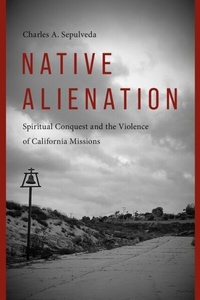
Native Alienation
Description
Alles über E-Books | Antworten auf Fragen rund um E-Books, Kopierschutz und Dateiformate finden Sie in unserem Info- & Hilfebereich.
Challenges the romantic portrayal of Spanish missions
Sites of slavery and spiritual conquest, the California missions played a central role in the brutal subjugation of the region's Indigenous peoples. Mainstream California history, however, still largely presents a romanticized portrait of the creation of the twenty-one Spanish missions between San Diego and Sonoma in the late eighteenth and early nineteenth centuries. Providing a corrective to this benign historiography, Charles A. Sepulveda reconstructs the violence toward Native people as well the resistance and refusals of his ancestors and other Native people during and after the Spanish genocide.
The conquest enforced the attempted spiritual possession of Native souls and the physical position of Native bodies and the land. At the same time, it strengthened the Spanish view of California's Indigenous people as disposable. Sepulveda demonstrates how enslavement was a key method of conquest, putting to rest the myth of the Spanish as benevolent and beneficial. Centering the experiences of Native peoples, Sepulveda brings to light the gendered dimensions of the conquest and genocide. His fuller history confronts the erasure of Indian individuality and resistance and historicizes the relationship between enslavement, dispossession, and environmental degradation. He also illuminates the mission system's central role in destroying Indigenous people's relationships to the land while examining the practice's centuries-long impact on the lives of Native people.
A groundbreaking reconsideration, Native Alienation transforms our understanding of California Indian history.
All prices
More details
Other editions
Additional editions
Person
Charles A. Sepulveda (Tongva and Acjachemen) is assistant professor in the Department of Ethnic Studies at the University of California, Riverside.
Content
- Cover
- Series Page
- Title Page
- Copyright
- Contents
- Acknowledgments
- Preface. Yaraarkomokreme' 'Eyoohiikmo Honuukvetmo
- Introduction. A Spiritual Conquest
- One. Slavery and Disavowal: Native Alienation
- Two. Hallucinations of the Spanish Imaginary: Mission Revival Architecture
- Three. Apocalyptic Colonialism: Environmental Devastation of Wanáw Waníicha/Kahoo' Paxaayt/Santa Ana River
- Four. Canonization Fodder: Resisting the Canonization of Junípero Serra
- Five. Ramona Redeemed? The Politics of Recognition and Rematriation
- Conclusion. The Afterlife of Native Alienation
- Notes
- Bibliography
- Index
- A
- B
- C
- D
- E
- F
- G
- H
- I
- J
- K
- L
- M
- N
- O
- P
- R
- S
- T
- U
- V
- W
- Y
- List of Series
- Back Cover

System requirements
File format: ePUB
Copy protection: Adobe-DRM (Digital Rights Management)
System requirements:
- Computer (Windows; MacOS X; Linux): Install the free reader Adobe Digital Editions prior to download (see eBook Help).
- Tablet/smartphone (Android; iOS): Install the free app Adobe Digital Editions or the app PocketBook before downloading (see eBook Help).
- E-reader: Bookeen, Kobo, Pocketbook, Sony, Tolino and many more (not Kindle).
The file format ePub works well for novels and non-fiction books – i.e., „flowing” text without complex layout. On an e-reader or smartphone, line and page breaks automatically adjust to fit the small displays.
This eBook uses Adobe-DRM, a „hard” copy protection. If the necessary requirements are not met, unfortunately you will not be able to open the eBook. You will therefore need to prepare your reading hardware before downloading.
Please note: We strongly recommend that you authorise using your personal Adobe ID after installation of any reading software.
For more information, see our ebook Help page.
File format: PDF
Copy-Protection: Adobe-DRM (Digital Rights Management)
System requirements:
- Computer (Windows; MacOS X; Linux): Install the free reader Adobe Digital Editions prior to download (see eBook Help).
- Tablet/smartphone (Android; iOS): Install the free app Adobe Digital Editions or the app PocketBook before downloading (see eBook Help).
- E-reader: Bookeen, Kobo, Pocketbook, Sony, Tolino and many more (only limited: Kindle).
The file format PDF always displays a book page identically on any hardware. This makes PDF suitable for complex layouts such as those used in textbooks and reference books (images, tables, columns, footnotes). Unfortunately, on the small screens of e-readers or smartphones, PDFs are rather annoying, requiring too much scrolling.
This eBook uses Adobe-DRM, a „hard” copy protection. If the necessary requirements are not met, unfortunately you will not be able to open the eBook. You will therefore need to prepare your reading hardware before downloading.
Please note: We strongly recommend that you authorise using your personal Adobe ID after installation of any reading software.
For more information, see our eBook Help page.
File format: ePUB
Copy protection: without DRM (Digital Rights Management)
System requirements:
- Computer (Windows; MacOS X; Linux): Use a reader that can handle the file format ePUB, such as Adobe Digital Editions or FBReader – both free (see eBook Help).
- Tablet/Smartphone (Android; iOS): Install the free app Adobe Digital Editions or the app PocketBook (see eBook Help).
- E-reader: Bookeen, Kobo, Pocketbook, Sony, Tolino and many more (not Kindle).
The file format ePUB works well for novels and non-fiction books – i.e., 'flowing' text without complex layout. On an e-reader or smartphone, line and page breaks automatically adjust to fit the small displays.
This eBook does not use copy protection or Digital Rights Management
For more information, see our eBook Help page.
