

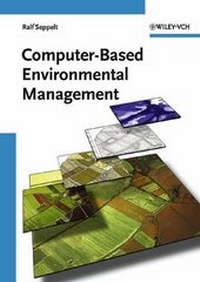
Computer-Based Environmental Management
1st Edition
Published on 27. June 2007
XXII, 278 pages
978-3-527-60921-5 (ISBN)
Description

Here, the author provides professionals in environmental research and management with the information they need with respect to computer modeling: An understanding of the mathematical fundamentals and the choice of the optimal approach and corresponding software for their particular task.
- Numerous illustrations, flowcharts and graphs, partly in color, as well as worked examples help in comprehending complex mathematical tasks and their solutions without the use of confusing mathematical formalism;
- Case studies from various fields of environmental research, such as landscape ecology, environmental assessment, population ecology, hydrology, and agroecology, facilitate the application of simulation models to the solution of real-world problems;
- Contains a detailed summary of currently available software tools and the application in spatially explicit simulation based on geographic information systems.
The worked examples and case studies cover a broad range of environmental systems and processes, adopting such modern mathematical methodology as partial differential equations, fuzzy logic, hybrid Petri nets, and optimum control theory. The result is a unique presentation of applications for high standard modeling and simulation methodologies in the interdisciplinary fields of environmental research.
From the Foreword by Robert Costanza (Gund Institute of Ecological Economics, Burlington, VT, USA): "As a teacher of environmental modeling, I've been searching for many years for the perfect text to use courses. My search has ended with the publication of Ralf Seppelt's book and I intend to use it as a core text in modeling courses."
- Numerous illustrations, flowcharts and graphs, partly in color, as well as worked examples help in comprehending complex mathematical tasks and their solutions without the use of confusing mathematical formalism;
- Case studies from various fields of environmental research, such as landscape ecology, environmental assessment, population ecology, hydrology, and agroecology, facilitate the application of simulation models to the solution of real-world problems;
- Contains a detailed summary of currently available software tools and the application in spatially explicit simulation based on geographic information systems.
The worked examples and case studies cover a broad range of environmental systems and processes, adopting such modern mathematical methodology as partial differential equations, fuzzy logic, hybrid Petri nets, and optimum control theory. The result is a unique presentation of applications for high standard modeling and simulation methodologies in the interdisciplinary fields of environmental research.
From the Foreword by Robert Costanza (Gund Institute of Ecological Economics, Burlington, VT, USA): "As a teacher of environmental modeling, I've been searching for many years for the perfect text to use courses. My search has ended with the publication of Ralf Seppelt's book and I intend to use it as a core text in modeling courses."
Reviews / Votes
"This book is a giant step forward in describing the development and use of environmental models..."Journal of Hazardous Materials
"This is a well-written and understandable book...The author is to be commended on his effort."
Energy Sources
"... the book is an important contribution to improved environmental modeling. The process-research-oriented readership can well derive opportunities for model-based experimental planning as well as to set up validation experiments for the assumptions underlying environmentally complex computer simulation models."
Journal of Plant Nutrition and Soil Science
"... the book is unique in its comprehensive integration of the theory and practice of environmental modeling and management."
Environmental Science and Pollution Research ESPR
"In summary, this book provides a straightforward yet comprehensive context linking insights and principles in environmental modeling with solid examples on how computer-based management can be practiced. It should benefit a wide range of landscape ecologists and modelers who, while varying in terms of their specialty and technical skill level, seek to enhance their understanding of environmental management based on computer modeling."
Landscape Ecology
More details
Other editions
Additional editions
R. Seppelt
Computer-Based Environmental Management
Software
06/2007
Wiley-VCH
€206.52
No shipping information available
Ralf Seppelt
Computer-Based Environmental Management
Book
10/2003
1st Edition
Wiley-VCH
€149.00
Article exhausted; check different version
Person
The major focus of Dr. Ralf Seppelt's research is the application of mathematical methodologies for solving environmental problems. He entered this interdisciplinary field upon obtaining a diploma in applied mathematics from the Technical University Clausthal, Germany, in 1994 and with his mater's thesis on socio-ecological models. He continued as a research associate at the Collaborative Research Center "Water and Matter Dynamics of Agroecosystems" in Brunswick, where he obtain his doctorate with distinction in science, agroecology, and system analysis in 1997. Over the last few years he has managed several research projects in cooperation with different research institutions as well as industry and with small companies. In 2000 Dr. Seppelt was visiting scientist at the Institute of Ecological Economics, Maryland, USA.
Ralf Seppelt has published more than 30 scientific articles and is a reviewer for several international journals. His successful research in the field of environmental science was made possible by his productive interdisciplinary teaching of undergraduate and graduate students. At the TU Brunswick, Dr.
Seppelt lectures in computer science, geographic information systems (GIS), theoretical ecological, and numerical environmental modeling.
Ralf Seppelt has published more than 30 scientific articles and is a reviewer for several international journals. His successful research in the field of environmental science was made possible by his productive interdisciplinary teaching of undergraduate and graduate students. At the TU Brunswick, Dr.
Seppelt lectures in computer science, geographic information systems (GIS), theoretical ecological, and numerical environmental modeling.
Content
Foreword
Acknowledgements
Introduction
PART I: SETTING THE SCENE: DIVERSITY OF ENVIRONMENTAL MODELING
From Conceptual Modeling to Computer Simulations
Environmental Models: Dynamic Processes
Environmental Models: Spatial Interactions
PART II: INTEGRATED MODELS
Multi-paradigm Modeling
Concepts: Hybrid Petri Nets
Case Studies: Hybrid Systems in Ecology
Applications: Environmental Impact Assessment
PART III: THE BIG PICTURE: ENVIRONMENTAL MANAGEMENT
Scenario Analysis and Optimization
Prerequisites: Temporal Hierarchies and Spatial Scales
Optimum Agroecosystem Management: Temporal Patterns
Optimum Agroecosystem Management: Spatial Patterns
Changing Landscapes: Optimum Landscape Patterns
Conclusions, Perspectives and Research Demands
References
Index
Supplementary Material on the Web
Acknowledgements
Introduction
PART I: SETTING THE SCENE: DIVERSITY OF ENVIRONMENTAL MODELING
From Conceptual Modeling to Computer Simulations
Environmental Models: Dynamic Processes
Environmental Models: Spatial Interactions
PART II: INTEGRATED MODELS
Multi-paradigm Modeling
Concepts: Hybrid Petri Nets
Case Studies: Hybrid Systems in Ecology
Applications: Environmental Impact Assessment
PART III: THE BIG PICTURE: ENVIRONMENTAL MANAGEMENT
Scenario Analysis and Optimization
Prerequisites: Temporal Hierarchies and Spatial Scales
Optimum Agroecosystem Management: Temporal Patterns
Optimum Agroecosystem Management: Spatial Patterns
Changing Landscapes: Optimum Landscape Patterns
Conclusions, Perspectives and Research Demands
References
Index
Supplementary Material on the Web
