

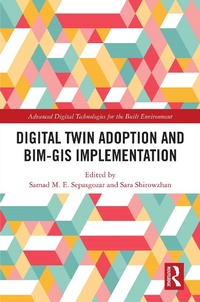
Digital Twin Adoption and BIM-GIS Implementation
1st Edition
Published on 9. August 2024
222 pages
978-1-040-11125-3 (ISBN)
Description

The aim of this edited book volume is to present new concepts, and applications of Digital Twin and relevant tools in the built environment context. The book identifies key organisational factors that influence the adoption of technology within the architectural service industry, setting the stage for a deeper understanding of the shift towards digital methodologies.
The book introduces the Digital Twin Readiness Level framework, a modified metric system with ten levels of risk-based maturity and an empirical development of a Digital Twin Adoption Model. Furthermore, the text ventures into immersive virtual environments and their applications, showcasing innovative practices that enhance learning and operational efficiency.
Additionally, the book examines the integration of Building Information Modelling (BIM) and Geographic Information Systems (GIS), revealing new workflows for creating 3D models of cities. A focus on Australia's government-funded infrastructure projects offers insights into the values and acceptance criteria for these technologies, providing a comprehensive overview of their practical implications and future potential. This book is essential reading for practitioners, engineers, and managers involved in any phase of the built environment from design to operation and other architectural, engineering, and construction (AEC) stakeholders who are a part of digital transformations, as well as researchers, educators, and students interested in the field.
The book introduces the Digital Twin Readiness Level framework, a modified metric system with ten levels of risk-based maturity and an empirical development of a Digital Twin Adoption Model. Furthermore, the text ventures into immersive virtual environments and their applications, showcasing innovative practices that enhance learning and operational efficiency.
Additionally, the book examines the integration of Building Information Modelling (BIM) and Geographic Information Systems (GIS), revealing new workflows for creating 3D models of cities. A focus on Australia's government-funded infrastructure projects offers insights into the values and acceptance criteria for these technologies, providing a comprehensive overview of their practical implications and future potential. This book is essential reading for practitioners, engineers, and managers involved in any phase of the built environment from design to operation and other architectural, engineering, and construction (AEC) stakeholders who are a part of digital transformations, as well as researchers, educators, and students interested in the field.
More details
Series
Edition
1. Auflage
Language
English
Place of publication
London
United Kingdom
Publishing group
Taylor & Francis Ltd
Target group
Professional and scholarly
Illustrations
2 Line drawings, black and white; 61 Halftones, color; 61 Illustrations, color; 2 Illustrations, black and white
ISBN-13
978-1-040-11125-3 (9781040111253)
Copyright in bibliographic data and cover images is held by Nielsen Book Services Limited or by the publishers or by their respective licensors: all rights reserved.
Schweitzer Classification
Other editions
Additional editions
Samad Sepasgozar | Sara Shirowzhan
Digital Twin Adoption and BIM-GIS Implementation
Book
approx. 12/2025
1st Edition
Routledge
€78.10
Not yet published
Samad Sepasgozar | Sara Shirowzhan
Digital Twin Adoption and BIM-GIS Implementation
Book
08/2024
1st Edition
Routledge
€211.20
Shipment within 10-20 days

Book
08/2024
Taylor & Francis
Unfortunately, price unknown
Article exhausted; check different version
Persons
Samad M. E. Sepasgozar is a top 2% researcher in the world computed by the Standard University and the first top researcher (field leader in Architecture) in Australia found by The Australian. He is an academic editor (editorial board member) at Scientific Reports Nature and Associate Editor of Architectural Engineering ASCE (Decile 1). He is also a top 1% reviewer globally, an editor, editorial board member, or reviewer for 60 leading high-ranked journals, and a lead assessor for national research projects on innovation and smart technologies. He published over 200 peer-reviewed articles and received various international and national awards annually. He is an Associate Professor at the University of New South Wales (top 19 globally), Sydney, Australia.
Sara Shirowzhan is a Senior Lecturer and the Co-convenor of smart cities and infrastructure cluster in the School of Built Environment at the University of New South Wales (UNSW), Sydney, Australia. Her areas of research in technologies relevant to built-environment informatics include sensing technologies, advanced GIS, BIM, Digital Twins, and Artificial Intelligence. She teaches and supervises students on Construction Informatics, City Analytics, GIS, and BIM-relevant topics at undergrad and postgrad levels. She is currently an Editorial Board member of the Journal of Sustainability and Advances in Civil Engineering. She is also a Topic Board member of the ISPRS International Journal of Geo-Information. She completed her PhD in Geomatics Engineering from the School of Civil and Environmental Engineering at UNSW.
Sara Shirowzhan is a Senior Lecturer and the Co-convenor of smart cities and infrastructure cluster in the School of Built Environment at the University of New South Wales (UNSW), Sydney, Australia. Her areas of research in technologies relevant to built-environment informatics include sensing technologies, advanced GIS, BIM, Digital Twins, and Artificial Intelligence. She teaches and supervises students on Construction Informatics, City Analytics, GIS, and BIM-relevant topics at undergrad and postgrad levels. She is currently an Editorial Board member of the Journal of Sustainability and Advances in Civil Engineering. She is also a Topic Board member of the ISPRS International Journal of Geo-Information. She completed her PhD in Geomatics Engineering from the School of Civil and Environmental Engineering at UNSW.
Content
Chapter 1: Introduction
Chapter 2: Organisational factors affecting digital technology adoption in the architecture industry: a systematic literature review
Chapter 3: Digital twin maturity and readiness metrics for assessing practitioners' intention to use: model development and multi-group structural analysis
Chapter 4: Digital twin adoption modelling incorporating job relevance, usefulness, and relative advantage: an empirical investigation
Chapter 5: Immersive virtual environments and digital twin applications for education and training: trends in construction, mining and urban planning studies
Chapter 6: Digital twin for urban decision support systems: scientometric and thematic analysis
Chapter 7: Web-based BIM-GIS integration workflows for making cities' digital twin 3D models
Chapter 8: BIM and GIS values and acceptance criteria in government-funded infrastructure projects: a case study of Australia
Chapter 2: Organisational factors affecting digital technology adoption in the architecture industry: a systematic literature review
Chapter 3: Digital twin maturity and readiness metrics for assessing practitioners' intention to use: model development and multi-group structural analysis
Chapter 4: Digital twin adoption modelling incorporating job relevance, usefulness, and relative advantage: an empirical investigation
Chapter 5: Immersive virtual environments and digital twin applications for education and training: trends in construction, mining and urban planning studies
Chapter 6: Digital twin for urban decision support systems: scientometric and thematic analysis
Chapter 7: Web-based BIM-GIS integration workflows for making cities' digital twin 3D models
Chapter 8: BIM and GIS values and acceptance criteria in government-funded infrastructure projects: a case study of Australia
