

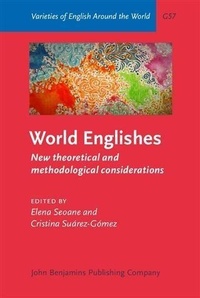
World Englishes
New theoretical and methodological considerations
1st Edition
Published on 25. May 2016
293 pages
978-90-272-6706-1 (ISBN)
Description

This book provides a collection of articles that reflect the current state of affairs in the blossoming field of World Englishes by bringing together several innovative synchronic and diachronic approaches. It contributes to the ongoing theoretical discussion concerning the criteria that make a low-frequency item represent an incipient change and examines the suitability of the sociolinguistics of globalisation theory for the study of non-traditional avenues for the spread of vernacular varieties of English (recent migrations, the entertainment industry, the web). It explores crucial aspects of language change and dialect evolution through the study of grammatical phenomena and the particular linguistic and socio-historical factors conditioning them. Together with theoretical questions, the volume shows a concern for methodological issues, such as sociolinguistic interviews, map-task experiments, metalinguistic comments, acceptability judgments and corpus-based methods. This volume represents the latest trends in the field and will undoubtedly set the agenda for the years ahead.
More details
Other editions
Additional editions
Elena Seoane | Cristina Suarez-Gomez
World Englishes
New theoretical and methodological considerations
Book
05/2016
John Benjamins Publishing Co
€119.20
Shipment within 10-15 days
Content
- Intro
- World Englishes
- Editorial page
- Title page
- LCC data
- Table of contents
- Acknowledgments
- World Englishes today
- 1. Introduction
- 2. Key publications, resources and models for the study of World Englishes
- 3. This volume
- References
- Beyond and between the "Three Circles": World Englishes research in the age of globalisation
- 1. Introduction: English - one of the world's 7,000 languages, and yet a language like no other?
- 2. Defining the place of English linguistics in the wider field of English Language Studies
- 3. Augmentation
- 4. Conclusion
- References
- Error, feature, (incipient) change - or something else altogether?
- 1. Introduction: The corpus linguist's 'lucky dip'
- 2. Metalinguistic comments and native speaker intuitions
- 2.1 Metalinguistic comments
- 2.2 Native speaker judgement survey
- 3. Corpus data
- 3.1 New Englishes
- 3.2 British and American English
- 3.3 Historical evidence
- 3.4 Dialects
- 3.5 Child language use
- 4. Discussion
- 4.1 Grammatical variation vs. spelling variation
- 4.2 be-been as a variant of the perfect: Error, feature, (incipient) change or something else?
- 5. Concluding remarks and outlook
- Acknowledgements
- Sources
- References
- "He don't like football, does he?" A corpus-based study of third person singular don'
- 1. Introduction
- 2. Don't versus doesn't: Origin and presence in different varieties of English
- 3. Methodology
- 4. Results
- 4.1 General frequency of don't versus doesn't in adults and teenagers
- 4.2 Tags versus non-tags in the language of adults and teenagers
- 4.3 Grammatical factors that condition the third person singular form don't
- 4.4 Sociolinguistic factors
- 5. Summary and conclusions
- Sources
- References
- Standards of English in the Caribbean: History, attitudes, functions, features
- 1. Introduction
- 2. History
- 3. Attitudes and functions
- 3.1 Attitudes: From 'bad' and 'proper' English to endonormative standards
- 3.2 Functions: Language use in the media and in education
- 4. Features
- 4.1 Written English in the Caribbean: Newspaper studies
- 4.2 Spoken English in the Caribbean: The English-creole continuum revisited
- 5. Conclusion
- References
- Overlap and divergence - aspects of the present perfect in World Englishes
- 1. Introduction
- 2. Data and methodology
- 3. A global perspective
- 4. From the center
- 5. to the margins
- 6. The present perfect and models of World Englishes
- 7. Conclusion
- References
- Appendix
- (Semi-)modals of necessity in Hong Kong and Indian Englishes
- 1. Introduction
- 1.1 The decline of English modal verbs
- 1.2 Modals and semi-modals in World Englishes
- 1.3 Aim and structure
- 2. Semi-modals of necessity in the three varieties
- 3. Semantic analysis of the (semi-)modals in BrE, HKE and IndE
- 3.1 Must: Semantic analysis
- 3.2 Have to, have got to and got to: Semantic analysis
- 3.3 Need (to): semantic analysis
- 3.4 Want to: Semantic analysis
- 4. Morphosyntactic analysis of the (semi-)modals in the BrE, HKE and IndE
- 4.1 Subject
- 4.2 Type of sentential complement
- 5. Discussion and conclusions
- References
- Indian English quotatives in a real-time perspective
- 1. Introduction
- 1.1 What is quotation?
- 1.2 The history of quotatives in native English
- 1.3 Quotative marking as a system
- 2. Data and method
- 3. Distributional analysis
- 4. Multivariate analyses
- 5. Discussion of findings
- 6. Conclusions and outlook
- References
- English in San Francisco Chinatown: Indexing identity with speech rhythm?
- 1. Introduction
- 2. Ethnicity, identity and linguistic variation
- 3. Linguistic background
- 4. Data and methodology
- 5. Results
- 5.1 Ethnic identity scores
- 5.2 Speech rhythm
- 6. Discussion
- 7. Conclusion
- References
- On the globalization of English: Observations of subjective progressives in present-day Englishes
- 1. Introduction
- 2. Background
- 2.1 Recent changes in the progressive structure
- 2.2 Focusing on the always-type progressive
- 3. Materials and methods
- 4. Results
- 4.1 Quantitative observations
- 4.2 Combining quantitative and qualitative observations
- 5. Conclusion
- Sources
- References
- World Englishes on YouTube: Treasure trove or nightmare?
- 1. Introduction: World Englishes and YouTube
- 2. YouTube: General characteristics and statistics
- 3. Linguistics and language varieties on YouTube
- 4. World Englishes on YouTube
- 4.1 A basic typology
- 4.2 Sub-types
- 5. Tracing and analyzing World Englishes on YouTube: Methodological issues
- 6. Conclusion: What for?
- References
- Index
