

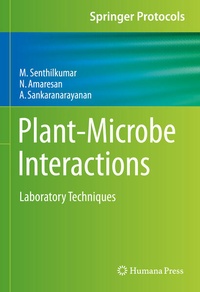
Plant-Microbe Interactions
Description

This manual details the techniques involved in the study of plant microbe interactions (PMI). Covering a wide range of basic and advanced techniques associated with research on biological nitrogen fixation, microbe-mediated plant nutrient use efficiency, the biological control of plant diseases and pests such as nematodes, it will appeal to postgraduate students, research scholars and postdoctoral fellows, as well as teachers from various fields, including pathology, entomology and agronomy.
It consists of five broad sections featuring different units. Information panels at the beginning of each unit present essential knowledge as well as advances in a particular topic. The manual can also serve as a textbook for undergraduate courses like Techniques for Plant-Microbe Interactions; Biological Control of Plant Diseases; and Nutrient Use Efficiency. Providing basic insights and working protocols from all related disciplines, this unique laboratory manual is a valuable resource for researchers interested in investigating PMI.
More details
Other editions
Additional editions
Persons
Dr. M. Senthil Kumar is currently a Principal Scientist (Microbiology) at ICAR-Indian Institute of Pulses Research, Kanpur. He is a postgraduate of Agricultural Microbiology and holds a Ph.D. (Microbiology) from the Indian Agricultural Research Institute, New Delhi. He received postdoctoral fellowship from the Korean Atomic Energy Research Institute, South Korea. He has fifteen years of research experience in various areas of plant-microbe interactions, including biological control of soybean diseases and microbial mediated abiotic stress management in pulses.
Dr. N. Amaresan is an Assistant Professor at C.G. Bhakta Institute of Biotechnology, UkaTarsadia University, Gujarat. He holds undergraduate, postgraduate and doctorate degrees in Microbiology. Dr. N. Amaresan has over fourteen years of experience in teaching & research in various allied fields of microbiology, including microbial ecology and plant-microbe interactions. He has been awarded young scientist awards by the Association of Microbiologists of India, National Academy of Biological Sciences and is the recipient of a visiting scientist fellowship from the National Academy of India.
Dr. Sankaranarayanan is associated with C.G. Bhakta Institute of Biotechnology, Uka Tarsadia University, Bardoli, Surat of Gujarat state, India from 2015 onwards. His current research focus is on antibacterial potential of herbal products against multi drug resistant microbial pathogens, bacterial diversity in fermented batter, microbial spoilage of fermented food and impact of irradiation on fermented food. He has received the Indian Academy of Sciences sponsored summer research fellowship for young teacher's category for three years consecutively.
Content
Chapter 1. Techniques for studying biological nitrogen fixation.- Chapter 2. Techniques for studying mineral solubilization and mobilization.- Chapter 3. Techniques for studying abiotic stress management.- Chapter 4. Techniques for studying biological control of plant pathogens.- Chapter 5. Techniques for studying biological control of insects and nematodes.
