

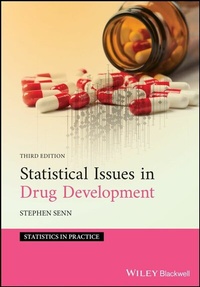
Statistical Issues in Drug Development
Description

The revised third edition of Statistical Issues in Drug Development delivers an insightful treatment of the intersection between statistics and the life sciences. The book offers readers new discussions of crucial topics, including cluster randomization, historical controls, responder analysis, studies in children, post-hoc tests, estimands, publication bias, the replication crisis, and many more.
This work presents the major statistical issues in drug development in a way that is accessible and comprehensible to life scientists working in the field, and takes pains not to gloss over significant disagreements in the field of statistics, while encouraging communication between the statistical and life sciences disciplines. In addition to new material on topics like invalid inversion, severity, random effects in network meta-analysis, and explained variation, readers will benefit from the inclusion of:
* A thorough introduction to basic topics in drug development and statistics, including the role played by statistics in drug development
* An exploration of the four views of statistics in drug development, including the historical, methodological, technical, and professional
* An examination of debatable and controversial topics in drug development, including the allocation of treatments to patients in clinical trials, baselines and covariate information, and the measurement of treatment effects
Perfect for life scientists and other professionals working in the field of drug development, Statistical Issues in Drug Development is the ideal resource for anyone seeking a one-stop reference to enhance their understanding of the use of statistics during drug development.
More details
Other editions
Additional editions
Person
Professor Stephen Senn (MSc, PhD, CStat) is a statistical consultant, researcher and blogger. He has extensive experience in both academia and industry, and is recognized worldwide for his studies in statistical methodology applied to drug development.
Professor Senn has been the recipient of national and international awards, including the 1st George C Challis award for Biostatistics at the University of Florida, and the Bradford Hill Medal of the Royal Statistical Society. He is a Fellow of the Royal Society of Edinburgh and an honorary life member of Statisticians in the Pharmaceutical Industry (PSI) and the International Society for Clinical Biostatistics (ISCB) and has honorary professorships in statistics at The University of Sheffield and the University of Edinburgh.
Content
Preface to the Third Edition
Preface to the Second Edition xiii
Preface to the First Edition xvii
Acknowledgements xxi
1 Introduction 1
1.1 Drug development 1
1.2 The role of statistics in drug development 2
1.3 The object of this book 3
1.4 The author's knowledge of statistics in drug development 4
1.5 The reader and his or her knowledge of statistics 4
1.6 How to use the book 5
References 6
Part 1 Four Views of Statistics in Drug Development: Historical, Methodological, Technical and Professional 9
2 A Brief and Superficial History of Statistics for Drug Developers 11
2.1 Introduction 11
2.2 Early Probabilists 12
2.3 James Bernoulli (1654-1705) 13
2.4 John Arbuthnott (1667-1753) 14
2.5 The mathematics of probability in the late 17th, the 18th and early 19th centuries 14
2.6 Thomas Bayes (1701-1761) 15
2.7 Adolphe Quetelet (1796-1874) 16
2.8 George Biddell Airy (1801-1892)
2.9 Francis Galton (1822-1911) 16
2.10 Karl Pearson (1857-1936) 17
2.11 'Student' (1876-1937) 17
2.12 R.A. Fisher (1890-1962) 17
2.13 Modern mathematical statistics 18
2.14 Medical statistics 19
2.15 Statistics in clinical trials today 20
2.16 The current debate 21
2.17 A living science 21
2.18 Further reading 23
References 23
3 Design and Interpretation of Clinical Trials as Seen by a Statistician 27
3.1 Prefatory warning 27
3.2 Introduction 27
3.3 Defining effects 28
3.4 Practical problems in using the counterfactual argument 28
3.5 Regression to the mean 29
3.6 Control in clinical trials 33
3.7 Randomization 34
3.8 Blinding 36
3.9 Using concomitant observations 37
3.10 Measuring treatment effects 38
3.11 Data generation models 39
3.12 In conclusion 41
3.13 Further reading 41
References 41
4 Probability, Bayes, P-values, Tests of Hypotheses and Confidence Intervals 43
4.1 Introduction 43
4.2 An example 44
4.3 Odds and sods 44
4.4 The Bayesian solution to the example 45
4.5 Why don't we regularly use the Bayesian approach in clinical trials? 46
4.6 A frequentist approach 47
4.7 Hypothesis testing in controlled clinical trials 48
4.8 Significance tests and P-values 49
4.9 Confidence intervals and limits and credible intervals 50
4.10 Some Bayesian criticism of the frequentist approach 51
4.11 Decision theory 51
4.12 Conclusion 52
4.13 Further reading 52
References 53
5 The Work of the Pharmaceutical Statistician 55
5.1 Prefatory remarks 55
5.2 Introduction 56
5.3 In the beginning 57
5.4 The trial protocol 57
5.5 The statistician's role in planning the protocol 58
5.6 Sample size determination 59
5.7 Other important design issues 60
5.8 Randomization 60
5.9 Data collection preview 61
5.10 Performing the trial 61
5.11 Data analysis preview 61
5.12 Analysis and reporting 62
5.13 Other activities 63
5.14 Statistical research 63
5.15 Further reading 64
References 65
Part 2 Statistical Issues: Debatable and Controversial Topics in Drug Development 67
6 Allocating Treatments to Patients in Clinical Trials 69
6.1 Background 69
6.2 Issues 71
References 87
6.A Technical appendix 88
7 Baselines and Covariate Information 95
7.1 Background 95
7.2 Issues 98
References 108
7.A Technical appendix 109
8 The Measurement of Treatment Effects 113
8.1 Background 113
8.2 Issues 114
References 129
8.A Technical appendix 130
9 Demographic Subgroups: Representation and Analysis 133
9.1 Background 133
9.2 Issues 134
References 144
9.A Technical appendix 145
10 Multiplicity 149
10.1 Background 149
10.2 Issues 150
References 161
10.A Technical appendix 162
11 Intention to Treat, Missing Data and Related Matters 165
11.1 Background 165
11.2 Issues 167
References 178
11.A Technical appendix 180
12 One-sided and Two-sided Tests and other Issues to Do with Significance and P-values 183
12.1 Background 183
12.2 Issues 184
References 192
13 Determining the Sample Size 195
13.1 Background 195
13.2 Issues 198
References 211
14 Multicentre Trials 213
14.1 Background 213
14.2 Issues 213
References 230
14.A Technical appendix 231
15 Active Control Equivalence Studies 235
15.1 Background 235
15.2 Issues 237
References 247
15.A Technical appendix 249
16 Meta-Analysis 251
16.1 Background 251
16.2 Issues 253
References 268
16.A Technical appendix 270
17 Cross-over Trials 273
17.1 Background 273
17.2 Issues 275
References 284
18 n-of-1 Trials 287
18.1 Background 287
18.2 Issues 289
References 293
19 Sequential Trials 295
19.1 Background 295
19.2 Issues 302
References 313
20 Dose-finding 317
20.1 Background 317
20.2 Issues 319
References 334
21 Concerning Pharmacokinetics and Pharmacodynamics 337
21.1 Background 337
21.2 Issues 343
References 358
22 Bioequivalence Studies 361
22.1 Background 361
22.2 Issues 362
References 379
23 Safety Data, Harms, Drug Monitoring and Pharmaco-epidemiology 383
23.1 Background 383
23.2 Issues 388
References 403
24 Pharmaco-economics and Portfolio Management 405
24.1 Background 405
24.2 Issues 407
References 429
25 Concerning Pharmacogenetics, Pharmacogenomics and Related Matters 433
25.1 Background 433
25.2 Issues 437
References 450
25.A Technical appendix 451
Glossary 453
Index 483
1
Introduction
Ye maun understand I found my remarks on figures, whilk . is the only true demonstrable root of human knowledge.
Sir Walter Scott, Rob Roy
Statisticians know that words are important to statistics, yet surely their importance is not fully recognized.
William Kruskal
Opinions are made to be changed - or how is truth to be got at? We don't arrive at it by standing on one leg.
Lord Byron, letter to Murray
1.1 DRUG DEVELOPMENT
Drug development is the process not only of finding and producing therapeutically useful pharmaceuticals and turning them into high-quality formulations of usable, effective and safe medicines, but also of delivering valuable, reliable, and trustworthy information about appropriate doses and dosing intervals and about likely effects and side-effects of these treatments. Drug development is a process carried out by sponsors (mainly pharmaceutical companies) and its acceptability is ultimately judged by regulators. It is an extremely complex business and the risks are high, but the potential rewards are also considerable.
It takes many years for a project to reach development. First, basic research must be undertaken to validate concepts and mechanisms. Assessments of commercial potential for diseases and therapies are also needed and these will continue throughout the life of a project. Next, a lead compound must be identified for a particular indication. This will then be subjected to a battery of screening tests to assess its potential in terms of therapeutic activity. Back-up compounds will also be investigated. If a compound looks promising, it will also be evaluated from both safety and practical points of view. Will it be easy to formulate? How many steps are involved in the synthesis? How difficult will it be to manufacture in large-scale quantities? Before a treatment can go into development, not only must satisfactory answers have been obtained to all these questions but a viable pharmaceutical formulation permitting further study must be available. This can be an extremely delicate matter, involving work to develop suitable solutions, pills, patches or aerosols, as the case may be.
If and when a molecule is accepted into development, animal studies will be undertaken in order to check safety and to establish a dose at which studies in humans may be undertaken. Once basic toxicological work has been undertaken, 'phase I' may begin and the first such studies may start. These will be single-dose studies in which lower doses are tried first and cautiously increased until a maximum tolerated dose may be established. In many indications such studies are carried out on healthy volunteers, but where the treatment is highly aggressive (and hence intended for serious diseases) patients will be used instead. In the meantime, longer-scale toxicological studies with animals will have been completed. Pharmacokinetic studies in humans will be undertaken in which the concentration-time profile of the drug in blood will be measured at frequent intervals in order to establish the rate at which the drug is absorbed and eliminated. These studies together, if successful, will permit multiple-dose studies to be undertaken.
Once maximum tolerated doses have been established, phase II begins and dose finding studies in patients are started. This is usually an extremely difficult phase of development but, if the drug proves acceptable, the object is that preliminary indications of efficacy should be available and that a firm recommendation for doses and dose schedules should emerge. Once these studies have been completed, the pivotal phase III studies can begin. These have the object of proving efficacy to a sceptical regulator and also of obtaining information on the safety and tolerability of the treatment.
A successfully completed development programme results in a dossier - an enormous collection of clinical trial and other reports, as well as expert summaries covering not only the clinical studies as regards efficacy and safety but also pre-clinical studies and other technical reports as well as details of the manufacturing process. If successful, the package leads to registration, but even during the review process, phase IV studies may have been initiated in order to discover more about the effect of the treatment in specialist subpopulations, or perhaps with the object of providing data to cover price negotiations with reimbursers.
Regulatory dossier: A mountain of documents which takes a forest of trees to obscure the wood.
Once a drug has been launched on the market, the process of monitoring and 'pharmacovigilance' begins in earnest, since the drug will now be used by far more persons than was ever the case in the clinical trials in phases I to III, and rare side-effects, which could not be detected earlier, may now appear. Some further phase IV postmarketing studies may be initiated and further work extending indications or preparing new formulations may be undertaken.
1.2 THE ROLE OF STATISTICS IN DRUG DEVELOPMENT
There is no aspect of drug development in which statistics cannot intrude: from screening chemicals for activity to forecasting sales. Because the efficacy and safety of treatments has to be judged against a background of considerable biological variability, all of the judgements of efficacy boil down in the end to a numerical summary of evidence whose message can only be understood with the help of the science of statistics. It is the norm that clinical trials are planned jointly by a statistician and a physician. Statisticians have also slowly been becoming more active in the shaping of projects as a whole. Furthermore, whereas in the past in Europe, the expert reports for a dossier would largely be a subjective qualitative assessment of evidence from individual trials, regulators increasingly expect to see quantitative summaries, so called meta-analyses. Hence statistics has increased its empire throughout the drug development process during the time since the first edition of this book.
Other quantitatively minded disciplines have also made important contributions. There is no question in my mind that statistics had benefitted and would benefit more if more attention was paid to impressive work in pharmacometric modelling, in particular the so-called 'population approach', due to Lewis Sheiner (1940-2004) and various colleagues. This work, using as it did, nonlinear mixed effects models as long ago as the 1970s, was ahead of its time. See (Senn, S.J. 2010) for an appreciation. Recently, there has been much interest in 'big data' and 'analytics' and many pharmaceutical companies have set up departments with or without statisticians involved to cover this new field. This represents both a threat and an opportunity to statisticians. The threat is that statistical lessons will be ignored. The opportunity is to learn from and contribute to the work of others with different perspectives. As an example of the value that statisticians can bring to this field, I would cite particularly the work led by various statisticians at Novartis on using historical data (Schmidli, H. et al. 2014). Since all data that do not use concurrent control are historical, this has profound implications for many analyses.
Decades before the first edition of this book (1997), the Food and Drugs Administration (FDA) in the United States was employing statisticians to assist in its review process, and by the second edition (2007) various national European regulatory agencies had followed suit, although the European Medicines Agency (EMA) had not done so. Well before the third edition, however, the EMA had caught up and, indeed, Olivier Collignon, a member of my group in Luxembourg, the Competence Centre for Methodology and Statistics of the Luxembourg Institute of Health, which I joined in 2011, was seconded to the EMA for four years (2014-2018) to join what was by then an active group of statisticians. The involvement of statisticians in drug regulation in Europe is a very welcome change.
Statistical issues have long been covered by FDA general guidelines and starting in the 1990s separate specific statistical guidelines produced (with the help of European national statisticians) by the Committee for Proprietary Medicinal Products (CPMP) in Europe started to appear, and also by the Japanese Ministry of Health and Welfare. The International Conference on Harmonisation (ICH) was set up to produce general guidelines that would be valid in all three of these regions and these were in turn influential on other countries, outside the regions concerned, that were developing guidelines of their own. There are also many national and international societies specifically for statisticians in the pharmaceutical industry. The exact duties of the statistician working in drug development are covered in some detail in Chapter 5.
1.3 THE OBJECT OF THIS BOOK
As implied by our chapter quotations, this book is about figures, words, and opinions; more precisely, it is an attempt to give a largely verbal account of the various opinions that are held by those who figure. The purpose is not to present an authoritative prescription as to how to deal with each particular application of statistics in...
