

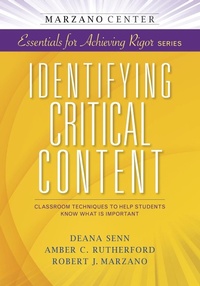
Identifying Critical Content: Classroom Techniques to Help Students Know What is Important
Description

Identifying Critical Content: Classroom Techniques to Help Students Know What is Important explores explicit techniques for mastering a crucial strategy of instructional practice: teaching students the skill of identifying critical content. It includes: . Explicit steps for implementation . Recommendations for monitoring if students are able to identify critical content . Adaptations for students who struggle, have special needs, or excel in learning . Examples and nonexamples from classroom practice . Common mistakes and ways to avoid them
The Essentials for Achieving Rigor series of instructional guides helps educators become highly skilled at implementing, monitoring, and adapting instruction. Put it to practical use immediately, adopting day-to-day examples as models for application in your own classroom.
More details
Content
- Cover
- IDENTIFYING CRITICAL CONTENT
- Title
- Copyright
- Dedication
- Table of Contents
- Acknowledgments
- About the Authors
- Introduction
- Identifying Critical Content
- Instructional Technique 1 Verbally Cue Critical Content
- Instructional Technique 2 Use Explicit Instruction to Convey Critical Content
- Instructional Technique 3 Use Dramatic Instruction to Convey Critical Content
- Instructional Technique 4 Provide Advance Organizers to Cue Critical Content
- Instructional Technique 5 Visually Cue Critical Content
- Instructional Technique 6 Use Storytelling to Cue Critical Content
- Instructional Technique 7 Use What Students Already Know to Cue Critical Content
- Conclusion
- References
- Index
