

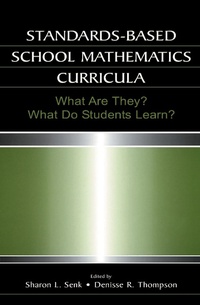
Standards-based School Mathematics Curricula
What Are They? What Do Students Learn?
1st Edition
Published on 24. July 2020
536 pages
978-1-000-10615-2 (ISBN)
Description

The Curriculum and Evaluation Standards for School Mathematics published by the National Council of Teachers of Mathematics in 1989 set forth a broad vision of mathematical content and pedagogy for grades K-12 in the United States. These Standards prompted the development of Standards-based mathematics curricula. What features characterize Standards-based curricula? How well do such curricula work?
To answer these questions, the editors invited researchers who had investigated the implementation of 12 different Standards-based mathematics curricula to describe the effects of these curricula on students' learning and achievement, and to provide evidence for any claims they made. In particular, authors were asked to identify content on which performance of students using Standards-based materials differed from that of students using more traditional materials, and content on which performance of these two groups of students was virtually identical. Additionally, four scholars not involved with the development of any of the materials were invited to write critical commentaries on the work reported in the other chapters.
Section I of Standards-Based School Mathematics Curricula provides a historical background to place the current curriculum reform efforts in perspective, a summary of recent recommendations to reform school mathematics, and a discussion of issues that arise when conducting research on student outcomes. Sections II, III, and IV are devoted to research on mathematics curriculum projects for elementary, middle, and high schools, respectively. The final section is a commentary by Jeremy Kilpatrick, Regents Professor of Mathematics Education at the University of Georgia, on the research reported in this book. It provides a historical perspective on the use of research to guide mathematics curriculum reform in schools, and makes additional recommendations for further research. In addition to the references provided at the end of each chapter, other references about the Standards-based curriculum projects are provided at the end of the book.
This volume is a valuable resource for all participants in discussions about school mathematics curricula--including professors and graduate students interested in mathematics education, curriculum development, program evaluation, or the history of education; educational policy makers; teachers; parents; principals and other school administrators. The editors hope that the large body of empirical evidence and the thoughtful discussion of educational values found in this book will enable readers to engage in informed civil discourse about the goals and methods of school mathematics curricula and related research.
To answer these questions, the editors invited researchers who had investigated the implementation of 12 different Standards-based mathematics curricula to describe the effects of these curricula on students' learning and achievement, and to provide evidence for any claims they made. In particular, authors were asked to identify content on which performance of students using Standards-based materials differed from that of students using more traditional materials, and content on which performance of these two groups of students was virtually identical. Additionally, four scholars not involved with the development of any of the materials were invited to write critical commentaries on the work reported in the other chapters.
Section I of Standards-Based School Mathematics Curricula provides a historical background to place the current curriculum reform efforts in perspective, a summary of recent recommendations to reform school mathematics, and a discussion of issues that arise when conducting research on student outcomes. Sections II, III, and IV are devoted to research on mathematics curriculum projects for elementary, middle, and high schools, respectively. The final section is a commentary by Jeremy Kilpatrick, Regents Professor of Mathematics Education at the University of Georgia, on the research reported in this book. It provides a historical perspective on the use of research to guide mathematics curriculum reform in schools, and makes additional recommendations for further research. In addition to the references provided at the end of each chapter, other references about the Standards-based curriculum projects are provided at the end of the book.
This volume is a valuable resource for all participants in discussions about school mathematics curricula--including professors and graduate students interested in mathematics education, curriculum development, program evaluation, or the history of education; educational policy makers; teachers; parents; principals and other school administrators. The editors hope that the large body of empirical evidence and the thoughtful discussion of educational values found in this book will enable readers to engage in informed civil discourse about the goals and methods of school mathematics curricula and related research.
More details
Series
Edition
1. Auflage
Language
English
Place of publication
London
United Kingdom
Publishing group
Taylor & Francis Ltd
Target group
College/higher education
ISBN-13
978-1-000-10615-2 (9781000106152)
Copyright in bibliographic data and cover images is held by Nielsen Book Services Limited or by the publishers or by their respective licensors: all rights reserved.
Schweitzer Classification
Other editions
Additional editions
Sharon L. Senk | Denisse R. Thompson
Standards-based School Mathematics Curricula
What Are They? What Do Students Learn?
Book
09/2003
Routledge
€136.00
Shipment within 10-20 days
Sharon L. Senk | Denisse R. Thompson
Standards-based School Mathematics Curricula
What Are They? What Do Students Learn?
Book
09/2002
Routledge
€232.90
Shipment within 10-20 days
Persons
Sharon L. Senk and Denisse R. Thompson
Content
Contents: Preface. Part I: Introduction.S.L. Senk, D.R. Thompson, School Mathematics Curricula: Recommendations and Issues. Part II: Elementary Grades Curriculum Projects.D.R. Thompson, S.L. Senk, Elementary School Mathematics Curriculum Reform. A. Carter, J.S. Beissinger, A. Cirulis, M. Gartzman, C.R. Kelso, P. Wagreich, Student Learning and Achievement With Math Trailblazers.W.M. Carroll, A. Isaacs, Achievement of Students Using the University of Chicago School Mathematics Project's Everyday Mathematics.J. Mokros, Learning to Reason Numerically: The Impact of Investigations.V. Battistich, S. Alldredge, I. Tsuchida,Number Power: An Elementary School Program to Enhance Students' Mathematical and Social Development. R.T. Putnam, Commentary on Four Elementary Mathematics Curricula. Part III: Middle Grades Curriculum Projects.S.L. Senk, D.R. Thompson, Middle School Mathematics Curriculum Reform. J.E. Ridgway, J.S. Zawojewski, M.N. Hoover, D.V. Lambdin, Student Attainment in the Connected Mathematics Curriculum. T.A. Romberg, M.C. Shafer,Mathematics in Context (MiC)-- Preliminary Evidence About Student Outcomes. R. Billstein, J. Williamson,Middle Grades MATH Thematics: The STEM Project.M.F. Chappell, Keeping Mathematics Front and Center: Reaction to Middle-Grades Curriculum Projects Research. Part IV: High School Curriculum Projects.D.R. Thompson, S.L. Senk, High School Mathematics Curriculum Reform. H.L. Schoen, C.R. Hirsch, The Core-Plus Mathematics Project: Perspectives and Student Achievement. D. Cichon, J.G. Ellis, The Effects of MATH Connections on Student Achievement, Confidence, and Perception. N.L. Webb, The Impact of the Interactive Mathematics Program on Student Learning. J.W. Lott, J. Hirstein, G. Allinger, S. Walen, M. Burke, M. Lundin, T.A. Souhrada, D. Preble, Curriculum and Assessment in SIMMS Integrated Mathematics.S.L. Senk, Effects of the UCSMP Secondary School Curriculum on Students' Achievement. J. Swafford, Reaction to High School Curriculum Projects Research. Part V: Final Commentary.J. Kilpatrick, What Works?
