

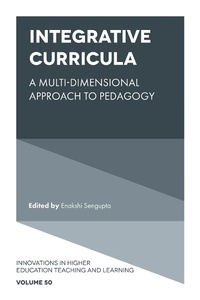
Integrative Curricula
A Multi-Dimensional Approach to Pedagogy
Published on 26. July 2023
200 pages
978-1-80071-462-5 (ISBN)
Description

Creativity, critical thinking and community-oriented learning have taken on new dimension and relevance in education. As a result, many academicians feel that current curricula need to be re-designed with the challenges of today's global landscape in mind. Integrated curricula rely heavily on interdisciplinary approaches that encourage student engagement, self-awareness and experiential learning. Providing practical advice based on empirical examples, Integrative Curricula: A Multi-Dimensional Approach to Pedagogy explores the phenomenon of integrative curricula and its relevant issues.
Emphasizing a need for flexibility and, above all, a student-centered focus, chapters discuss different theoretical frameworks and models utilized, benefits gained and challenges encountered in the process of curricula integration. They include case studies, policies and other methods that have been implemented and adopted in universities to enhance their teaching practices. Contributors also address issues such as integrating interdisciplinary curricula and building relationships across traditional subjects and learning experiences.
As integrative curricula provide a framework through which a standard, meaningful benchmark can be applied to student learning, so will Integrative Curricula: A Multi-Dimensional Approach to Pedagogy act as a fundamental resource to facilitate, advise and support higher education institutions in putting forward practices that are most effective for teaching and, ultimately, the benefit of student development.
Emphasizing a need for flexibility and, above all, a student-centered focus, chapters discuss different theoretical frameworks and models utilized, benefits gained and challenges encountered in the process of curricula integration. They include case studies, policies and other methods that have been implemented and adopted in universities to enhance their teaching practices. Contributors also address issues such as integrating interdisciplinary curricula and building relationships across traditional subjects and learning experiences.
As integrative curricula provide a framework through which a standard, meaningful benchmark can be applied to student learning, so will Integrative Curricula: A Multi-Dimensional Approach to Pedagogy act as a fundamental resource to facilitate, advise and support higher education institutions in putting forward practices that are most effective for teaching and, ultimately, the benefit of student development.
More details
Series
Language
English
Place of publication
Bingley
United Kingdom
Target group
Professional and scholarly
File size
7,18 MB
ISBN-13
978-1-80071-462-5 (9781800714625)
Copyright in bibliographic data and cover images is held by Nielsen Book Services Limited or by the publishers or by their respective licensors: all rights reserved.
Schweitzer Classification
Other editions
Additional editions
Book
07/2023
Emerald Publishing Limited
€133.80
Shipment within 3-4 weeks
Person
Enakshi Sengupta is an Independent Researcher and Scholar based in India.
Content
PART I: INTEGRATING STUDENT'S EXPERIENCE
Introduction to Integrative Curricula - A Multi-dimensional Approach to Pedagogy; Enakshi Sengupta
Chapter 1. The Peer Support Program: A Case Study of Peer Mentoring and Tutoring across Freshman Calculus Courses; Ahmad Samarji
Chapter 2. Education for Social Justice: an integrative framework for inclusive curriculum redesign to enable fair outcomes and promote social change; Digby Warren and Zainab Khan
Chapter 3. Designing, Implementing, and Assessing Learning within an Integrated Pharmacy Course; Kimberly B. Garza, Channing R. Ford, Lindsey E. Moseley, and Bradley M. Wright
PART II: DESIGNING INTEGRATIVE CURRICULA
Chapter 4. The Integrative Curriculum in EAP Programs: Design and Instructional Considerations; Alanna Carter
Chapter 5. Teaching Three Courses Like One: A Case for Integrated Teaching; Heather A. Ranson, Christian D. Van Buskirk, and Richard D. Cotton
Chapter 6. Tracing 'symbolic' policy ideas about an integrative curriculum in the Bologna Process post-2020 international agenda; Iryna Kushnir
Chapter 7. Competence-based HE: Future Proofing Curricula; Rebecca Huxley-Binns, Jenny Lawrence, and Graham Scott
Chapter 8. Designing an Integrative Curriculum using CLIL for Medical English Courses in the Faculty of Health Sciences during COVID-19; Neslihan Onder-Ozdemir
Introduction to Integrative Curricula - A Multi-dimensional Approach to Pedagogy; Enakshi Sengupta
Chapter 1. The Peer Support Program: A Case Study of Peer Mentoring and Tutoring across Freshman Calculus Courses; Ahmad Samarji
Chapter 2. Education for Social Justice: an integrative framework for inclusive curriculum redesign to enable fair outcomes and promote social change; Digby Warren and Zainab Khan
Chapter 3. Designing, Implementing, and Assessing Learning within an Integrated Pharmacy Course; Kimberly B. Garza, Channing R. Ford, Lindsey E. Moseley, and Bradley M. Wright
PART II: DESIGNING INTEGRATIVE CURRICULA
Chapter 4. The Integrative Curriculum in EAP Programs: Design and Instructional Considerations; Alanna Carter
Chapter 5. Teaching Three Courses Like One: A Case for Integrated Teaching; Heather A. Ranson, Christian D. Van Buskirk, and Richard D. Cotton
Chapter 6. Tracing 'symbolic' policy ideas about an integrative curriculum in the Bologna Process post-2020 international agenda; Iryna Kushnir
Chapter 7. Competence-based HE: Future Proofing Curricula; Rebecca Huxley-Binns, Jenny Lawrence, and Graham Scott
Chapter 8. Designing an Integrative Curriculum using CLIL for Medical English Courses in the Faculty of Health Sciences during COVID-19; Neslihan Onder-Ozdemir
