

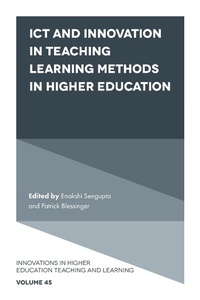
ICT and Innovation in Teaching Learning Methods in Higher Education
Published on 2. August 2022
216 pages
978-1-80043-264-2 (ISBN)
Description

The role of ICT is now central to the quality of classroom delivery, supporting the growth of research and expanding horizons for students with limited accessibility to education. But what impediments exist surrounding ICT in Higher Education? How can we overcome the inaccessibility, economic disparity, and ineffective implementation which have prevented the efficient adoption, diffusion and integration of ICT into pedagogy?
ICT and Innovation in Teaching Learning Methods in Higher Education is a collection of interventions and collaborative practices from across the world that showcase the multifaceted ways of how various institutions have been engaged in supporting teaching and learning with the use of technology. Written at a critical moment of evolution for higher education, the chapters explore how ICT has created a positive impact in the teaching-learning environment and how it is equipping our future generation with the skills required to face a changing job market, but also present the challenges and solutions to enabling access to ICT resources across educational settings.
ICT and Innovation in Teaching Learning Methods in Higher Education is a collection of interventions and collaborative practices from across the world that showcase the multifaceted ways of how various institutions have been engaged in supporting teaching and learning with the use of technology. Written at a critical moment of evolution for higher education, the chapters explore how ICT has created a positive impact in the teaching-learning environment and how it is equipping our future generation with the skills required to face a changing job market, but also present the challenges and solutions to enabling access to ICT resources across educational settings.
Reviews / Votes
'In this very challenging time of pandemic where conventional pedagogical practices are insufficient to meet the changing needs, this book, composed of top-quality academic papers, provides valuable insights on the most effective pedagogical means of transforming higher educational institutions into innovation centers by engaging the appropriate tools of ICT.' -- Zarifullah Darkhily, Vice-Dean and Assistant Professor, Faculty of Public Policy and Administration at Kabul UniversityMore details
Series
Language
English
Place of publication
Bingley
United Kingdom
Target group
Professional and scholarly
File size
3,36 MB
ISBN-13
978-1-80043-264-2 (9781800432642)
Copyright in bibliographic data and cover images is held by Nielsen Book Services Limited or by the publishers or by their respective licensors: all rights reserved.
Schweitzer Classification
Other editions
Additional editions
Enakshi Sengupta | Patrick Blessinger
ICT and Innovation in Teaching Learning Methods in Higher Education
Book
08/2022
Emerald Publishing Limited
€136.50
Shipment within 3-4 weeks
Persons
Enakshi Sengupta serves as the Director of the Centre for Teaching and Learning, and Associate Professor of Business at American University of Afghanistan.
Patrick Blessinger is adjunct associate professor of education at St. John's University, USA. He is also the chief research scientist of the International Higher Education Teaching and Learning Association.
Patrick Blessinger is adjunct associate professor of education at St. John's University, USA. He is also the chief research scientist of the International Higher Education Teaching and Learning Association.
Content
Part I. Integrative Learning
Introduction to ICT and Innovation in Teaching Learning Methods in Higher Education; Enakshi Sengupta and Patrick Blessinger
Chapter 1. Teaching through Collaborative Problem Solving to Make Teaching More Interactive, Student-Based and Future Proof. A Teacher-Researcher Collaboration in Medicine Education; Annelies Raes, Marieke Pieters, and Celine Vens
Chapter 2. Innovative Teaching and Learning Methods at the University of Mauritius; Fareeda Khodabocus, Bahadur Goonesh Kumar, and Sheeba Armoogum
Chapter 3. Implementing an Innovative Curriculum across a College; Jennifer W. Shewmaker and Stephen Baldridge
Chapter 4. Implementing Affective Learning Outcomes through a Meaning Centered Curriculum; Vincent Nix, Kaye Shelton, and Misty Song
Chapter 5. Launching into Life after College; Leonard Shedletsky, Jeanette Andonian, David Bantz, and Dennis Gilbert
Chapter 6. Fostering Creativity through the Integration of Classroom Technologies: A Digital Stoaryboarding Case Study Example; Samantha Read
Part II. Group Based Learning
Chapter 7. Group Based Learning: An Innovative Practice for Engaged Learning in an Online Environment; Amar Kanekar
Chapter 8. Using Cloud-Based Collaborative Office Productivity Tools (Google Workspace) to Engage Students in their Learning and Prepare them for the Workplace; Jonathan Maurice Lake
Introduction to ICT and Innovation in Teaching Learning Methods in Higher Education; Enakshi Sengupta and Patrick Blessinger
Chapter 1. Teaching through Collaborative Problem Solving to Make Teaching More Interactive, Student-Based and Future Proof. A Teacher-Researcher Collaboration in Medicine Education; Annelies Raes, Marieke Pieters, and Celine Vens
Chapter 2. Innovative Teaching and Learning Methods at the University of Mauritius; Fareeda Khodabocus, Bahadur Goonesh Kumar, and Sheeba Armoogum
Chapter 3. Implementing an Innovative Curriculum across a College; Jennifer W. Shewmaker and Stephen Baldridge
Chapter 4. Implementing Affective Learning Outcomes through a Meaning Centered Curriculum; Vincent Nix, Kaye Shelton, and Misty Song
Chapter 5. Launching into Life after College; Leonard Shedletsky, Jeanette Andonian, David Bantz, and Dennis Gilbert
Chapter 6. Fostering Creativity through the Integration of Classroom Technologies: A Digital Stoaryboarding Case Study Example; Samantha Read
Part II. Group Based Learning
Chapter 7. Group Based Learning: An Innovative Practice for Engaged Learning in an Online Environment; Amar Kanekar
Chapter 8. Using Cloud-Based Collaborative Office Productivity Tools (Google Workspace) to Engage Students in their Learning and Prepare them for the Workplace; Jonathan Maurice Lake
