

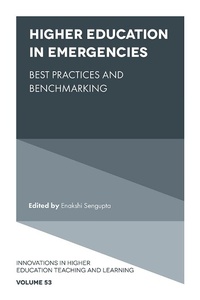
Higher Education in Emergencies
Best Practices and Benchmarking
Published on 11. December 2023
128 pages
978-1-80117-380-3 (ISBN)
Description

Today's world is fraught with perils and pandemics. Education offers structure, stability, and hope for the future, supporting conflict resolution, peacebuilding efforts, and scientific research that can help prevent and mitigate both natural and manmade disasters. With these values in mind, how can universities apply their experiences from the COVID-19 pandemic to other emergency situations? How can they ensure accessibility to education under any circumstances without compromising on quality?
With diverse contributions from Qatar, Kosovo, Turkey, Austria, Israel, Sweden, and the United States, Higher Education in Emergencies: Best Practices and Benchmarking challenges educators to design curriculums that focus on resilience and equip staff with the capability to navigate future scenarios, and students with the skills they need to someday solve them. Avoiding prescriptive standards and advocating for programmes that address the needs of individual campuses, chapters focus on effective methods for evaluating and assessing emergency preparedness, as well as exhibiting exemplary responses that have set a precedent for institutional adaptability moving forward.
Championing tangible action and its measurable impacts, Higher Education in Emergencies: Best Practices and Benchmarking provides a critical toolkit for preparing universities for the next pandemic, earthquake, or civil conflict.
With diverse contributions from Qatar, Kosovo, Turkey, Austria, Israel, Sweden, and the United States, Higher Education in Emergencies: Best Practices and Benchmarking challenges educators to design curriculums that focus on resilience and equip staff with the capability to navigate future scenarios, and students with the skills they need to someday solve them. Avoiding prescriptive standards and advocating for programmes that address the needs of individual campuses, chapters focus on effective methods for evaluating and assessing emergency preparedness, as well as exhibiting exemplary responses that have set a precedent for institutional adaptability moving forward.
Championing tangible action and its measurable impacts, Higher Education in Emergencies: Best Practices and Benchmarking provides a critical toolkit for preparing universities for the next pandemic, earthquake, or civil conflict.
More details
Series
Language
English
Place of publication
Bingley
United Kingdom
Target group
Professional and scholarly
File size
1,04 MB
ISBN-13
978-1-80117-380-3 (9781801173803)
Copyright in bibliographic data and cover images is held by Nielsen Book Services Limited or by the publishers or by their respective licensors: all rights reserved.
Schweitzer Classification
Other editions
Additional editions
Book
12/2023
Emerald Publishing Limited
€136.80
Shipment within 3-4 weeks
Person
Enakshi Sengupta is an Independent Researcher and Scholar and a long-time editor of the Innovations in Higher Education, Teaching and Learning series.
Content
Part I. Transformation in Higher Education
Chapter 1. Introduction to Higher Education in Emergencies: Best Practices and Benchmarking; Enakshi Sengupta
Chapter 2. Response of Higher Education Leadership in Times of Crisis: A Global Insight; Armend Berisha, Elif Bengue, Renate Nantschev, and Nissim Harel
Chapter 3. Beyond the Emergency Civilization: The Urgency of Educating Towards Unpredictability; Piero Dominici
Part II. Successful Support Structures
Chapter 4. Post-disaster Research Study: An HBCU's Academic Resilience in the aftermath of Hurricanes Irma and Maria; Kula A. Francis and Kenny A. Hendrickson
Chapter 5. Challenges Facing Educators and Displaced Students during Emergencies: Implications for Higher Education; Rose Cardarelli
Chapter 6. The Influence of an SQD-Based Practicum Experience on Student Teachers' TPACK-Practical Development: Opportunities and Challenges; Youmen Chaaban and Rania Sawalhi
Chapter 1. Introduction to Higher Education in Emergencies: Best Practices and Benchmarking; Enakshi Sengupta
Chapter 2. Response of Higher Education Leadership in Times of Crisis: A Global Insight; Armend Berisha, Elif Bengue, Renate Nantschev, and Nissim Harel
Chapter 3. Beyond the Emergency Civilization: The Urgency of Educating Towards Unpredictability; Piero Dominici
Part II. Successful Support Structures
Chapter 4. Post-disaster Research Study: An HBCU's Academic Resilience in the aftermath of Hurricanes Irma and Maria; Kula A. Francis and Kenny A. Hendrickson
Chapter 5. Challenges Facing Educators and Displaced Students during Emergencies: Implications for Higher Education; Rose Cardarelli
Chapter 6. The Influence of an SQD-Based Practicum Experience on Student Teachers' TPACK-Practical Development: Opportunities and Challenges; Youmen Chaaban and Rania Sawalhi
