

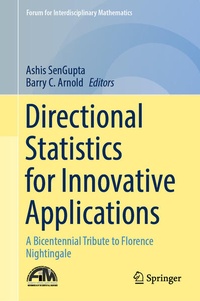
Directional Statistics for Innovative Applications
Description

More details
Other editions
Additional editions
Persons
Ashis SenGupta is Adjunct Professor at Augusta University, Georgia, USA; Distinguished Professor at Middle East Technical University, Turkey; and Advisor/Consultant at the Indian Statistical Institute, Kolkata, India. He completed his Ph.D. from Ohio State University, USA, and was visiting faculty at renowned universities across the world, including Stanford University, USA; University of California, Riverside, USA; University of California, Santa Barbara, USA; University of Wisconsin, Madison, USA; Michigan State University, East Lansing, USA; Concordia University, Montreal, Canada; Hebrew University of Jerusalem, Israel; Institute of Statistical Mathematics, Tokyo, Japan; Hacettepe University, Ankara, Turkey; and the University of Malaya, Malaysia. He is on the editorial board of the Forum for Interdisciplinary Mathematics (a Springer book series) and has been Editor-in-Chief of two international journals.
Professor SenGupta has supervised the Ph.D. thesis of 14 scholars in India, Turkey and USA, and has authored more than 100 publications, including 12 books and edited volumes. His research interests include big data analytics, directional statistics, distribution theory, financial statistics, multivariate statistical analysis, reliability inference and statistical machine learning. He visited Mainland China as a Citizen Ambassador from the American Statistical Association and is the recipient of several international and national recognitions, including two lifetime achievements and one distinguished statistician awards. He is a member of several Expert, Project Advisory and Monitoring committees of the Department of Science and Technology, Government of India. He served as Vice-President of the Forum for Interdisciplinary Mathematics, USA; President (India chapter, 3 successive terms) of the International Indian Statistical Association, and President of the Mathematical Sciences section of the Indian Science Congress, and is recognized by International Statistical Institute, the Netherlands (Elected Member); Indian Society of Probability and Statistics, India (Fellow); National Academy of Sciences, India (Fellow); and American Statistical Association, USA (Fellow).
Barry C. Arnold is Distinguished Professor Emeritus at the Department of Statistics, University of California, Riverside, USA. He received his Ph.D. in Statistics from Stanford University, USA, in 1965. He has authored 14 books and more than 275 research papers in reputed peer-reviewed journals and contributed volumes. Professor Arnold has guided 17 Ph.D. scholars and has been on editorial boards of renowned journals. His research interests include estimation theory, probability, stochastic processes, mathematical learning models, biological models, characterizations, income distributions, order statistics, inequality measurement, record values, conditionally specified distributions, and Bayesian inference. He has been invited for scholarly lectures from across the world and is recognized by American Statistical Association, USA (Fellow); American Association for the Advancement of Science, USA (Fellow); Institute of Mathematical Statistics, USA (Fellow); Royal Statistical Society, UK (Fellow); International Statistical Institute, the Netherlands (Elected Member); and Forum for Interdisciplinary Mathematics, USA (Vice-President).
