

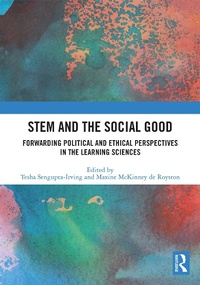
STEM and the Social Good
Forwarding Political and Ethical Perspectives in the Learning Sciences
1st Edition
Published on 17. December 2020
160 pages
978-1-000-19824-9 (ISBN)
Description

This compilation of empirical studies interrogates the global high-speed train of STEM education, particularly as a promise of social, economic, and political enfranchisement for marginalized communities.
In this book, scholars of race, education, and learning offer a range of analyses from which to consider the "who", "what", and "toward ends" of STEM education. Together with scholarly commentaries, the studies frame STEM learning as a personal and political enterprise worthy of closer examination in the lives of children, the work of adults, and the making of nations. Thus, the studies vary in scope and scale, but coalesce in surfacing the ideologies and values underlying the rapid ingestion of STEM in schools and communities as a "social good for all". Readers will journey through a Latinx student's reflections on social justice mathematics, African American primary school students studying water and justice, Indigenous families engaged in storytelling with robotics, college STEM mentors' work with youth, an online portal created for youth in Singapore to envision a STEM-infused future; and finally, frameworks for teaching and research that engage marginalized children's histories, cultural practices and sensemaking. The socio-political grounding and visioning of these works makes this a must-read for researchers, teachers, teacher educators and policy makers in STEM.
The chapters in this book were originally published in a special issue of the journal, Cognition and Instruction.
In this book, scholars of race, education, and learning offer a range of analyses from which to consider the "who", "what", and "toward ends" of STEM education. Together with scholarly commentaries, the studies frame STEM learning as a personal and political enterprise worthy of closer examination in the lives of children, the work of adults, and the making of nations. Thus, the studies vary in scope and scale, but coalesce in surfacing the ideologies and values underlying the rapid ingestion of STEM in schools and communities as a "social good for all". Readers will journey through a Latinx student's reflections on social justice mathematics, African American primary school students studying water and justice, Indigenous families engaged in storytelling with robotics, college STEM mentors' work with youth, an online portal created for youth in Singapore to envision a STEM-infused future; and finally, frameworks for teaching and research that engage marginalized children's histories, cultural practices and sensemaking. The socio-political grounding and visioning of these works makes this a must-read for researchers, teachers, teacher educators and policy makers in STEM.
The chapters in this book were originally published in a special issue of the journal, Cognition and Instruction.
More details
Edition
1. Auflage
Language
English
Place of publication
London
United Kingdom
Publishing group
Taylor & Francis Ltd
Target group
College/higher education
ISBN-13
978-1-000-19824-9 (9781000198249)
Copyright in bibliographic data and cover images is held by Nielsen Book Services Limited or by the publishers or by their respective licensors: all rights reserved.
Schweitzer Classification
Other editions
Additional editions
Tesha Sengupta-Irving | Maxine McKinney de Royston
STEM and the Social Good
Forwarding Political and Ethical Perspectives in the Learning Sciences
Book
09/2023
1st Edition
Routledge
€61.70
Shipment within 15-20 days
Tesha Sengupta-Irving | Maxine McKinney de Royston
STEM and the Social Good
Forwarding Political and Ethical Perspectives in the Learning Sciences
Book
10/2020
1st Edition
Routledge
€204.10
Shipment within 15-20 days
Persons
Tesha Sengupta-Irving is Assistant Professor of the Learning Sciences in the Graduate School of Education at the University of California, Berkeley, USA. Her research explores the sociocultural and political dimensions of teaching and learning that resist the stratifying power of mathematics as a project of race, gender, and class in schools.
Maxine McKinney de Royston is Assistant Professor in the Department of Curriculum & Instruction at the University of Wisconsin-Madison, USA. Her research examines the multidimensional, relational, and politicized nature of teaching and learning, namely how schools and mathematics and science classrooms operate as racialized learning spaces.
Maxine McKinney de Royston is Assistant Professor in the Department of Curriculum & Instruction at the University of Wisconsin-Madison, USA. Her research examines the multidimensional, relational, and politicized nature of teaching and learning, namely how schools and mathematics and science classrooms operate as racialized learning spaces.
Content
Introduction: Another Step Forward: Engaging the Political in Learning
Tesha Sengupta-Irving and Maxine McKinney de Royston
1. MySkillsFuture for Students: Stem Learning and the Design of Neoliberal Citizenship in Singapore
Roberto Santiago de Roock and Mark Baildon
2. Storywork in STEM-Art: Making, Materiality and Robotics within Everyday Acts of Indigenous Presence and Resurgence
Carrie Tzou, Meixi, Enrique Suarez, Philip Bell, Don LaBonte, Elizabeth Starks & Megan Bang
3. Learning in Community for STEM Undergraduates: Connecting a Learning Sciences and a Learning Humanities Approach in Higher Education
Leslie Rupert Herrenkohl, Jiyoung Lee, Fan Kong, Susie Nakamura, Kimia Imani, Kari Nasu, Ansel Hartman, Benjamin Pennant, Elisa Tran, Evert Wang, Noushyar Panahpour Eslami, Daniel Whittlesey, David Whittlesey, Tri Minh Hyunh, Allen Jung, Chris Batalon, Adam Bell and Katie Headrick Taylor
4. Integrating Power to Advance the Study of Connective and Productive Disciplinary Engagement in Mathematics and Science
Priyanka Agarwal and Tesha Sengupta-Irving
5. Troubling Troubled Waters in Elementary Science Education: Politics, Ethics and Black Children's Conceptions of Water [Justice] in the Era of Flint
Natalie R. Davis and Janelle Schaeffer
6. Looking at My (Real) World through Mathematics: Memories and Imaginaries of Math and Science Learning
Patricia M. Buenrostro and Josh Radinsky
7. The Restorying of STEM Learning through the Lens of Multiples
Jrene Rahm
8. Read Me Last: Constructing a Scholarly Catchment Through a Black Feminist Reading
Maisie L. Gholson
Tesha Sengupta-Irving and Maxine McKinney de Royston
1. MySkillsFuture for Students: Stem Learning and the Design of Neoliberal Citizenship in Singapore
Roberto Santiago de Roock and Mark Baildon
2. Storywork in STEM-Art: Making, Materiality and Robotics within Everyday Acts of Indigenous Presence and Resurgence
Carrie Tzou, Meixi, Enrique Suarez, Philip Bell, Don LaBonte, Elizabeth Starks & Megan Bang
3. Learning in Community for STEM Undergraduates: Connecting a Learning Sciences and a Learning Humanities Approach in Higher Education
Leslie Rupert Herrenkohl, Jiyoung Lee, Fan Kong, Susie Nakamura, Kimia Imani, Kari Nasu, Ansel Hartman, Benjamin Pennant, Elisa Tran, Evert Wang, Noushyar Panahpour Eslami, Daniel Whittlesey, David Whittlesey, Tri Minh Hyunh, Allen Jung, Chris Batalon, Adam Bell and Katie Headrick Taylor
4. Integrating Power to Advance the Study of Connective and Productive Disciplinary Engagement in Mathematics and Science
Priyanka Agarwal and Tesha Sengupta-Irving
5. Troubling Troubled Waters in Elementary Science Education: Politics, Ethics and Black Children's Conceptions of Water [Justice] in the Era of Flint
Natalie R. Davis and Janelle Schaeffer
6. Looking at My (Real) World through Mathematics: Memories and Imaginaries of Math and Science Learning
Patricia M. Buenrostro and Josh Radinsky
7. The Restorying of STEM Learning through the Lens of Multiples
Jrene Rahm
8. Read Me Last: Constructing a Scholarly Catchment Through a Black Feminist Reading
Maisie L. Gholson
