

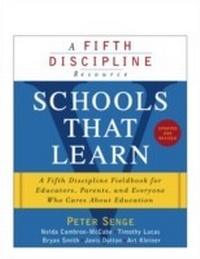
Schools That Learn (Updated and Revised)
Description

"A rich, much-needed remedy for the standardized institutions that comprise too much of our school system today… ideal for teachers and parents intent on resurrecting and fostering students' inherent drive to learn…An essential resource." -Daniel H. Pink, author of DRIVE and A WHOLE NEW MIND "Schools that Learn is a magnificent, grand book that pays equal attention to the small and the big picture - and what's more integrates them. There is no book on education change that comes close to Senge et al's sweeping and detailed treatment. Classroom, school, community, systems, citizenry---it's all there. The core message is stirring: what if we viewed schools as a means of shifting society for the better!" -Michael Fullan, author of Change Leader and Learning Places A new edition of the groundbreaking book that brings organizational learning and systems thinking into classrooms and schools, showing how to keep our nation's educational system competitive in today's world. Revised and updated - with more than 100 pages of new material - for the first time since its initial publication in 2000 comes a new edition of the seminal work acclaimed as one of the best books ever written about education and schools. A unique collaboration between the celebrated management thinker and Fifth Discipline author Peter Senge and a team of renowned educators and organizational change leaders, Schools that Learn describes how schools can adapt, grow, and change in the face of the demands and challenges of our society, and provides tools, techniques and references for bringing those aspirations to life. The new revised and updated edition offers practical advice for overcoming the many challenges that face our communities and educational systems today. It shows teachers, administrators, students, parents and community members how to successfully use principles of organizational learning, including systems thinking and shared vision, to address the challenges that face our nation's schools. In a fast-changing world where school populations are increasingly diverse, children live in ever-more-complex social and media environments, standardized tests are applied as overly simplistic "quick fixes," and advances in science and technology continue to accelerate, the pressures on our educational system are inescapable. Schools That Learn offers a much-needed way to open dialogue about these problems - and provides pragmatic opportunities to transform school systems into learning organizations. Drawing on observations and advice from more than 70 writers and experts on schools and education, this book features: -Methods for implementing organizational learning and explanations of why they work -Compelling stories and anecdotes from the "field" - classrooms, schools, and communities -Charts, tables and diagrams to illustrate systems thinking and other practices -Guiding principles for how to apply innovative practices in all types of school systems -Individual exercises useful for both teachers and students -Team exercises to foster communication within the classroom, school, or community group -New essays on topics like educating for sustainability, systems thinking in the classroom, and "the great game of high school." -New recommendations for related books, articles, videotapes and web sites -And more Schools That Learn is the essential guide for anyone who cares about the future of education and keeping our nation's schools competitive in our fast-changing world.
More details
Other editions
Additional editions
Persons
PETER SENGE is a senior lecturer at the Massachusetts Institute of Technology, and the founding chair of The Society for Organizational Learning. A renowned pioneer, theorist, and writer in the field of management innovation, he is the author of the widely acclaimed book, The Fifth Discipline: The Art and Practice of The Learning Organization. In 2008 the Wall Street Journal named Dr. Senge among the top 20 most influential business thinkers. The Journal of Business Strategy has named him as one of the 24 people who had the greatest influence on business strategy over the last 100 years. The Financial Times named him as one of the world's "top management gurus," and Business Week has rated him as one of The Top (ten) Management Gurus. BRYAN SMITH is an internationally recognized author, speaker and consultant on leadership development, vision-based planning and organizational learning. Prior to founding Broad Reach Innovations, Bryan was a Senior Partner for eighteen years at Innovation Associates, the firm that pioneered the field of Organizational Learning. He has worked with the UN Foundation, the UN Office of the Secretary-General, and many other education, governmental, non-profit and business organizations worldwide. He is a founding faculty member for the Sustainable Enterprise Academy at York University in Toronto. NELDA CAMBRON-MCCABE is a professor, Department of Educational Leadership, Miami University (Ohio), and a nationally known expert on school reform and leadership. She is co-author of The Superintendant's Fieldbook (2005) and co-author of Public School Law: Teachers' and Students' Rights 6th ed.(2009). Since 2007, Dr. Cambron-McCabe has worked with the National Superintendents Roundtable as its members initiated educational reform in their school districts. Many of their experiences appear in Schools That Learn. TIMOTHY LUCAS is a founding member and lead consultant for The Institute for the Future of Learning, a non-profit group focused on creating sustainable 21st century learning environments, and is an adjunct professor at Wilkes University in Pennsylvania. He has been involved with public education for the past 35 years, having taught elementary school, middle school, high school, and college. He has been a middle school vice principal, elementary principal, curriculum director, Assistant Superintendent, and Superintendent of Schools. JANIS DUTTON is an education writer, consultant, director of a peace and justice center,and community activist. She has used the learning organization principles as an elected official and in a variety of community conversations, and leadership and grass-roots initiatives. ART KLEINER is the editor-in-chief of strategy+business, the award-winning management magazine published by Booz & Company. Kleiner is also a writer, lecturer and commentator, and author of The Age of Heretics: A History of the Radical Thinkers Who Reinvented Corporate Management and Who Really Matters: The Core Group Theory of Power, Privilege, and Success. This book is part of the Fifth Discipline Fieldbook series, which also includes The Fifth Discipline Fieldbook and The Dance of Change (coauthored by Senge, Smith, Kleiner, and others.) Senge and Smith are also coauthors of The Necessary Revolution.
Content
- Intro
- Title Page
- Copyright
- Contents
- Getting Started
- I Orientation
- 1 The Remembered Moment
- 2 The Idea of a School That Learns
- 3 Core Concepts About Learning in Organizations
- 4 How to Read This Book
- 5 What's New in the New Edition
- 6 The Industrial Age System of Education: Peter Senge
- II A Primer on the Five Disciplines
- 1 Creating a Context for Organizational Learning
- 2 Personal Mastery
- 3 Shared Vision
- 4 Mental Models
- 5 Team Learning
- 6 Systems Thinking
- 7 Are You Smarter Than a Thermostat?: Nelda Cambron-McCabe, Janis Dutton
- Classroom
- III Opening the Classroom Door
- 1 Creating Classrooms That Learn
- 2 Designing a Learning Classroom: Nelda Cambron-McCabe
- 3 "Legal, Safe, and Something You Want to Learn": Carol Ann Kenerson
- IV Seeing the Learner
- 1 The Dignity of the Child: Tim Lucas
- 2 Revealing the Learner: Tim Lucas
- 3 Overcoming Absurdity: Terry O'Connor, Deirdre Bangham
- 4 We Dance Together: Candee Basford
- 5 What Signals Are You Sending?: Janis Dutton, Nelda Cambron-McCabe, Tim Lucas, Art Kleiner
- V Practices
- 1 Teaching Structural Tension: Robert Fritz
- 2 A Shared Vision Process for the Classroom: Tim Lucas
- 3 Homework: The Beast: Betty Quantz
- 4 Assessment as Learning: Bena Kallick
- 5 Assessment and Accountability: Steve Price
- 6 Intelligent Behaviors: Art Costa
- 7 Knowledge and Power: Nelda Cambron-McCabe, Janis Dutton
- VI Productive Conversation
- 1 Check-In: Carol Kenerson, Micah Fierstein, Janis Dutton
- 2 Opening Day: Nelda Cambron-McCabe
- 3 Reframing the Parent-Teacher Conference: Nelda Cambron-McCabe, Janis Dutton, Tim Lucas, Betty Quantz, Art Kleiner
- 4 "Don't eat the pizza .": Bryan Smith, Nelda Cambron-McCabe, Tim Lucas, Art Kleiner, Janis Dutton
- VII Systems Thinking in the Classroom
- 1 Systems Study for the Long Term: Jay W. Forrester
- 2 A Guide to Practice for Systems Thinking in the Classroom: Assembled and edited by Lees Stuntz and Nina Kruschwitz
- 3 Context and Engagement: Peter Senge
- 4 Pitfalls and Skills: Michael Goodman
- 5 Learning to Connect the Dots: Linda Booth Sweeney
- School
- VIII Entering School
- 1 Creating Schools That Learn
- 2 Schooling as an Ethical Endeavor: Nelda Cambron-McCabe
- IX School Vision
- 1 A Shared Vision for Your School: Bryan Smith, Tim Lucas
- 2 Renewing Educational Leadership: Nelda Cambron-McCabe
- X Current Reality
- 1 Predetermined Uncertainty: Art Kleiner
- 2 The $19,000 Question: As told to Micah Fierstein
- 3 Success to the Successful: Michael Goodman, Janis Dutton
- 4 Shifting the Burden: Michael Goodman, Janis Dutton, Art Kleiner
- 5 The Great Game of High School: Nathan Dutton, Rick Quantz, Nolan Dutton
- 6 The Youth Leadership Forum: Joyce Bisso
- XI Development
- 1 No More "Drive-By Staff Development": Edward T. Joyner
- 2 The Cognitive Studies Group: Faith Florer
- 3 Learning to Teach: Nancy Hoffmann
- XII Leadership
- 1 Leading Without Control: Charlotte Roberts
- 2 Peer Partners
- 3 "Lone Ranger" to Lead Learner: One Superintendent's Journey: Peter Negroni
- 4 No Throw-Away Children: Mary Leiker
- 5 Creating a Core Learning Group: Les Omotani
- 6 "You Can't Do That!": Ann Marie Gallo
- Community
- XIII Moving Into Community
- 1 Fostering Communities That Learn
- XIV Identity
- 1 Taking Stock of Community Connections: Tim Lucas, Janis Dutton, Nelda Cambron-McCabe, Bryan Smith
- 2 "Expression is the First Step Out of Oppression": Bonnie Neumeier
- 3 Reclaiming Citizenship through Conversations: Peter Block
- 4 Sharing a Vision, Nationwide: Tan Soon Yong
- XV Connections
- 1 Parent to Parent: Roland Chevalier
- 2 The Over-the-Rhine Residency Program: Thomas A. Dutton
- 3 The "Systems Basketball Coach": Nancy W. Lippe
- 4 Improving Business-Education Partnerships: Andrea Gabor
- XVI Sustainability
- 1 The Rainmakers: Katharine Briar-Lawson
- 2 Public Engagement: Ellen Bueschel
- 3 Vision Escalation, Position De-Escalation: Bryan Smith
- 4 It Takes a Child to Raise a Village: Jaimie P. Cloud
- 5 The Tragedy of the Commons: Michael Goodman, Janis Dutton, Art Kleiner
- 6 Children as Leaders: Sara Cameron
- 7 How Do You Know Your Organization Is Learning?: Janis Dutton
- 8 The Systems Citizen: Peter Senge
- XVII End Notes
- 1 Acknowledgments
- 2 About the Authors
