

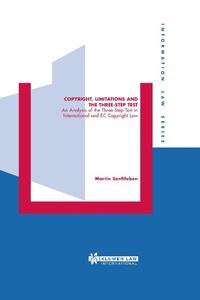
Copyright, Limitations and the Three-Step Test
An Analysis of the Three-Step Test in International and EC Copyright Law
Published on 1. January 2004
356 pages
978-90-411-5709-6 (ISBN)
Description

The three-step test - by which limitations on exclusive copyrights are confined to 'certain special cases' which do not conflict with a 'normal exploitation of the work' and do not 'unreasonably prejudice the legitimate interests of the author'- is among the most enduring of standards affecting limitations on intellectual property rights. Its field of application is the delicate balance between exclusive rights and sufficient breathing space for the free flow of ideas and information. However, the emerging information society has thrown numerous unforeseen obstacles in the once-clear path of its implementation. Can the traditional balance between grants and reservations of copyright law be recalibrated along the lines of the three-step test in order to meet current and future needs? Controversies over this crucial question - in Europe, the U.S., Australia, and elsewhere, as well as in two significant WTO panels in 2002 - have brought the three-step test into focus, the essential principle governing copyright limitations in the information society. Investigating the development, structure, and function of the three-step test in international copyright law with thoroughness and precision, Copyright, Limitations and the Three-Step Test offers a close and insightful analysis of its continuing utility for the twenty-first century. The book includes:
viable restatements of the rationales of copyright protection for the emerging IP environment;
new insights into the relationship between copyright protection and copyright limitations;
in-depth explanation of the structure and functioning of the three-step test;
detailed interpretations of each criterion of the test;
discussion of the two WTO panel reports dealing with the test;
a proposal for the further improvement of the copyright system and the international rules governing copyright law;
detailed information about international conference material concerning the test; and
discussion of potential future trends in copyright law.
The author provides many examples that demonstrate the test's impact on different types of limitations, such as private use privileges and the U.S. fair use doctrine. He explains the test's role in the European Copyright Directive. The detailed examination and explanation of the three-step test will be of extraordinary value to policymakers, judges, and lawyers in the field of intellectual property law seeking to react adequately to the challenges of the digital environment.
viable restatements of the rationales of copyright protection for the emerging IP environment;
new insights into the relationship between copyright protection and copyright limitations;
in-depth explanation of the structure and functioning of the three-step test;
detailed interpretations of each criterion of the test;
discussion of the two WTO panel reports dealing with the test;
a proposal for the further improvement of the copyright system and the international rules governing copyright law;
detailed information about international conference material concerning the test; and
discussion of potential future trends in copyright law.
The author provides many examples that demonstrate the test's impact on different types of limitations, such as private use privileges and the U.S. fair use doctrine. He explains the test's role in the European Copyright Directive. The detailed examination and explanation of the three-step test will be of extraordinary value to policymakers, judges, and lawyers in the field of intellectual property law seeking to react adequately to the challenges of the digital environment.
More details
Other editions
Additional editions
Martin Senftleben
Copyright, Limitations and the Three-Step Test
An Analysis of the Three-Step Test in International and EC Copyright Law
Book
02/2004
Kluwer Law International
€242.15
Shipment within 10-20 days
Content
- Cover
- Half Title Page
- Title Page
- Copyright Page
- Dedication
- FOREWORD
- Table of Contents
- LIST OF ABBREVIATIONS
- Chapter 1 Introduction
- Chapter 2 The Three-Step Test Within the Copyright System
- 2.1 Rationales of Copyright Protection
- 2.1.1 THE HISTORICAL INTERPLAY OF NATURAL LAW AND UTILITARIAN NOTIONS
- 2.1.2 THE LABOURER'S CLAIM AND THE ENTITLEMENT OF THE PUBLIC
- 2.1.3 THE CULTURAL RATIONALE AS THE ESSENTIAL FOUNDATION OF COPYRIGHT
- 2.2 Justifications for Copyright Limitations
- 2.2.1 FREEDOM OF EXPRESSION AND INFORMATION
- 2.2.2 THE DISSEMINATION OF INFORMATION
- 2.2.3 THE RIGHT TO PRIVACY
- 2.2.4 THE ENHANCEMENT OF DEMOCRACY
- 2.3 Copyright's Delicate Balance
- Chapter 3 The Contextual Background to the Three-Step Test
- 3.1 The Berne Convention
- 3.1.1 THE 'MINOR RESERVATIONS DOCTRINE' AS A PRECURSOR
- 3.1.2 THE INTRODUCTION OF THE TEST AT THE 1967 STOCKHOLM CONFERENCE
- 3.1.3 NATIONAL LIMITATIONS AT THE TIME OF THE STOCKHOLM CONFERENCE
- 3.1.3.1 THE FEDERAL REPUBLIC OF GERMANY
- 3.1.3.2 THE NETHERLANDS
- 3.1.3.3 FRANCE
- 3.1.3.4 THE UNITED KINGDOM
- 3.1.3.5 INDIA
- 3.1.4 THE DUALISM INHERENT IN THE THREE-STEP TEST
- 3.2 The TRIPs Agreement
- 3.2.1 THE DOUBLE INSERTION OF THE THREE-STEP TEST
- 3.2.2 ARTICLE 13 TRIPS AS A BERNE-PLUS ELEMENT
- 3.3 The WIPO 'Internet' Treaties
- 3.3.1 PREVIOUS DISCUSSIONS BASED ON THE THREE-STEP TEST
- 3.3.2 THE DEBATE AT THE 1996 WIPO CONFERENCE
- Chapter 4 The Interpretation of the Three Criteria
- 4.1 Principles of Interpretation
- 4.1.1 THE VIENNA CONVENTION ON THE LAW OF TREATIES
- 4.1.2 THE MATERIAL AVAILABLE FOR INTERPRETATION
- 4.1.2.1 THE WORDING OF THE THREE-STEP TEST
- 4.1.2.2 THE CONTEXT SURROUNDING THE THREE-STEP TEST
- 4.1.2.3 THE ROLE OF WTO PANEL REPORTS
- 4.1.2.4 THE INTERCONNECTION OF SUPPLEMENTARY SOURCES
- 4.1.2.5 THE US FAIR USE DOCTRINE
- 4.1.2.6 THE LANGUAGE SITUATION
- 4.1.3 THE CIRCLE OF RELEVANT LIMITATIONS
- 4.2 Two Different Functions
- 4.2.1 CONTROLLING LIMITATIONS DIRECTLY
- 4.2.2 SERVING AS AN ADDITIONAL SAFEGUARD
- 4.3 The System of the Three Criteria
- 4.3.1 THE BASIC RULE
- 4.3.2 THE TWO CONDITIONS
- 4.3.3 OVERVIEW OF THE REGULATORY FRAMEWORK
- 4.4 Certain Special Cases
- 4.4.1 CERTAINTY
- 4.4.2 SPECIALITY
- 4.4.2.1 ASSESSING QUANTITATIVE AND QUALITATIVE CONSIDERATIONS
- 4.4.2.2 REJECTING THE QUANTITATIVE CONCEPT OF THE WTO PANEL
- 4.4.2.3 BRINGING QUALITATIVE CONSIDERATIONS INTO FOCUS
- 4.4.2.4 DEFINING A SPECIAL CASE
- 4.4.2.5 CLARIFYING THE INTERPLAY WITH THE THIRD CRITERION
- 4.4.3 THE IMPACT ON INTERNATIONALLY RECOGNISED LIMITATIONS
- 4.4.4 THE IMPACT ON REMAINING NATIONAL LIMITATIONS
- 4.4.4.1 PERSONAL AND INTERNAL USE
- 4.4.4.2 FAIR USE
- 4.5 Conflict with a Normal Exploitation
- 4.5.1 THE HISTORICAL APPROACH OF BORNKAMM
- 4.5.2 THE EMPIRICAL APPROACH OF RICKETSON
- 4.5.3 THE DEVELOPMENT OF A NORMATIVE CONCEPT
- 4.5.3.1 THE GUIDELINE GIVEN AT THE STOCKHOLM CONFERENCE
- 4.5.3.2 ADAPTING THE GUIDELINE TO THE DIGITAL ENVIRONMENT
- 4.5.3.3 BRINGING THE ECONOMIC CORE OF COPYRIGHT INTO FOCUS
- 4.5.3.4 DETERMINING THE CORRECT REFERENCE POINT
- 4.5.3.5 DEFINING A CONFLICT WITH A NORMAL EXPLOITATION
- 4.5.4 THE IMPACT ON INTERNATIONALLY RECOGNISED LIMITATIONS
- 4.5.4.1 CRITICISM AND PARODY
- 4.5.4.2 UTILISATION FOR TEACHING
- 4.5.4.3 THE 'MINOR RESERVATIONS DOCTRINE'
- 4.5.4.4 COMPULSORY BROADCASTING LICENCES
- 4.5.5 THE IMPACT ON REMAINING NATIONAL LIMITATIONS
- 4.5.5.1 STRICTLY PERSONAL USE
- 4.5.5.2 LIBRARIES
- 4.6 Unreasonable Prejudice to Legitimate Interests
- 4.6.1 THE REFERENCE TO INTERESTS INSTEAD OF RIGHTS
- 4.6.2 ECONOMIC INTERESTS
- 4.6.3 NON-ECONOMIC INTERESTS
- 4.6.3.1 ARTICLE 9(2) BC AND ARTICLE 10 WCT
- 4.6.3.2 ARTICLE 13 TRIPS
- 4.6.4 THE PROPORTIONALITY TEST
- 4.6.4.1 IDENTIFYING LEGITIMATE INTERESTS
- 4.6.4.2 AVOIDING AN UNREASONABLE PREJUDICE
- 4.6.5 THE IMPACT ON INTERNATIONALLY RECOGNISED LIMITATIONS
- 4.6.6 THE SYSTEM OF THE THREE CRITERIA REVISITED
- Chapter 5 The Three-Step Test in the European Copyright Directive
- 5.1 The Contextual Background
- 5.1.1 THE DRAFTING HISTORY OF ARTICLE 5(5) CD
- 5.1.2 THE FRAMEWORK SET OUT FOR LIMITATIONS
- 5.1.3 THE OBJECTIVES UNDERLYING THE DIRECTIVE
- 5.2 The Function of Article 5(5) CD
- 5.3 The Impact on the List of Permissible Limitations
- 5.3.1 CERTAIN SPECIAL CASES
- 5.3.1.1 SPECIALITY
- 5.3.1.2 NO NEED FOR FURTHER SPECIFICATION
- 5.3.2 CONFLICT WITH A NORMAL EXPLOITATION
- 5.3.3 UNREASONABLE PREJUDICE TO LEGITIMATE INTERESTS
- 5.3.4 OVERVIEW OF INTERNATIONAL OBLIGATIONS
- 5.4 The Addressees of Article 5(5) CD
- Chapter 6 Summary
- Chapter 7 Conclusion
- 7.1 Aligning Copyright Law with the Users among Authors
- 7.2 Restructuring International Copyright Law
- BIBLIOGRAPHY
- INDEX
- ABOUT THE AUTHOR
- Back Cover
