

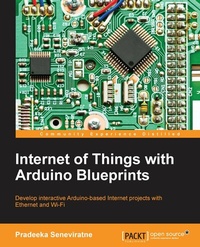
Internet of Things with Arduino Blueprints
Develop interactive Arduino-based Internet projects with Ethernet and WiFi
Published on 8. July 2025
210 pages
978-1-78528-191-4 (ISBN)
Description

Develop interactive Arduino-based Internet projects with Ethernet and WiFi
Key Features
Book DescriptionArduino is a small single-chip computer board that can be used for a wide variety of creative hardware projects. The hardware consists of a simple microcontroller, board, and chipset. It comes with a Java-based IDE to allow creators to program the board. Arduino is the ideal open hardware platform for experimenting with the world of the Internet of Things. This credit card sized Arduino board can be used via the Internet to make more useful and interactive Internet of things projects. Internet of Things with Arduino Blueprints is a project-based book that begins with projects based on IoT and cloud computing concepts. This book covers up to eight projects that will allow devices to communicate with each other, access information over the Internet, store and retrieve data, and interact with users-creating smart, pervasive, and always-connected environments. It explains how wired and wireless Internet connections can be used with projects and the use of various sensors and actuators. The main aim of this book is to teach you how Arduino can be used for Internet-related projects so that users are able to control actuators, gather data from various kinds of sensors, and send and receive data wirelessly across HTTP and TCP protocols. Finally, you can use these projects as blueprints for many other IoT projects and put them to good use. By the end of the book, you will be an expert in the use of IoT with Arduino to develop a set of projects that can relate very well to IoT applications in the real world.What you will learn
Make a powerful Internet controlled relay with an embedded web server to monitor and control your home electrical appliances
Build a portable WiFi signal strength sensor to give haptic feedback about signal strength to the user
Measure water flow speed and volume with liquid flow sensors and record realtime readings
Secure your home with motionactivated Arduino security cameras and upload images to the cloud
Implement realtime data logging of a solar panel voltage with Arduino cloud connectors
Track locations with GPS and upload location data to the cloud
Control a garage door light with your Twitter feed
Control infrared enabled devices with IR remote and Arduino
Who this book is for
Key Features
Book DescriptionArduino is a small single-chip computer board that can be used for a wide variety of creative hardware projects. The hardware consists of a simple microcontroller, board, and chipset. It comes with a Java-based IDE to allow creators to program the board. Arduino is the ideal open hardware platform for experimenting with the world of the Internet of Things. This credit card sized Arduino board can be used via the Internet to make more useful and interactive Internet of things projects. Internet of Things with Arduino Blueprints is a project-based book that begins with projects based on IoT and cloud computing concepts. This book covers up to eight projects that will allow devices to communicate with each other, access information over the Internet, store and retrieve data, and interact with users-creating smart, pervasive, and always-connected environments. It explains how wired and wireless Internet connections can be used with projects and the use of various sensors and actuators. The main aim of this book is to teach you how Arduino can be used for Internet-related projects so that users are able to control actuators, gather data from various kinds of sensors, and send and receive data wirelessly across HTTP and TCP protocols. Finally, you can use these projects as blueprints for many other IoT projects and put them to good use. By the end of the book, you will be an expert in the use of IoT with Arduino to develop a set of projects that can relate very well to IoT applications in the real world.What you will learn
Make a powerful Internet controlled relay with an embedded web server to monitor and control your home electrical appliances
Build a portable WiFi signal strength sensor to give haptic feedback about signal strength to the user
Measure water flow speed and volume with liquid flow sensors and record realtime readings
Secure your home with motionactivated Arduino security cameras and upload images to the cloud
Implement realtime data logging of a solar panel voltage with Arduino cloud connectors
Track locations with GPS and upload location data to the cloud
Control a garage door light with your Twitter feed
Control infrared enabled devices with IR remote and Arduino
Who this book is for
All prices
More details
Edition
Digital original
Language
English
Place of publication
Birmingham
United Kingdom
Target group
Professional and scholarly
US School Grade: College Graduate Student
Edition type
Digital original
File size
5,98 MB
ISBN-13
978-1-78528-191-4 (9781785281914)
Copyright in bibliographic data and cover images is held by Nielsen Book Services Limited or by the publishers or by their respective licensors: all rights reserved.
Schweitzer Classification
Other editions
Additional editions
Pradeeka Seneviratne
Internet of Things with Arduino Blueprints
Develop interactive Arduino-based Internet projects with Ethernet and WiFi
Book
10/2015
Packt Publishing
€50.40
Shipment within 3-4 weeks
Person
Seneviratne Pradeeka :
Pradeeka Seneviratne is a software engineer with over 10 years' experience in computer programming and systems design. He is an expert in the development of Arduino- and Raspberry Pi-based embedded systems. Pradeeka is currently a full-time embedded software engineer who works with embedded systems and highly scalable technologies. Previously, he worked as a software engineer for several IT infrastructure and technology servicing companies. He collaborated with the Outernet project as a volunteer hardware and software tester for Lighthouse- and Raspberry Pi-based DIY Outernet receivers based on Ku band satellite frequencies. He is also the author of five books: Internet of Things with Arduino Blueprints [Packt Publishing] IoT: Building Arduino-Based Projects [Packt Publishing] Building Arduino PLCs [Apress] Raspberry Pi 3 Projects for Java Programmers [Packt Publishing] Beginning BBC micro:bit [Apress]
Pradeeka Seneviratne is a software engineer with over 10 years' experience in computer programming and systems design. He is an expert in the development of Arduino- and Raspberry Pi-based embedded systems. Pradeeka is currently a full-time embedded software engineer who works with embedded systems and highly scalable technologies. Previously, he worked as a software engineer for several IT infrastructure and technology servicing companies. He collaborated with the Outernet project as a volunteer hardware and software tester for Lighthouse- and Raspberry Pi-based DIY Outernet receivers based on Ku band satellite frequencies. He is also the author of five books: Internet of Things with Arduino Blueprints [Packt Publishing] IoT: Building Arduino-Based Projects [Packt Publishing] Building Arduino PLCs [Apress] Raspberry Pi 3 Projects for Java Programmers [Packt Publishing] Beginning BBC micro:bit [Apress]
Content
Table of Contents
Internet Controlled 5A Wall Socket
WiFi Signal Strength Reader with Haptic Feedback
Internet Connected Water Meter
Motion Activated Arduino Camera
Solar Panel Voltage/Current Logging with NearBus Cloud Connector
Arduino GPS Tracker
Tweet-a-Light: Twitter Enabled Garage Door Light
Control Infrared Devices with Internet using IR remote
Internet Controlled 5A Wall Socket
WiFi Signal Strength Reader with Haptic Feedback
Internet Connected Water Meter
Motion Activated Arduino Camera
Solar Panel Voltage/Current Logging with NearBus Cloud Connector
Arduino GPS Tracker
Tweet-a-Light: Twitter Enabled Garage Door Light
Control Infrared Devices with Internet using IR remote

