

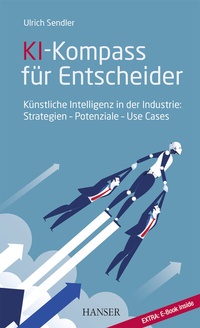
KI-Kompass für Entscheider
Künstliche Intelligenz in der Industrie: Strategien - Potenziale - Use Cases
1st Edition
Published on 10. August 2020
288 pages
978-3-446-46590-9 (ISBN)
Description

So setzen Sie Künstliche Intelligenz gewinnbringend in Ihrem Unternehmen ein
Endlich ist die Künstliche Intelligenz reif für die Nutzung in industriellen Prozessen, Produkten und Diensten. Die Potenziale sind enorm, doch eine erfolgreiche Integration von KI-Anwendungen kann nur gelingen, wenn man das Thema zur Chefsache macht. Dieser Leitfaden wendet sich an Entscheidungsträger, die ihr Unternehmen fit für den Einsatz industrieller KI machen wollen.
Folgende Themen erwarten Sie:
- Kompakter Einstieg in die KI-Technik: Data Science, Machine Learning, Künstliche Neuronale Netze
- Das Zusammenspiel von KI, Industrie 4.0 und IoT
- KI in der Industrie: Einsatzszenarien in Produktentwicklung und Produktion sowie für produktbasierende Dienste, KI in der (Edge-)Cloud und auf dem Chip
- Die Rolle der Industrieplattformen: B2B-Angebote für KI-Apps, Managed Services, Cloud Infrastructure as a Service
- Fragen der Datensicherheit und Ethik
Wertvolle Einblicke in die Strategien, Angebote und Use Cases führender Unternehmen und Forschungseinrichtungen auf dem Gebiet der industriellen KI, wie ABB, Dassault Systèmes, Siemens, it's OWL und das Werkzeugmaschinenlabor der RWTH Aachen, runden den Inhalt ab.
Systemvoraussetzungen für E-Book inside: Internet-Verbindung und Adobe-Reader oder Ebook-Reader bzw. Adobe Digital Editions
More details
Other editions
Additional editions
Ulrich Sendler
KI-Kompass für Entscheider
Künstliche Intelligenz in der Industrie: Strategien - Potenziale - Use Cases
E-Book
08/2020
1st Edition
Hanser
€39.99
Available for download
Ulrich Sendler
KI-Kompass für Entscheider
Künstliche Intelligenz in der Industrie: Strategien - Potenziale - Use Cases
Book
08/2020
Hanser
€39.99
Shipment within 5-7 days
Person
Author
Dipl.-Ing. (FH) Ulrich Sendler (www.ulrichsendler.de) ist Feinwerktechnik-Ingenieur, Werkzeugmacher und NC-Programmierer. Seit Ende der Achtzigerjahre ist er als freier Fachjournalist, Buchautor, Technologieanalyst, Redner und Moderator im Umfeld der virtuellen Produktentwicklung und Digitalisierung tätig. Er ist Gründer und Organisator des sendler\circle, einer Interessengemeinschaft der Anbieter von Software und Services für die Industrie, und betreibt ein Nachrichtenportal zu Digitalisierung, Industrie 4.0 und PLM (www.plmportal.org).
ISNI:
ISNI:
Content
- Intro
- Inhalt
- Vorwort
- 1 Einführung
- 1.1 Worüber reden wir?
- 1.2 Das Besondere an der industriellen KI
- 1.3 Theorie und Praxis
- 2 Eine kurze Geschichte der Künstlichen Intelligenz
- 2.1 Begriffsklärung: Intelligenz vs. Künstliche Intelligenz
- 2.2 Starke und schwache KI, Expertensysteme
- 2.3 Künstliche neuronale Netze (KNN)
- 3 Die jüngste Geschichte der Industrialisierung
- 3.1 Deutschland: Von SPS zu Industrie 4.0
- 3.2 USA: Silicon Valley und Industrial Internet
- 3.3 China: Die verlängerte Werkbank wird zur ernsthaften Konkurrenz
- 4 Stand der KI-Technik
- 4.1 Datenwissenschaft (Data Science)
- 4.2 Wie Maschinen lernen
- 4.3 Künstliche neuronale Netze: Auswahl der passenden Netzstruktur
- 4.4 Was Maschinen lernen
- 5 Industrielle KI
- 5.1 Warum und wofür KI in der Industrie?
- 5.1.1 KI in Produktion und Produktentstehung
- 5.1.2 KI für produktbasierende Dienste
- 5.2 KI in Cloud und Edge Cloud, KI auf dem Chip
- 5.3 Safety First
- 5.4 Eine Frage der Ethik
- 6 Industrieplattformen
- 6.1 Neue Ökosysteme
- 6.2 B2B-Plattformen
- 6.3 Die Schichten einer Industrieplattform
- 6.3.1 Die Plattform als Basis
- 6.3.2 Managed Services
- 6.3.3 Cloud Infrastructure as a Service
- 6.3.4 IT, Systemintegration und Beratung
- 6.4 Plattform-Communities
- 7 Industrie und industrienahe Forschung betreten das Feld der KI
- 8 ABB - von der Automatisierung zur Autonomisierung der Industrie
- Dr.?Christopher Ganz, Head of Strategic Solutions and Standardization, ABB Future Labs
- 8.1 ABB Ability
- 8.2 Das Beispiel Anlagenbetrieb
- 8.3 Das Beispiel Robotereinsatz
- 8.4 Das Eigentum an Daten und KI-Systemen
- 8.5 Die Safety hat absolute Priorität
- 8.6 Vertrauenswürdige KI aus Europa
- 8.7 Die Herausforderung für die Industriekunden
- 9 Dassault Systèmes: Eine durchgängige Datenkette
- Ulrich Sendler
- 9.1 Von der CAD-Software zum Lösungsangebot
- 9.2 Finden und Wiederverwenden
- 9.3 Zusammenhänge verstehen, Lösungen bieten
- 9.4 KI im Labor
- 9.5 Anwendungsfälle und Datenbeschaffung
- 10 it's OWL: Der Mittelstand vernetzt sich für KI
- Prof.?Dr.?Roman Dumitrescu, Geschäftsführer it's OWL Clustermanagement GmbH
- 10.1 Gelbe Seiten für KI in der Produktentstehung
- 10.2 Vertrauenswürdiger Datenraum
- 10.3 App Store für KI Engineering-Lösungen
- 10.4 Selbst konfigurierbare Industrie-Apps
- 11 Siemens - ein Vorreiter der Digitalisierung
- Klaus Helmrich, Mitglied des Vorstands der Siemens AG und CEO Digital Industries
- 11.1 Erfahrung ist die Basis für Innovationen
- 11.2 Von Forschungsprojekten zum produktiven Einsatz
- 11.3 Integration von Prozesswissen und Data Science
- 11.4 Die industrielle Cloud-Plattform MindSphere
- 11.5 Siemens als verantwortungsbewusster KI-Vorreiter
- 12 Benchmarking-Studie der RWTH Aachen: "Künstliche Intelligenz in der F&E"
- Dr.-Ing. Christian Dölle, Jan Koch, Werkzeugmaschinenlabor WZL der RWTH Aachen
- 12.1 Studienschwerpunkte
- 12.2 Studienablauf
- 12.3 Fragebogenaufbau
- 12.4 Studienauswertung
- 12.5 Fallstudien und Unternehmensbesuche
- 12.6 Erfolgsfaktoren
- 12.7 Successful Practice Insight: Dürr Systems AG
- Dr.-Ing. Annabel Linsel, Dr.-Ing. Simon Alt, Kristin Roth, Dürr Systems Aktiengesellschaft
- 12.8 Successful Practice Insight: Airbus S.A.S.
- Guillaume Alléon, Leiter KI-Forschung, Airbus S.A.S.
- 12.8.1 Automatisierung in der zivilen Luftfahrt
- 12.8.2 Autonomes Fliegen
- 12.8.3 Künstliche Intelligenz im Flugbetrieb
- 12.8.4 Bordseitige Künstliche Intelligenz
- 12.8.5 Fazit
- 12.9 Successful Practice Insight: 3M Deutschland GmbH
- Dr.?Katja Hansen, Andreas Kassner, Klaus Bohle, 3M Deutschland GmbH
- 12.9.1 Integration von Künstlicher Intelligenz bei 3M
- 12.9.2 Produkte für den Einsatz von Künstlicher Intelligenz im Automotive-Sektor
- 12.9.3 Künstliche Intelligenz im Gesundheitswesen
- 13 Internet of Production (IoP)
- Dr.-Ing. Christian Dölle, Stefan Perau, Werkzeugmaschinenlabor WZL der RWTH Aachen
- Index
