

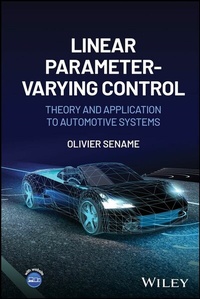
Linear Parameter-Varying Control
Description

An authoritative new exploration of the latest theoretical and applied advances in Linear Parameter-Varying systems
In Linear Parameter-Varying Control: Theory and Application to Automotive Systems, distinguished researcher Dr. Olivier Sename delivers a comprehensive and up-to-date discussion of the theoretical aspects and real applications of Linear Parameter-Varying (LPV) control, with a strong focus on systems theory and in real automotive systems. The author covers the primary methods used to model, control, and analyze LPV systems, and illustrates how to model those systems using examples.
This book covers developing adaptive LPV control using the provided recipes as guides and contextual aids as well as discovering effective methods to design LPV controllers that have already been validated through real applications.
Readers will also find:
- A thorough introduction to vehicle dynamics control in automated vehicles, as well as suspension control
- Comprehensive explorations of LPV systems modelling, including dynamical systems
- Practical discussions of the properties of LPV systems, including controllability, observability, and stability
- Complete treatments of LPV systems control, including state feedback control and dynamic output feedback LPV control
Perfect for researchers and students with an interest in vehicle dynamics, Linear Parameter-Varying Control will also benefit postgraduate and PhD students, control engineers, and academics teaching control theory and applications courses.
More details
Other editions
Additional editions
Person
Olivier Sename, PhD, is a full Professor at Grenoble INP. His main research focus is on Linear Parameter-Varying systems with automotive applications. He has authored or co-authored four books, around 100 international journal papers, more than 280 international conference papers and 6 patents.
Content
About the Author xv
Preface xvii
Acronyms xxi
About the Companion Website xxiii
Introduction xxv
Part I Some Theoretical Aspects on LPV Systems: From Modeling to Control 1
1 Some Modeling Approaches for LPV and qLPV Systems 3
1.1 Introduction 3
1.2 Dynamical Systems 4
1.3 An Introduction to LPV Models 5
1.4 Specific Classes of LPV Systems 10
1.5 From a Nonlinear Model to an LPV Representation 19
1.6 An Introduction to Identification of LPV Systems 23
1.7 The Nonuniqueness Issue: A Control-Oriented LPV Modeling Perspective 25
1.8 Illustrative Example 1: A Single Tank System 26
1.9 Illustrative Example 2: qLPV Modeling and Time-Varying Characteristics 30
1.10 Conclusion 34
Bibliography 34
2 Properties of LPV Systems 41
2.1 Introduction 41
2.2 Controllability 42
2.3 Observability 46
2.4 Comments on State-Space Realizations of LPV Systems 49
2.5 Stability 50
2.6 Performance Criteria: H8, gH2, and Pole Placement 55
2.7 About Stabilizability and Detectability 62
2.8 The Case of Discrete-Time LPV Systems 63
2.9 Conclusion 68
Bibliography 68
3 Control of LPV Systems 75
3.1 Introduction 75
3.2 LPV State-Feedback Control 77
3.3 The LPV Dynamic Output Feedback Control 88
3.4 LPV Observer Design 104
3.5 About Control of Discrete-Time LPV Systems 109
3.6 Conclusion 111
Bibliography 111
Part II LPV Methods for Nonlinear Systems 121
4 Control and Observer Design for Nonlinear Systems Using Quasi-LPV Models: An Illustration Through Examples 123
4.1 Introduction 123
4.2 H8/LPV Control of a Nonlinear System 124
4.3 An H8/LPV Observer of a Three-Tank Nonlinear System 134
4.4 Conclusion 140
Bibliography 140
5 Observer Design for Semi-active Suspension Systems: qLPV Approaches 143
5.1 Introduction 143
5.2 Illustrative Case Study: The INOVE Testbench, a Semi-active Suspension System 145
5.3 Electro-Rheological Dampers: Modeling Approaches 147
5.4 qLPV Quarter Car Semi-active Suspension Models 152
5.5 Method 1: An H8/gH2 Observer for Suspension State Estimation 158
5.6 Method 2: A H8 Filtering Approach for Damper Force Estimation 163
5.7 Method 3: A Nonlinear Parameter Varying Approach for State Estimation 168
5.8 Concluding Remarks 175
Bibliography 176
6 Lateral Control of Autonomous Vehicle 181
6.1 Introduction 181
6.2 Modeling 182
6.3 H8/LPV Control Design 187
6.4 Analysis of the Polytopic and Grid-Based Design Methods 191
6.5 Simulation Results 192
6.6 Conclusion 197
Bibliography 197
Part III LPV Adaptive-Like Control Methods 203
7 Methods and Tools for LPV Adaptive-Like Control 205
7.1 Introduction 205
7.2 The H8Framework: A Generic Tool for "Adaptive-Like" Control 206
7.3 LPV Adaptive Control with Varying Closed-Loop Performances (Function of External Parameters) 208
7.4 LPV Adaptive Control Function of Varying Endogeneous Parameters 215
7.5 Concluding Remarks 223
Bibliography 223
8 LPV Road Adaptive Suspension Control 227
8.1 Introduction 227
8.2 The Semi-active Suspension Quarter-Car Model 230
8.3 Road Roughness Estimator 233
8.4 Synthesis of a Semi-active Suspension Control 237
8.5 Simulation Results 246
8.6 Conclusions 249
Bibliography 249
9 LPV Fault-Tolerant Control Strategies for Suspension Systems 257
9.1 Introduction 257
9.2 Related Works 259
9.3 Fault Diagnosis Problem Formulation for Semi-active ER Suspension Systems 261
9.4 Fault Estimation Using LPV PI Observers 265
9.5 FTC LPV Control of Semi-active Suspension Systems 276
9.6 Conclusion 284
Bibliography 284
10 Lateral LPV Adaptive-Like Control of Automated Vehicles Adapted to Driver Performance 293
10.1 Introduction 293
10.2 LPV Observer-Based Control Structure for ADAS Systems 294
10.3 Driver Fault Estimation Using a Discrete-Time LPV PI Observer 295
10.4 Robust H8/LPV ADAS Strategy 301
10.5 Simulation Results 308
10.6 Conclusion 313
Bibliography 313
Index 317
Preface
This book is the culmination of over 20 years of experience with linear parameter-varying (LPV) systems and control, particularly in automotive applications. We started working on this topic during the PhD thesis of Alessandro Zin to design a suspension controller that could account for the nonlinearities of the suspension stiffness [Zin et al., 2004; Zin, 2005] to improve passenger comfort. From this study, numerous projects have been conducted across various academic and industrial settings, such as in engine control [Gauthier, 2007; Rivas Caicedo, 2012; Ngo, 2014; Dubuc, 2018], energy systems [Hernandez-Torres, 2011; Nwesaty, 2015; Wang, 2013], network-controlled systems [Robert, 2007; Roche, 2011], time-delay systems [Briat, 2008], model predictive control [Morato, 2023], aerospace [Vinco, 2024], and automotive vehicle dynamics [Poussot-Vassal, 2008; Aubouet, 2010; Do, 2011; Lozoya-Santos, 2012; Fergani, 2014; Tudon Martinez, 2013; Nguyen, 2016; Vu, 2017; Yamamoto, 2017; Pham, 2020; Atoui, 2022; Kapsalis, 2022; Medero Borrell, 2023].
The inspiration behind this book is to present a holistic approach to studying LPV systems, both in theory and in practical applications, building upon concepts introduced in my master's/PhD course [Sename, 2024]. It aims to cover the key aspects of system theory - from modeling to analysis and control design - and their application to real-world automotive systems.
On the theoretical side, the book offers methods for modeling, analyzing, and controlling LPV systems, providing an integrated approach to their study. Throughout this part, several examples illustrate how to model LPV systems from nonlinear ones; analyze properties such as controllability, observability, and stability; and develop LPV control and observation methods, particularly emphasizing the adaptive nature of LPV control. The ultimate objective is to offer guidelines for developing and synthesizing control and observation approaches within the LPV context.
On the application side, the book presents effective methods to develop LPV controllers and observers that have been validated in real-world applications. The primary focus is on the automotive domain, where extensive control studies have been conducted over the past 30 years. However, applying robust control to automotive systems has been limited by relying purely on linear approaches. The LPV approach addresses this limitation by extending robust control theory to nonlinear systems through the representation of these systems as LPV models using scheduling parameters. We illustrate this with several classical and important cases related to comfort and road safety, such as vehicle dynamics control for automated vehicles, and suspension control and fault diagnosis.
This book would not have seen the light of day without the collaborative efforts of our PhD students. I am deeply grateful for their dedication, teamwork, and the innovative contributions they made throughout their research. Special thanks to Charles, Lam, Jorge, Juan-Carlos, Soheib, Quan, Donatien, Hussam, Phong, Ariel, and Marcelo, whose results are prominently featured in this book.
I extend my heartfelt thanks to my international collaborators, whose contributions have been invaluable to the projects featured in this book. Special thanks to Peter Gaspar, Jozsef Bokor, and Zoltan Szabo from Hungary; Ricardo Ramirez Mendoza and Ruben Morales Menendez from Mexico; Sergio Savaresi from Italy; and Vicenc Puig from Spain.
On the other hand, a number of the results presented in this book would not have been possible without the support of the automotive industrial collaborations I have nurtured over the years Vicente Milanes, Vincent Talon, and Hubert Béchard from Renault; Benjamin Talon from Soben; Christophe Gauthier from Volvo Trucks; and Pascal Moulaire from JTEKT.
I am equally grateful to my close colleagues from our research team, Emmanuel Witrant, Delphine Bresch-Pietri, Damien Koenig, and John-Jairo Martinez-Molina, for their collaboration on these automotive projects.
Last but not least, I cannot thank my friend and colleague Luc Dugard enough. He warmly welcomed me to the Laboratoire d'Automatique de Grenoble when I arrived as a Maître de Conférences in 1995 and supported me for many years in the studies that led to this achievement.
Now, I invite you to delve into this book and explore its comprehensive approach to understanding LPV systems, both theoretically and in practical applications for control. You'll discover a range of methods and recipes for developing LPV controllers and observers, presented in an integrated and accessible manner. Additionally, we illustrate these concepts with real-world applications in automotive systems, bringing the theory to life. I hope you enjoy the journey and find the information as exciting and valuable as I do.
September 30, 2024 Olivier SenameGrenoble
France
Bibliography
- Hussam Atoui. Switching/Interpolating LPV Control based on Youla-Kucera Parameterization: Application to Autonomous Vehicles. PhD thesis, Université Grenoble Alpes, 2022.
- Sébastien Aubouet. Semi-Active SOBEN Suspensions Modeling and Control. PhD thesis, Institut National Polytechnique de Grenoble-INPG, 2010.
- Corentin Briat. Robust Control and Observation of LPV Time-Delay Systems. PhD thesis, Grenoble Institute of Technology, GIPSA-lab/Control Systems dpt, 2008.
- Anh-Lam Do. Approche LPV pour la commande robuste de la dynamique des véhicules: amélioration conjointe du confort et de la sécurité. PhD thesis, Université de Grenoble, 2011.
- Donatien Dubuc. Observation and Diagnosis for Trucks. PhD thesis, Université Grenoble Alpes (GIPSA-lab), France, 2018.
- Soheib Fergani. Robust Multivariable Control for Vehicle Dynamics. PhD thesis, Université de Grenoble, 2014.
- Christophe Gauthier. Modélisation et commande d'un système common rail. PhD thesis, INPG, Laboratoire d'Automatique de Grenoble (new GIPSA-lab) and Delphi Diesel Systems, Grenoble, France, 2007.
- David Hernandez-Torres. Robust Control of Hybrid Electro-Chemical Generators. PhD thesis, Université de Grenoble, 2011.
- Dimitrios Kapsalis. LPV/Gain-Scheduled Lateral Control Architectures for Autonomous Vehicles. PhD thesis, Université Grenoble Alpes, 2022.
- Jorge de Jesús Lozoya-Santos. Control of Automotive Semi-Active Suspensions. PhD thesis, Instituto Tecnologico y de Estudios Superiores de Monterrey, Mexico, 2012.
- Ariel Medero Borrell. LPV Lateral Control of Autonomous and Automated Vehicles. PhD thesis, Université Grenoble Alpes, 2023.
- Marcelo Menezes Morato. Predictive Control Methods for Linear Parameter Varying Systems. PhD thesis, Université Grenoble Alpes, 2023.
- Caroline Ngo. Surveillance du système de post-traitement essence et contrôle de chaîne d'air suralimentée. PhD thesis, Université de Grenoble, 2014.
- Manh-Quan Nguyen. LPV Approaches for Modeling and Control of Vehicle Dynamics: Application to a Small Car Pilot Plant with ER Dampers. PhD thesis, Université de Grenoble, 2016.
- Waleed Nwesaty. LPV/Hinf Control Design of On-Board Energy Management Systems for Electric Vehicles. PhD thesis, Université de Grenoble, 2015.
- Thanh-Phong Pham. LPV Observer and Fault-Tolerant Control of Vehicle Dynamics: Application to An Automotive Semi-Active Suspension System. PhD thesis, Université de Grenoble, 2020.
- Charles Poussot-Vassal. Robust Multivariable Linear Parameter Varying Control of Automotive Chassis. PhD thesis, Université de Grenoble, 2008.
- Maria Adelina Rivas Caicedo. Modeling and Control for Euro VI Spark Ignited (SI) Engine. PhD thesis, Université de Grenoble, 2012.
- David Robert. Contribution à l'interaction commande/ordonnancement. PhD thesis, INP Grenoble (Laboratoire d'Automatique de Grenoble), France, January 2007.
- Emilie Roche. Commande à échantillonnage variable pour les systèmes LPV: application à un sous-marin autonome. PhD thesis, Université de Grenoble (GIPSA-lab), France, October 2011.
- Olivier Sename. The linear parameter varying approach: theory and application to vehicle dynamic, 2024. URL https://oliviersename.fr.
- Juan-Carlos Tudon Martinez. Fault Tolerant Control in Automotive Semi-Active Suspensions. PhD thesis, Instituto Tecnologico y de Estudios Superiores de Monterrey, Mexico, 2013.
- Gian Marco Vinco. Flight Dynamics Modeling and Autopilot Design for Guided Projectiles via Linear Parameter-Varying Techniques. PhD thesis, Université Grenoble Alpes, 2024.
- Van Tan Vu. Enhancing the Roll Stability of Heavy Vehicles by Using An Active Anti-Roll Bar System. PhD thesis, Université Grenoble Alpes, 2017.
- Tinghong Wang. Robust Control Approach to Battery Health Accommodation of EMS in HEV. PhD...
