

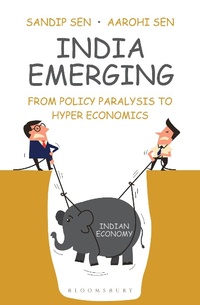
India Emerging
From Policy Paralysis to Hyper Economics
1st Edition
Published on 18. April 2019
286 pages
978-93-87457-94-2 (ISBN)
Description

India, like most democratic developing nations, is prone to populist politics. In the search of votes, politicians look for popular solutions with mass appeal. Some popular solutions benefit the poor, some hurt the economy. Poor economics leads to falling numbers. Falling numbers get statistically captured as economic data. And, the impact of such economic data is immense. This data can lift or crash currency markets, stock markets, affect credit ratings, fuel inflation, affect new investments and even result in mass layoffs.
However, there is always a story behind the data. These stories are guided mostly by executive decisions. Some decisions are far-reaching and beneficial to the masses, some cater to political vote banks, some are guided by increasing activism, some serve the need for social justice, some are aimed at environmental protection, while some are simply driven by the greed of power or wealth. This is the story of every regime.
The book narrates this compelling data story in a layman's language. Even where data is wrong it leaves behind a tell-tale mark of anomalies, which trips the economy sooner than later. Fudged, incorrect or lazily collected data is worse than genuine but unimpressive data as you do not know what to correct. India Emerging thus captures this dialogue on the pros and cons of economic and political decisions that can be understood by the common voter who is neither an economist nor an academician.
However, there is always a story behind the data. These stories are guided mostly by executive decisions. Some decisions are far-reaching and beneficial to the masses, some cater to political vote banks, some are guided by increasing activism, some serve the need for social justice, some are aimed at environmental protection, while some are simply driven by the greed of power or wealth. This is the story of every regime.
The book narrates this compelling data story in a layman's language. Even where data is wrong it leaves behind a tell-tale mark of anomalies, which trips the economy sooner than later. Fudged, incorrect or lazily collected data is worse than genuine but unimpressive data as you do not know what to correct. India Emerging thus captures this dialogue on the pros and cons of economic and political decisions that can be understood by the common voter who is neither an economist nor an academician.
More details
Edition
1. Auflage
Language
English
Place of publication
New Delhi
India
ISBN-13
978-93-87457-94-2 (9789387457942)
Copyright in bibliographic data and cover images is held by Nielsen Book Services Limited or by the publishers or by their respective licensors: all rights reserved.
Schweitzer Classification
Persons
Sandip Sen is an author, journalist and a TV commentator. He has worked for The Indian Express, Delhi Press and IPP as an editor and has authored two books. He has been published by national newspapers such as The Times of India, Hindustan Times, DNA, Hindu Business Line, The Economic Times, Financial Express, besides think tanks like CSE, TERI and ORF for more than a decade. Prior to journalism, he worked for 10 years in the energy industry and 22 years in manufacturing.
Aarohi Sen is a principal at Accenture. He is a thought leader researching on the impact of digital technologies on large industrial enterprises. He joined Accenture in 2007 and has worked on ideas of innovation, the future of IT and manufacturing operations. He has been a contributor to leading business periodicals such as The Harvard Business Review, The European Business Review, Fortune and Mint. The views expressed in the book are his own and not of Accenture.
Aarohi Sen is a principal at Accenture. He is a thought leader researching on the impact of digital technologies on large industrial enterprises. He joined Accenture in 2007 and has worked on ideas of innovation, the future of IT and manufacturing operations. He has been a contributor to leading business periodicals such as The Harvard Business Review, The European Business Review, Fortune and Mint. The views expressed in the book are his own and not of Accenture.
Content
- Cover Page
- Half Title
- Title Page
- Copyright
- Dedication
- Contents
- Acknowledgements
- Author's Note
- Introduction
- Part I Early Development
- 1. India Before the Millennium: Only Indira Gandhi Was Disruptive
- Part II Finance and Economy
- 2. Living Dangerously with a Troubled Legacy: The Chimera of Achhe Din
- 3. Jan Dhan and Demonetisation: A Political Gain and Economic Loss
- 4. GST: Reform Done, Revamp Needed for a Business-Friendly Solution
- Part III Energy
- 5. Coal Makes a New Beginning: Production and Distribution Revives
- 6. Opportunity to Build Oil Infrastructure Lost: High Taxes Hurt the Consumer
- 7. A Remarkable Progress in Renewable Energy: Solar, Wind Cheaper Than Fossils
- Part IV Manufacturing and Infrastructure
- 8. Mining in the Pits: Activism and Illegal Mining Continues
- 9. Infrastructure: Reasonable Growth but Environmental Concerns Remain
- 10. Manufacturing: Moving Out of the Woods but Slowly
- Part V Food and Agriculture
- 11. Volatility in Food Prices: Can It Be Controlled?
- 12. Indian Agriculture at Crossroads: New Direction Needed
- Part VI Social Sector
- 13. MGNREGA: Need Wage Distribution and Rural Asset Building
- 14. Swachh Bharat Mission: Is Rural India Using the Toilets Build?
- Part VII Employment
- 15. Jobs Are Growing, but So Are Educated Unemployed
- 16. Entrepreneurship: Start-Ups Flourish, Unicorns Prosper
- Part VIII Digital India
- 17. Telecom: A Growth Story Despite Call Drops
- 18. IT Sector: Facing Global Headwinds
- Part IX The Way Ahead
- 19. Managing Future Risks
- Conclusion
- Bibliography
- Index
- About the Authors
