

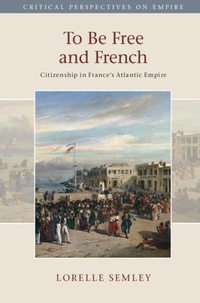
To Be Free and French
Citizenship in France's Atlantic Empire
Published on 26. July 2017
978-1-108-29476-8 (ISBN)
Description

The Haitian Revolution may have galvanized subjects of French empire in the Americas and Africa struggling to define freedom and 'Frenchness' for themselves, but Lorelle Semley reveals that this event was just one moment in a longer struggle of women and men of color for rights under the French colonial regime. Through political activism ranging from armed struggle to literary expression, these colonial subjects challenged and exploited promises in French Republican rhetoric that should have contradicted the continued use of slavery in the Americas and the introduction of exploitative labor in the colonization of Africa. They defined an alternative French citizenship, which recognized difference, particularly race, as part of a 'universal' French identity. Spanning Atlantic port cities in Haiti, Senegal, Martinique, Benin, and France, this book is a major contribution to scholarship on citizenship, race, empire, and gender, and it sheds new light on debates around human rights and immigration in contemporary France.
Reviews / Votes
'Semley seeks to understand the intersection of citizenship, race, and gender within the 19th- and 20th-century French Atlantic empire. She does this through a series of engaging and well-researched chapters centered on important imperial events where the local and imperial intersect and where imperial subjects see themselves within both French and local identities. ... As a whole, the work illustrates the complexity of race, citizenship, and gender in that they often worked together while they were also at odds. Many of the figures described in the book embraced the larger revolutionary ideals of citizenship, but then had to negotiate them within their local contexts. Finally, even as slaves became free and freed men became citizens, women had to wait. ... Recommended. Upper-division undergraduates and above.' T. M. Reese, Choice 'Semley combines outstanding archival research from three continents with insightful analysis and engaging prose. She consistently shows her ability to tell a good a story in an intriguing location. To Be Free and French is full of surprises and fascinating individuals who actively sought to define themselves within the context of French imperialism. Like her subjects, Semley refuses to fall into the simplistic dualities of colonizer and colonized, French or not-French, and white or black.' Michael G. Vann, World History Connected '... this book responds brilliantly to a decades-old call to better represent Africa, Africans and their diaspora in Atlantic history. In doing so, Semley provides us with an exemplary model for grounding broad historical concerns in close readings of primary evidence from disparate and connected places. I field-tested this book in an upper-division undergraduate course. To Be Free and French received high praise from young people in need of nuanced analysis and innovative methods to critique racialized and gendered inequities in their own complex and globalizing worlds.' Sarah Zimmerman, European History Quarterly 'Lorelle Semley's work ambitiously integrates the fields of African diaspora and Atlantic studies with the history of citizenship, French empire, gender, law, transnationalism, and urban studies. ... Semley's work offers a praiseworthy contribution to the existing literature on French empire and colonial citizenship as well as an important foundation for understanding contemporary debates about citizenship in France.' Elizabeth Heath, The American Historical ReviewMore details
Series
Language
English
Place of publication
Cambridge
United Kingdom
Target group
Professional and scholarly
Illustrations
Worked examples or Exercises; 27 Halftones, black and white
File size
9,59 MB
ISBN-13
978-1-108-29476-8 (9781108294768)
Copyright in bibliographic data and cover images is held by Nielsen Book Services Limited or by the publishers or by their respective licensors: all rights reserved.
Schweitzer Classification
Other editions
Additional editions
Book
07/2017
Cambridge University Press
€107.50
Shipment within 15-20 days
Book
07/2017
Cambridge University Press
€45.00
Shipment within 15-20 days
Person
Lorelle Semley is an Associate Professor of History at the College of the Holy Cross, Massachusetts, where she teaches courses in African history, the African diaspora, and gender studies. Her research has been facilitated by fellowships at the John Carter Brown Library, the W. E. B. Dubois Research Institute, and the Schomburg Center for Research in Black Culture at the New York Public Library. Research grants have supported travel to Benin, Brazil, France, Great Britain, Martinique, and Senegal. Previous works include Mother Is Gold, Father Is Glass: Gender and Colonialism in a Yoruba Town (2010) and articles for Law and History Review, Radical History Review, and Gender and History.
Content
List of figures; List of maps; List of tables; Preface: coincidental crossings; Acknowledgments; Part I. Revolutionary Foundations: Prologue: citizens of the world; 1. To live and die, free and French; 2. Signares before citizens; Part II. Colonial Constructions: 3. When Blacks broke the chains in the 'Little Paris of the Antilles'; 4. The trans-African origins of Porto-Novo; 5. An 'evolution revolution' in Paris; Part III. Planning after Empire: 6. A more perfect French Union; Epilogue: the art of citizenship; Bibliography; Index.
