

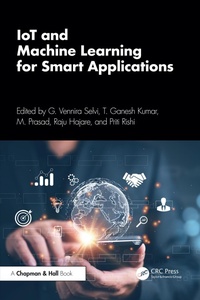
IoT and Machine Learning for Smart Applications
1st Edition
Published on 6. March 2025
210 pages
978-1-040-30430-3 (ISBN)
Description

This book provides an illustration of the various methods and structures that are utilized in machine learning to make use of data that is generated by IoT devices. Numerous industries utilize machine learning, specifically machine learning-as-a-service (MLaaS), to realize IoT to its full potential. On the application of machine learning to smart IoT applications, it becomes easier to observe, methodically analyze, and process a large amount of data to be used in various fields.
Features:
Explains the current methods and algorithms used in machine learning and IoT knowledge discovery for smart applications
Covers machine- learning approaches that address the difficulties posed by IoT- generated data for smart applications
Describes how various methods are used to extract higher- level information from IoT- generated data
Presents the latest technologies and research findings on IoT for smart applications
Focuses on how machine learning algorithms are used in various real- world smart applications and engineering problems
It is a ready reference for researchers and practitioners in the field of information technology who are interested in the IoT and Machine Learning fields.
Features:
Explains the current methods and algorithms used in machine learning and IoT knowledge discovery for smart applications
Covers machine- learning approaches that address the difficulties posed by IoT- generated data for smart applications
Describes how various methods are used to extract higher- level information from IoT- generated data
Presents the latest technologies and research findings on IoT for smart applications
Focuses on how machine learning algorithms are used in various real- world smart applications and engineering problems
It is a ready reference for researchers and practitioners in the field of information technology who are interested in the IoT and Machine Learning fields.
More details
Edition
1. Auflage
Language
English
Place of publication
London
United Kingdom
Publishing group
Taylor & Francis Ltd
Target group
Professional and scholarly
Illustrations
12 Tables, black and white; 50 Line drawings, black and white; 2 Halftones, black and white; 52 Illustrations, black and white
File size
16,18 MB
ISBN-13
978-1-040-30430-3 (9781040304303)
Copyright in bibliographic data and cover images is held by Nielsen Book Services Limited or by the publishers or by their respective licensors: all rights reserved.
Schweitzer Classification
Other editions
Additional editions
G. Vennira Selvi | T. Ganesh Kumar | M. Prasad
IoT and Machine Learning for Smart Applications
Book
approx. 07/2026
1st Edition
Chapman & Hall/CRC
€64.50
Not yet published
G. Vennira Selvi | T. Ganesh Kumar | M. Prasad
IoT and Machine Learning for Smart Applications
Book
03/2025
1st Edition
Chapman & Hall/CRC
€206.20
Shipment within 10-20 days
Persons
G. Vennira Selvi is Professor at the School of Computer Science and Engineering and Information Science at Presidency University, Bengaluru, India. She received her Doctorate Degree in Computer Science and Engineering from Pondicherry University, Pondicherry in 2018 and M.E. degree in Computer Science and Engineering from Manonmaniam Sundaranar University, Tirunelveli. She has published 20 papers in reputed international journals, 6 papers as part of international conferences, and 12 papers as part of national conferences. She has published two books and nine book chapters. She has received eight Indian patents, one Design grant patent, and one international patent. She has 22 years of teaching experience in undergraduate and postgraduate courses. Her current research areas are IoT, wireless sensor networks, machine learning, and artificial intelligence.
T.Ganesh Kumar works as Associate Professor in the School of Computing Science and Engineering at Galgotias University, NCR, Delhi. He received an M.E. degree in Computer Science and Engineering from Manonmaniam Sundaranar University, Tamil Nadu, India. He completed his full- time Ph.D. degree in Computer Science and Engineering at Manonmaniam Sundaranar University. He was Co- Investigator for two Government of India- sponsored funded projects. He has publications in many reputed international Science Citation Index and Scopus indexed journals and conference proceedings. He has published more than ten Indian patents.
M. Prasad received his B.Tech, M.Tech, and doctorate degrees in Information Technology, Information Security, and Mobile Communication from Pondicherry University, Pondicherry, in 2008, 2010, and 2017, respectively. He is currently working in VIT Chennai campus School of Computing Science and Engineering. His current areas of research include IoT, security in mobile communication, cyber physical systems, machine learning, and artificial intelligence. He is having various professional memberships like IEEE, ACM, CSI, and Internet Society of India. He has published in more than 20 journals and holds 10 patents to his name.
Raju Hajare is Professor at the BMS Institute of Technology and Management. He is a doctorate in the field of "Nano Devices Modeling and Simulation". He has 19 years of academic and 2 years of industry experience at various levels of organizations. Dr. Raju has published more than 30 quality research publications in reputed Scopusindexed international journals and IEEE proceedings. Professor Raju has two textbooks to his credit in the domain of electronics.
Priti Rishi is Associate Professor at the College of Engineering and Technology, SRM Institute of Engineering and Technology, Vadapalani Campus, Chennai. She received an M.E. degree in Electronics and Communication Engineering from Thapar Institute of Engineering and Technology, Punjab, India. She completed her part-time Ph.D. degree at the Faculty of Information and Communication Engineering at Anna University Chennai. She has multiple publications to her credit and holds more than three Indian patents.
T.Ganesh Kumar works as Associate Professor in the School of Computing Science and Engineering at Galgotias University, NCR, Delhi. He received an M.E. degree in Computer Science and Engineering from Manonmaniam Sundaranar University, Tamil Nadu, India. He completed his full- time Ph.D. degree in Computer Science and Engineering at Manonmaniam Sundaranar University. He was Co- Investigator for two Government of India- sponsored funded projects. He has publications in many reputed international Science Citation Index and Scopus indexed journals and conference proceedings. He has published more than ten Indian patents.
M. Prasad received his B.Tech, M.Tech, and doctorate degrees in Information Technology, Information Security, and Mobile Communication from Pondicherry University, Pondicherry, in 2008, 2010, and 2017, respectively. He is currently working in VIT Chennai campus School of Computing Science and Engineering. His current areas of research include IoT, security in mobile communication, cyber physical systems, machine learning, and artificial intelligence. He is having various professional memberships like IEEE, ACM, CSI, and Internet Society of India. He has published in more than 20 journals and holds 10 patents to his name.
Raju Hajare is Professor at the BMS Institute of Technology and Management. He is a doctorate in the field of "Nano Devices Modeling and Simulation". He has 19 years of academic and 2 years of industry experience at various levels of organizations. Dr. Raju has published more than 30 quality research publications in reputed Scopusindexed international journals and IEEE proceedings. Professor Raju has two textbooks to his credit in the domain of electronics.
Priti Rishi is Associate Professor at the College of Engineering and Technology, SRM Institute of Engineering and Technology, Vadapalani Campus, Chennai. She received an M.E. degree in Electronics and Communication Engineering from Thapar Institute of Engineering and Technology, Punjab, India. She completed her part-time Ph.D. degree at the Faculty of Information and Communication Engineering at Anna University Chennai. She has multiple publications to her credit and holds more than three Indian patents.
Content
1. Recent Advances in Machine Learning Strategies and its Applications 2. Understanding the Concept of IoT 3. Unlocking the Power of IoT: An In-Depth Exploration 4. Machine Learning in Internet of Things 5. Role of Machine Learning in Real Life Environment 6. Efficient Blockchain Based Edge Computing System Using Transfer Learning Model 7. Introducing a Compact and High-Speed Machine Learning Accelerator for IoT enabled health monitoring systems 8. Realization of smart city based on IoT and AI 9. Sentiment Analysis of airline tweets using Machine Learning Algorithms and Regular Expression 10. Smart Workspace Automation: Harnessing IoT and AI for Sustainable Urban Development and Improved Quality of Life 11. Application of Digital Image Watermarking in the Internet of Things and Machine Learning
