

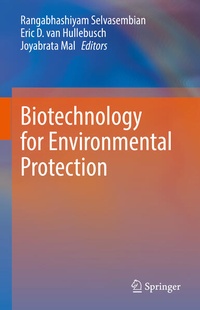
Biotechnology for Environmental Protection
Description

This book covers broader application of biotechnology for the protection of environment through different bioremediation and biodegradation techniques developed for removal of environmental contaminants including the recently discovered contaminants. The book offers a comprehensive overview of environmental pollutants including their fate, behavior, environmental and associated health risks. It is useful reading material for postgraduate and graduate students of environmental biotechnology, environmental microbiology and ecology. Young researchers also find the chapters useful understanding the latest developments.
More details
Other editions
Additional editions
Persons
Dr. Rangabhashiyam Selvasembian currently working as Assistant Professor in the School of Chemical & Biotechnology, SASTRA Deemed University, India. He received his Doctor of Philosophy degree from National Institute of Technology Calicut, India. He has received Post-Doctoral Fellowship from Max Planck Institute for Dynamics of Complex Technical Systems, Germany, received National-Post Doctoral Fellowship from SERB-DST, India, selected as Young Scientist by DST, India for the BRICS Conclave held in Durban, South Africa and received Hiyoshi Young Leaf Award from Hiyoshi Ecological Services, Hiyoshi Corporation, Japan. His major research interests are bioremediation and wastewater treatment. He is Associate Editor in Frontiers in Environmental Chemistry; International Journal of Environmental Science & Technology; IET Nanobiotechnology, Academic Editor of Adsorption Science and Technology and Editorial Board member of Scientific Reports, Biomass conversion and biorefinery. He has published over 95 articles and also contributed several book chapters including editing books.
Prof. Eric D. van Hullebusch is currently full professor Biogeochemistry of engineered ecosystems at Institut de Physique du Globe de Paris / Université Paris Cité (France). He received his PhD (Aquatic Chemistry and Microbiology) from Université de Limoges (France). He was Marie Curie Postdoctoral fellow at Wageningen University & Research (the Netherlands) where his research focused on the optimization of anaerobic granular sludge reactors by studying the speciation, bioavailability and dosing strategies of trace metals. In 2005, he was appointed as associate professor in biogeochemistry of engineered ecosystems at Université Gustave Eiffel (France). He has also worked at IHE Delft (the Netherlands) as chair professor in Environmental Science and Technology and head of the Pollution Prevention and Resource Recovery chair group. Prof. Eric D. van Hullebusch has published morethan 262 peer-reviewed papers (10000+ citations, h-index 53) in the field of biogeochemistry of metals and metalloids in engineered ecosystems. His research is currently mostly focusing on the implementation of biohydrometallurgical approaches for the recovery of technology critical elements as well as polluted soils (bio)remediation.
Dr. Joyabrata Mal currently working as Assistant Professor Assistant Professor, Department of Biotechnology, Motilal Nehru National Institute of Technology Allahabad (MNNIT Allahabad), Prayagraj, India. Dr. Mal completed his Ph.D. form UNESCO-IHE, Netherlands as an Erasmus Mundus Joint Doctoral Fellow. His PhD thesis also got nominated (top 7) for the best PhD Thesis award in Environmental science and technology by The Royal Netherlands Chemical Society. Before joining MNNIT Allahabad, he worked in University of Berkeley, USA and National University of Ireland Galway, Ireland as Postdoctoral researcher in Environmental Biotechnology.His research primarily focuses on biological treatment of wastewater using various reactors (e.g. UASB, SBR), Bioremediation and resource recovery and environmental nanotechnology including its application in wastewater treatment. His major research interests are bioremediation and wastewater treatment.
