

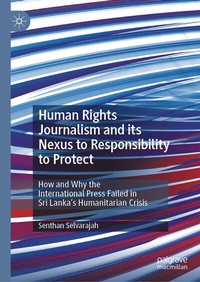
Human Rights Journalism and its Nexus to Responsibility to Protect
Description

This book takes a holistic approach by capturing the various perspectives and viewpoints concerning the theory and practice of Human Rights Journalism. Firstly, this book helps fill the epistemological vacuum present in Human Rights Journalism by proposing 'pragmatic objectivity' within the critical constructivist epistemology. Secondly, it defines the Human Rights Journalism-Responsibility to Protect nexus by identifying five key elements. Thirdly, it proposes a Human Rights Journalism-Responsibility to Protect conceptual model, which illustrates how an embedded human rights focussed media strategy can be designed. Fourthly, this book proposes two novel quantitative analysis tools called the 'Framing Matrix' and the 'Multimodal Discourse Analysis Matrix' that are equipped to deal with a big sample size over a long period of time. These tools are used to examine the practice of Human Rights Journalism and the typology of news stories of distant sufferings. Finally, it providesa scientific explanation for those in search of the answer to why one of the worst humanitarian crises in the world, which took place in Sri Lanka in 2009, did not create any global compassion or garner attention.
More details
Other editions
Additional editions
Person
Senthan Selvarajah is Co-Director of the Centre for Media, Human Rights and Peacebuilding based in the UK. Dr. Selvarajah has over 20 years of experience as a journalist, researcher, consultant and academic, and currently serves as the Convener of the Media, Conflicts, and Journalism Commission of the International Peace Research Association.
Content
1. Introduction: Understanding Human Rights Journalism and Its Nexus to Responsibility to Protect.- 2. The Failings of Conventional War Journalism.- 3. Human Rights Journalism: Tracing Its Epistemological Foundation.- 4. Exploring the links between Responsibility to Protect (R2P) and Human Rights Journalism (HRJ).- 5. Analysing feature detection of media representations via Framing Matrix and Multimodal Discourse Analysis Matrix.- 6. Accessibility Effect of the Agenda Setting of the Humanitarian Crisis of Sri Lanka.- 7. Applicability Effect of the Agenda Setting of the Humanitarian Crisis of Sri Lanka.- 8. Exploring the Impact of the Applicability Effect of the Humanitarian Crisis in Sri Lanka in the International Press.- 9. Journalists Speak Up on Their Reporting of the Crisis in Sri Lanka.- 10. Conclusion: Theory and Practice of Human Rights Journalism.
