

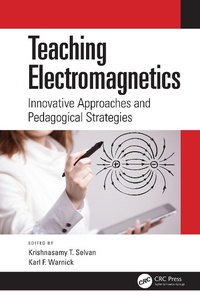
Teaching Electromagnetics
Innovative Approaches and Pedagogical Strategies
1st Edition
Published on 17. June 2021
258 pages
978-1-000-40083-0 (ISBN)
Description

Teaching Electromagnetics: Innovative Approaches and Pedagogical Strategies is a guide for educators addressing course content and pedagogical methods primarily at the undergraduate level in electromagnetic theory and its applications. Topics include teaching methods, lab experiences and hands-on learning, and course structures that help teachers respond effectively to trends in learning styles and evolving engineering curricula. The book grapples with issues related to the recent worldwide shift to remote teaching.
Each chapter begins with a high-level consideration of the topic, reviews previous work and publications, and gives the reader a broad picture of the topic before delving into details. Chapters include specific guidance for those who want to implement the methods and assessment results and evaluation of the effectiveness of the methods. Respecting the limited time available to the average teacher to try new methods, the chapters focus on why an instructor should adopt the methods proposed in it. Topics include virtual laboratories, computer-assisted learning, and MATLAB (R) tools. The authors also review flipped classrooms and online teaching methods that support remote teaching and learning. The end result should be an impact on the reader represented by improvements to his or her practical teaching methods and curricular approach to electromagnetics education. The book is intended for electrical engineering professors, students, lab instructors, and practicing engineers with an interest in teaching and learning. In summary, this book:
Surveys methods and tools for teaching the foundations of wireless communications and electromagnetic theory
Presents practical experience and best practices for topical coverage, course sequencing, and content
Covers virtual laboratories, computer-assisted learning, and MATLAB tools
Reviews flipped classroom and online teaching methods that support remote teaching and learning
Helps instructors in RF systems, field theory, and wireless communications bring their teaching practice up to date
Dr. Krishnasamy T. Selvan is Professor in the Department of Electronics & Communication Engineering, SSN College of Engineering, since June 2012.
Dr. Karl F. Warnick is Professor in the Department of Electrical and Computer Engineering at BYU.
Each chapter begins with a high-level consideration of the topic, reviews previous work and publications, and gives the reader a broad picture of the topic before delving into details. Chapters include specific guidance for those who want to implement the methods and assessment results and evaluation of the effectiveness of the methods. Respecting the limited time available to the average teacher to try new methods, the chapters focus on why an instructor should adopt the methods proposed in it. Topics include virtual laboratories, computer-assisted learning, and MATLAB (R) tools. The authors also review flipped classrooms and online teaching methods that support remote teaching and learning. The end result should be an impact on the reader represented by improvements to his or her practical teaching methods and curricular approach to electromagnetics education. The book is intended for electrical engineering professors, students, lab instructors, and practicing engineers with an interest in teaching and learning. In summary, this book:
Surveys methods and tools for teaching the foundations of wireless communications and electromagnetic theory
Presents practical experience and best practices for topical coverage, course sequencing, and content
Covers virtual laboratories, computer-assisted learning, and MATLAB tools
Reviews flipped classroom and online teaching methods that support remote teaching and learning
Helps instructors in RF systems, field theory, and wireless communications bring their teaching practice up to date
Dr. Krishnasamy T. Selvan is Professor in the Department of Electronics & Communication Engineering, SSN College of Engineering, since June 2012.
Dr. Karl F. Warnick is Professor in the Department of Electrical and Computer Engineering at BYU.
Reviews / Votes
"The book's structure allows for reading the chapters independently and in no particular order....This nonbinding structure of independent and easy-to-read, stand-alone chapters is no coincidence. It clearly results from the editors' effort to adequately capture the richness and variety of approaches to education and ideas on teaching. To this end, they assembled a lineup of 20 contributors, varying in their disciplinary backgrounds as well as geographic location, seniority, and gender. The resulting diversity of topics, writing styles, and offered techniques and strategies guarantees that there will be something of interest in the book for everyone. Personally, I found very inspiring and eye-opening many of the numerous examples for interactive numerical exercises as well as the review of available mobile apps for EM education. Chapter 7 stood out to me, as it (very enjoyably) put me back in the student role for a short while, but each of the chapters contains some ideas that I found appealing and suitable to my teaching style. Although carefully curated with a general philosophy in mind, the book does not advocate for one approach, nor does it impose a rigid teaching paradigm. It is more of a snapshot of contemporary thought on EM education and newly available teaching tools and techniques, suggested by peers, which serves as a substrate for further discussion. Indeed, my urge while the reading to bring up these topics with my colleagues immediately sparked some very passionate and intriguing conversations. Evidently, the book achieves its primary aim: to further the ever-continuing discussion among teachers and students on bettering education in our field." - Yaniv Brick, School of Electrical and Computer Engineering Ben-Gurion University of the Negev, Beer-Sheva, Israel/IEEE Antennas and Propogation MagazineMore details
Edition
1. Auflage
Language
English
Place of publication
London
United Kingdom
Publishing group
Taylor & Francis Ltd
Target group
Professional and scholarly
Product notice
Reflowable
Illustrations
7 Tables, black and white; 59 Line drawings, black and white; 28 Halftones, black and white; 87 Illustrations, black and white
ISBN-13
978-1-000-40083-0 (9781000400830)
Copyright in bibliographic data and cover images is held by Nielsen Book Services Limited or by the publishers or by their respective licensors: all rights reserved.
Schweitzer Classification
Other editions
Additional editions
Krishnasamy T. Selvan | Karl F. Warnick
Teaching Electromagnetics
Innovative Approaches and Pedagogical Strategies
Book
06/2021
1st Edition
CRC Press
€95.80
Shipment within 15-20 days
Krishnasamy T. Selvan | Karl F. Warnick
Teaching Electromagnetics
Innovative Approaches and Pedagogical Strategies
Book
06/2021
1st Edition
CRC Press
€241.90
Shipment within 15-20 days
Persons
Dr. Krishnasamy T. Selvan is Professor in the Department of Electronics & Communication Engineering, SSN College of Engineering, since June 2012.
Dr. Karl F. Warnick is Professor in the Department of Electrical and Computer Engineering at BYU.
Dr. Karl F. Warnick is Professor in the Department of Electrical and Computer Engineering at BYU.
Content
1. Introduction.
2.Teaching and Learning Electromagnetics in 2020.
3. An Experiential Learning Approach in Electromagnetics Education.
4. Teaching and Learning Electromagnetics through MATLAB (R) Programming of Electromagnetic Fields.
5. Interactive Computational Tools for Electromagnetics Education Enhancement.
6. Computational Electromagnetics and Mobile Apps For Electromagnetics Education.
7. Teaching Electromagnetic Field Theory Using Differential Forms.
8. Maxwell's Displacement Current: A Teaching Approach Infusing Ideas of Innovation and Creativity.
9. Teaching Electromagnetic Waves to Electrical Engineering Students: An Abridged Approach.
10. Taking Electromagnetics Beyond Electrical and Electronics Engineering.
11. HyFlex Flipping: Combining In-Person and On-Line Teaching for the Flexible Generation.
12. Learning and Teaching in a Time of Pandemic.
13. Conclusion and Outlook.
2.Teaching and Learning Electromagnetics in 2020.
3. An Experiential Learning Approach in Electromagnetics Education.
4. Teaching and Learning Electromagnetics through MATLAB (R) Programming of Electromagnetic Fields.
5. Interactive Computational Tools for Electromagnetics Education Enhancement.
6. Computational Electromagnetics and Mobile Apps For Electromagnetics Education.
7. Teaching Electromagnetic Field Theory Using Differential Forms.
8. Maxwell's Displacement Current: A Teaching Approach Infusing Ideas of Innovation and Creativity.
9. Teaching Electromagnetic Waves to Electrical Engineering Students: An Abridged Approach.
10. Taking Electromagnetics Beyond Electrical and Electronics Engineering.
11. HyFlex Flipping: Combining In-Person and On-Line Teaching for the Flexible Generation.
12. Learning and Teaching in a Time of Pandemic.
13. Conclusion and Outlook.
