

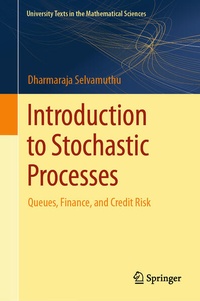
Introduction to Stochastic Processes
Description

This is an essential textbook for senior undergraduate and graduate students of statistics, stochastic processes, stochastic finance, and probability theory. It covers all the important notations of probability theory and stochastic processes that are crucial for students to overcome their initial challenges during their studies. It thoroughly discusses the concepts of stochastic processes, both Markov and non-Markov processes, as well as stochastic calculus. With a special focus on finance, the book dedicates three chapters to explore the applications of stochastic processes in options, credit risk and insurance.
Organized into sixteen chapters and one appendix, the book takes the readers to a well-organized learning. To fully grasp the intricacies of stochastic processes, students are expected to have a solid grounding in real analysis, linear algebra, and differential equations. Practical examples are emphasized throughout the book, carefully selected from various fields. The exercises at the end of each chapter are designed with the same objective in mind. Stochastic processes play a significant role in various scientific disciplines and real-life applications.
More details
Other editions
Additional editions
Person
Dharmaraja Selvamuthu is Professor at the Department of Mathematics, Indian Institute of Technology Delhi, India. He also served as Head of the Department of Mathematics, Indian Institute of Technology Delhi. He earned his M.Sc. degree in Applied Mathematics at Anna University, Chennai, India, in 1994 and Ph.D. degree in Mathematics from the Indian Institute of Technology Madras, India, in 1999. He has held visiting positions at Duke University, USA; Emory University, USA; University of Calgary, Canada; University of Los Andes, Bogota, Colombia; National University of Colombia, Bogota, Colombia; University of Verona, Italy; Sungkyunkwan University, Suwon, Korea; and Universita Degli Studi di Salerno, Fisciano, Italy. His research interests include applied probability, queueing theory, stochastic modeling, performance analysis of computer and communication systems, and financial mathematics. He has published over 85 research papers in several international journals of repute and over 40 research papers at various international conferences.
Content
Preface.- 1. Introduction to Stochastic Processes.- 2. Discrete Time Markov Chains - Part I.- 3. Discrete Time Markov Chains - Part II.- 4. Continuous Time Markov Chains, Part I.- 5. Continuous Time Markov Chains, Part II.- 6. Continuous Time Markov Chains, Part III.- 7. Simple Markov Queueing Models.- 8. Advanced Markov Queueing Models.- 9. Non-Markov Processes.- 10. Non-Markov Queueing Models.- 11. Diffusion and Jump-diffusion Processes.- 12. Stochastic Calculus.- 13. Stochastic Differential Equations.- 14. Applications to Finance - Option Pricing- 15. Applications to Finance - Credit Risk.- 16. Applications to Finance - Insurance Problems.- Appendix.
