

MGMT MEMO: Management Lessons from DEC
Description

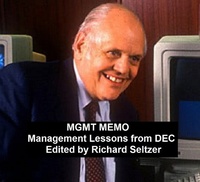
DEC was the creation of its co-founder and president Ken Olsen, who for four decades shaped the cadre of managers and the corporate culture that motivated and enabled one generation after another of creativity and innovation as his company grew from a small team to a global corporation with over 140,000 employees. Fortune Magazine called him "the ultimate entrepreneur". When MGMT MEMO was originally published, most DEC employees couldn't read it. Labelled "For Internal Communication Only", it was only sent to managers, with the understanding that they would communicate the messages to their employees. Now, twenty years after the demise of the company, when there is no longer a need for confidentiality, these documents can help us to remember and relive the challenges, the triumphs, and the cameraderie of that time. Over the course of eleven years, this publication evolved from a collection of short news items to lengthy discussions of the many reorganizations and the reasons behind them, as well as Ken's thoughts on management and corporate culture, his hopes and his advice. It served as a tool for him to deliver messges that he considered important and timely. The articles reflect the dynamics of rapid growth in a fast changing high tech environment: the stress of the ever-urgent need to develop one new product after another and related services, for an ever-expanding range of uses; the need to come up with new ways to connect product to product and people to people, with new kinds of organization and new theories of how to motivate and manage large numbers of people. They repeatedly attempt to redefine the company, as the employee population doubled in size. They recount the struggle to invent not just new products but also new kinds of new products and to find ways to effectively use those same products to develop the next generation of products and to market them and to help an expanding range of customers who needed our products and services to build their businesses and to create new businesses and invent new kinds of business. How was it possible to manage such an entity in hyper-growth mode, to accurately prophesize changing customer needs and tastes and come up with new products and services that they would need and to be prepared to manufacture products in the volumes required, and to recruit and train the people necessary for all that, and to do all of this in sync, so the money and the resources were available when and where they were needed? How could such an entity -- such a storm of creative activity -- hold together and continue to grow? How was it possible to "manage" it, to deal with one unprecedented challenge after another? How was it possible to foster a core of values, a sense of corporate culture and identity?
All prices
More details
Content
Edited by Richard Seltzer
Published by Seltzer Books. seltzerbooks.com
established in 1974, as B&R Samizdat Express
offering over 14,000 books
feedback welcome: seltzer@seltzerbooks.com
Introduction: Refreshing Memories Of DEC, 20 Years After Its Demise
Volume 1, Number 1__ November/ 1982
Volume 1, Number 2 __ December, 1982
Volume 2, Number 1 January, 1983
Volume 2, Number 2 February, 1983
Volume 2, Number 8 August 1983
Volume 2, Number 9 September 1983
Volume 2, Number 10 October 1983
Volume 2, Number 11 November 1983
Volume 2, Number 12 December 1983-January 1984
Volume 3, Number 1 February 1984
Volume 3, Number 4 August/September 1984
Volume 3, Number 5 October 1984
Volume 3, Number 7 December 1984
Volume 4, Number 1 February, 1985
Volume 4, Number 3 April/May 1985
Volume 4, Number 5 August 1985
Volume 4, Number 6 October 1985
Volume 4, Number 7 November 1985
Volume 4 Number 8 December 1985
Volume 5 , Number 1 January, 1986
Volume 5, Number 7 September/October 1986
Volume 5, Number 8 November/December 1986
Volume 6, Number 1 January 1987
Volume 6, Number 2 February/March 1987
Volume 6, Number 3 April, 1987
Volume 6, Number 6 August, 1987
Volume 6, Number 7 October, 1987
Volume 6, Number 8 December, 1987
Volume 7, Number 1 February, 1988
Volume 7, Number 2 March, 1988
Volume 7, Number 6 August, 1988
Volume 7, Number 7 October, 1988
Volume 7, Number 8 December, 1988
Volume 8, Number 1 January, 1989
Volume 8, Number 2 February/March, 1989
Volume 8, Number 3 April-May, 1989
Volume 8, Number 6 August, 1989
Volume 8, Number 7 October, 1989
Volume 8, Number 8 November, 1989
Volume 9, Number 1 January, 1990
Volume 9, Number 2 February, 1990
Volume 9, Number 3 March, 1990
Volume 9, Number 4 April/May, 1990
Volume 9, Number 6 Part 1 - July, 1990
Volume 9, Number 7 Part 2 - July, 1990
Volume 9, Number 8 August/September, 1990
Volume 9, Number 9 October/November, 1990
Volume 10, Number 1 January, 1991
Volume 10, Number 2 February, 1991
Volume 10, Number 3 March/April 1991
Volume 10, Number 7 Aug./Sept. 1991
Volume 10 Number 8 Oct./Nov1991
Volume 11, Number 1 Jan./Feb. 1992
Volume 11, Number 2 March 1992
Volume 11, Number 3 April/May 1992
Volume 11, Number 5 August 1992
Introduction: Refreshing Memories Of DEC, 20 Years After Its Demise
I worked for DEC for 19 years (1979-1998), first in Corporate Employee Communications and then in the Internet Business Unit. For Communications, I was the editor/writer of DECWORLD the company newspaper, and then I was the editor/writer of MGMT MEMO for its full run of eleven years (1982-1992). For the Internet Business Group, I wrote the book "The AltaVista Search Revolution," and, as "Internet Evangelist," delivered speeches around the world to awaken audiences to the business opportunities that were opening on the Internet.
Now, 20 years after the demise of DEC, I'm making all of MGMT MEMO available to the public, because they may be of historical and nostalgic interest, and also for what they reveal about the evolution of DEC's unique culture and management style.
DEC was the creation of its co-founder and president Ken Olsen, who for four decades shaped the cadre of managers and the corporate culture that motivated and enabled one generation after another of creativity and innovation as his company grew from a small team to a global corporation with over 140,000 employees. Fortune Magazine called him "the ultimate entrepreneur". While the company is long gone, the lessons learned remain valuable for managers building other high tech enterprises.
As Moore's Law drove technological advancement from one generation of products to the next, and the company grew and evolved in response to growing demand and changing needs of customers,...
