

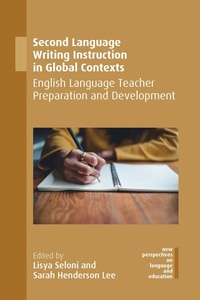
Second Language Writing Instruction in Global Contexts
English Language Teacher Preparation and Development
Published on 11. October 2019
336 pages
978-1-78892-588-4 (ISBN)
Description

This book revisits second language (L2) writing teacher education by exploring the complex layers of L2 writing instruction in non-English dominant contexts (i.e. English as a foreign language contexts). It pushes the boundaries of teacher education by specifically examining the development of teacher literacy in writing in under-represented L2 writing contexts, and re-envisions L2 writing teacher education that is contextually and culturally situated, moving away from the uncritical embracement of Western-based writing pedagogies. It explores and expands on writing teacher education - how language teachers come to understand their own writing practices and instruction, and what their related experiences are in non-English dominant contexts across the globe.
Chapter 4 is free to download as an open access publication under a CC BY NC ND licence. You can access it here: https://zenodo.org/record/7096127#.YymCsHbMLcs
Chapter 4 is free to download as an open access publication under a CC BY NC ND licence. You can access it here: https://zenodo.org/record/7096127#.YymCsHbMLcs
Reviews / Votes
The message from the well-known scholars in this volume seems clear: As the English language continues to grow in global importance, so does the importance of well-prepared writing teachers. This important book calls for more attention to preparing teachers of writing and to finding ways to deal with contextual and institutional constraints that have historically underplayed attention to English L2 writing. * Christine Pearson Casanave, Temple University, Japan and Middlebury Institute of International Studies at Monterey, USA * The many contributors to this volume broaden, diversify, and challenge our notions of second language writing teacher education and its contexts by taking us far beyond the usual constrained purview of amply resourced English-dominant settings so common in prior published work. Current and future teachers and teacher-educators who care about second language writing will benefit from the wealth of perspectives on offer. * Diane D. Belcher, Georgia State University, USA * Writing is becoming an integral part of language education throughout the world, and it is increasingly important to understanding how teachers are being prepared to address the needs of L2 writers. This volume provides much-needed insights from around the world, which can in turn help shape the future of the field. * Paul Kei Matsuda, Arizona State University, USA * [This book] has many strengths. First, it is remarkably informative. The book includes studies of English writing education in various parts of the world, which broadens my understanding [...] Second, the book includes studies that research various topics using different frameworks of adaptive expertise, written corrective feedback, motivation and identity [...] Finally, the book focuses on the English writing education in non-English speaking countries. This significantly contributes to the field of researching English writing education as the majority of studies on this topic are conducted in English speaking countries. -- Dung My Tran, University of Texas at San Antonio, USA * LINGUIST List 31.1992 * By including valued experiences and empirical studies in global contexts, this book sheds light on understanding the practices, common patterns, and complexities of writing instruction and English teacher education programs in a range of L2 contexts [...] the collection successfully presents a diversity of writing teaching contexts, and draws attention to the complexity of writing instruction in underexplored contexts. -- Jingjing Wang and Jiaxian Gao, Hubei University, China * Journal of English for Academic Purposes 46 (2020) *More details
Series
Language
English
Place of publication
Bristol
United Kingdom
Target group
College/higher education
Product notice
Reflowable
ISBN-13
978-1-78892-588-4 (9781788925884)
Copyright in bibliographic data and cover images is held by Nielsen Book Services Limited or by the publishers or by their respective licensors: all rights reserved.
Schweitzer Classification
Other editions
Additional editions
Lisya Seloni | Sarah Henderson Lee
Second Language Writing Instruction in Global Contexts
English Language Teacher Preparation and Development
Book
10/2019
Multilingual Matters
€61.80
Shipment within 3-4 weeks
Persons
Lisya Seloni is Associate Professor of English, Illinois State University, USA. Her research areas include L2 writing, teacher education, intercultural rhetoric and language-based ethnography.
Sarah Henderson Lee is Associate Professor of English, Minnesota State University, USA. Her research areas include L2 writing, World Englishes, critical pedagogy and language teacher identity.
Sarah Henderson Lee is Associate Professor of English, Minnesota State University, USA. Her research areas include L2 writing, World Englishes, critical pedagogy and language teacher identity.
Content
Introduction. Lisya Seloni and Sarah Henderson Lee: Issues and Perspectives in Second Language Writing Teacher Education in Non-English Dominant Contexts
Chapter 1. Alan Hirvela: Exploring Second Language Writing Teacher Education: The Role of Adaptive Expertise
Chapter 2. Icy Lee: Second Language Writing Teacher Education and Feedback Literacy Development: Perspectives from Hong Kong
Chapter 3. Zhiwei Wu and Xiaoye You: English Writing Teachers' Concept Development in China
Chapter 4. Keiko Hirose and Chris Harwood: Factors Influencing English as a Foreign Language Writing Instruction in Japan from a Teacher Education Perspective
This chapter is open access under a CC BY NC ND licence and can be downloaded for free at: https://zenodo.org/records/7096127#.YymCsHbMLcs
Chapter 5. Sarah J. McCarthey: Teacher Preparation for Writing Instruction in Singapore
Chapter 6. Tanita Saenkhum: English Writing Instruction and Teacher Preparation in Thailand: Perspectives from the Primary and Secondary Schools
Chapter 7. Sarah Henderson Lee and Shyam B. Pandey: Writing Pedagogy and Practice in South Asia: A Case of English Language Teachers and Teacher Trainers in Nepal
Chapter 8. Thomas D. Mitchell and Silvia Pessoa: Scaffolding Second Language Disciplinary Writing in Qatar: A Case Study of a Design Teacher's Development
Chapter 9. Aylin UEnaldi, Lisya Seloni, Sebnem Yalcin, and Nur Yigitoglu Aptoula: The Role of Writing in an English as a Foreign Language Teacher Preparation Program in Turkey: Institutional Demands, Pedagogical Practices and Student Needs
Chapter 10. Alev OEzbilgin and Betil Eroez: Opportunities and Resources for Pre-service English Teachers to Teach Writing: The Case of Northern Cyprus
Chapter 11. Lourdes Cerezo, Belen Gonzalez-Cruz and Jose Angel Mercader: English as a Foreign Language Writing Teacher Education and Development in Spain: The Relevance of a Focus on Second Language Writing as a Tool for Second Language Development
Chapter 12. Dario Luis Banegas, Marianela Herrera, Cristina Nieva, Luisina Doronuk and Yanina Salgueiro: 'Writing Makes us Professional': Second Language Writing in Argentinian Teacher Education
Chapter 13. Solange Aranha and Luciana C. de Oliveira: Second Language Writing Teacher Education in Brazil
Chapter 14. Melinda Reichelt: Preparing Teachers to Teach Writing in Various English as a Foreign Language Contexts
Chapter 1. Alan Hirvela: Exploring Second Language Writing Teacher Education: The Role of Adaptive Expertise
Chapter 2. Icy Lee: Second Language Writing Teacher Education and Feedback Literacy Development: Perspectives from Hong Kong
Chapter 3. Zhiwei Wu and Xiaoye You: English Writing Teachers' Concept Development in China
Chapter 4. Keiko Hirose and Chris Harwood: Factors Influencing English as a Foreign Language Writing Instruction in Japan from a Teacher Education Perspective
This chapter is open access under a CC BY NC ND licence and can be downloaded for free at: https://zenodo.org/records/7096127#.YymCsHbMLcs
Chapter 5. Sarah J. McCarthey: Teacher Preparation for Writing Instruction in Singapore
Chapter 6. Tanita Saenkhum: English Writing Instruction and Teacher Preparation in Thailand: Perspectives from the Primary and Secondary Schools
Chapter 7. Sarah Henderson Lee and Shyam B. Pandey: Writing Pedagogy and Practice in South Asia: A Case of English Language Teachers and Teacher Trainers in Nepal
Chapter 8. Thomas D. Mitchell and Silvia Pessoa: Scaffolding Second Language Disciplinary Writing in Qatar: A Case Study of a Design Teacher's Development
Chapter 9. Aylin UEnaldi, Lisya Seloni, Sebnem Yalcin, and Nur Yigitoglu Aptoula: The Role of Writing in an English as a Foreign Language Teacher Preparation Program in Turkey: Institutional Demands, Pedagogical Practices and Student Needs
Chapter 10. Alev OEzbilgin and Betil Eroez: Opportunities and Resources for Pre-service English Teachers to Teach Writing: The Case of Northern Cyprus
Chapter 11. Lourdes Cerezo, Belen Gonzalez-Cruz and Jose Angel Mercader: English as a Foreign Language Writing Teacher Education and Development in Spain: The Relevance of a Focus on Second Language Writing as a Tool for Second Language Development
Chapter 12. Dario Luis Banegas, Marianela Herrera, Cristina Nieva, Luisina Doronuk and Yanina Salgueiro: 'Writing Makes us Professional': Second Language Writing in Argentinian Teacher Education
Chapter 13. Solange Aranha and Luciana C. de Oliveira: Second Language Writing Teacher Education in Brazil
Chapter 14. Melinda Reichelt: Preparing Teachers to Teach Writing in Various English as a Foreign Language Contexts
