

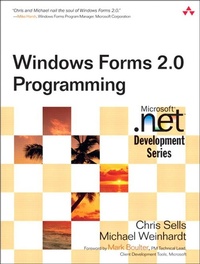
Windows Forms 2.0 Programming
Description

Windows Forms 2.0 Programming is the successor to the highly praised Windows Forms Programming in C#. This edition has been significantly updated to amalgamate the sheer mass of new and improved support that is encompassed by Windows Forms 2.0, the .NET Framework 2.0, and Visual Studio 2005. This is the one book developers need in order to learn how to build and deploy leading-edge Windows Forms 2.0 applications.
Readers will gain a deep understanding from Sells and Weinhardt's practical, well-balanced approach to the subject and clear code samples.
. Windows Forms 2.0 fundamentals, including forms, dialogs, data validation, help, controls, components, and rendering
. Static and dynamic layout, snap lines, HTML-style flow and table layout, automatic resizing, and automatic cross-DPI scaling
. Office 2003-style tool strip control coverage, including dynamic layout and custom rendering
. Design-time integration with the Visual Studio 2005 Properties Window and Smart Tags
. Resource management, strongly typed resources, and internationalization considerations
. Strongly typed application and user settings
. SDI, MDI, Single Instancing, Multiple-Instance SDI, Single-Instance MDI, database-centric, and document-centric applications
. Databinding data-source management, drag-and-drop databinding, the BindingSource, the BindingNavigator, and applied databinding
. Events, delegates, multithreaded UIs, long-running operations, simplified multithreading with the BackgroundWorker, and asynchronous web service calls
. ClickOnce application development publishing, shell integration, and partial trust security
. Best practices for developers transitioning from Windows Forms 1.0 and MFC
More details
Persons
Chris Sells is a program manager for the Connected Systems Division. He's written several books, including Programming Windows Presentation Foundation (O'Reilly), Windows Forms Programming in C# (Addison-Wesley), and ATL Internals (Addison-Wesley). In his free time, Chris hosts various conferences and makes a pest of himself on Microsoft internal product team discussion lists. More information about Chris-and his various projects-is available at .
Michael Weinhardt is a programmer/writer at Microsoft, working on the Windows Client SDK. Michael has coauthored a variety of articles with Chris, contributed to the "Wonders of Windows Forms" column at MSDN Online, reviewed several Windows technology books, and generally loves communicating the whys and wherefores of technology to his peers. Michael is sure that his parents attribute his fascination in technology to their purchase of an Amiga 1000 in the mid-80s. They would be right.
Content
About the Authors xxv
Foreword xxvii
Preface xxxi
Chapter 1 Hello, Windows Forms 1
Chapter 2 Forms 41
Chapter 3 Dialogs 99
Chapter 4 Layout 137
Chapter 5 Drawing Basics 179
Chapter 6 Drawing Text 231
Chapter 7 Advanced Drawing 265
Chapter 8 Printing 291
Chapter 9 Components 327
Chapter 10 Controls 353
Chapter 11 Design-Time Integration: The Properties Window 399
Chapter 12 Design-Time Integration: Designers and Smart Tags 453
Chapter 13 Resources 505
Chapter 14 Applications 549
Chapter 15 Settings 579
Chapter 16 Data Binding Basics 629
Chapter 17 Applied Data Binding 681
Chapter 18 Multithreaded User Interfaces 737
Chapter 19 ClickOnce Deployment 775
Appendix A What's New in Windows Forms 2.0 829
Appendix C Delegates and Events 867
Appendix D Component and Control Survey 881
Appendix E Drag and Drop 901
Appendix F Document Management 927
Bibliography 957
Index 961
