

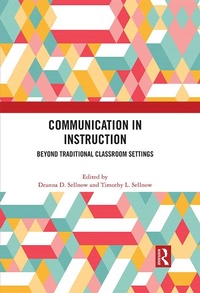
Communication in Instruction
Beyond Traditional Classroom Settings
1st Edition
Published on 15. June 2021
106 pages
978-1-000-39526-6 (ISBN)
Description

Communication in Instruction: Beyond Traditional Classroom Settings explores the various challenges we face when trying to teach others in various contexts beyond traditional classroom settings, as well as the possible strategies for overcoming them.
Instructional communication is a research field that focuses on the role communication plays in instructing others. Although many resources focus on effectively instructional communication strategies within a traditional classroom setting, this book expands the scope to include diverse settings where instructional communication also occurs (e.g., risk and crisis situations, health care contexts, business settings), as well as new directions where instructional communication research and practice are (or ought to be) headed.
Whether we are trying to teach a youngster to ride a bike, to help a friend evaluate the claims made on an advertisement, or to conduct a safety drill with colleagues in the workplace, we are engaging in instructional communication. If we want to do so effectively, however, we need to equip ourselves with best practice tools and strategies for doing so. That is what this book is intended to do. In it, you will read about how to teach advocacy to health care practitioners, guide others to become socialised in a new workplace setting, employ strategies for teaching digital media literacy to nondigital natives, and use artificial intelligence (AI) and robots when instructing and engaging strategies for instruction around socially relevant issues such as religion, politics, and violence. Together, they point to some of the ways instructional communication scholarship may be used to explore and inform best practices across communication contexts.
The chapters in this book were originally published in Communication Education.
Instructional communication is a research field that focuses on the role communication plays in instructing others. Although many resources focus on effectively instructional communication strategies within a traditional classroom setting, this book expands the scope to include diverse settings where instructional communication also occurs (e.g., risk and crisis situations, health care contexts, business settings), as well as new directions where instructional communication research and practice are (or ought to be) headed.
Whether we are trying to teach a youngster to ride a bike, to help a friend evaluate the claims made on an advertisement, or to conduct a safety drill with colleagues in the workplace, we are engaging in instructional communication. If we want to do so effectively, however, we need to equip ourselves with best practice tools and strategies for doing so. That is what this book is intended to do. In it, you will read about how to teach advocacy to health care practitioners, guide others to become socialised in a new workplace setting, employ strategies for teaching digital media literacy to nondigital natives, and use artificial intelligence (AI) and robots when instructing and engaging strategies for instruction around socially relevant issues such as religion, politics, and violence. Together, they point to some of the ways instructional communication scholarship may be used to explore and inform best practices across communication contexts.
The chapters in this book were originally published in Communication Education.
More details
Edition
1. Auflage
Language
English
Place of publication
London
United Kingdom
Publishing group
Taylor & Francis Ltd
Target group
College/higher education
Product notice
Reflowable
ISBN-13
978-1-000-39526-6 (9781000395266)
Copyright in bibliographic data and cover images is held by Nielsen Book Services Limited or by the publishers or by their respective licensors: all rights reserved.
Schweitzer Classification
Other editions
Additional editions
Deanna D. Sellnow | Timothy L. Sellnow
Communication in Instruction
Beyond Traditional Classroom Settings
Book
09/2023
1st Edition
Routledge
€49.59
Shipment within 15-20 days
Deanna D. Sellnow | Timothy L. Sellnow
Communication in Instruction
Beyond Traditional Classroom Settings
Book
06/2021
1st Edition
Routledge
€179.81
Shipment within 15-20 days
Persons
Deanna D. Sellnow and Timothy L. Sellnow are Professors of Strategic Communication in the Nicholson School of Communication and Media at the University of Central Florida. Collectively, their research focuses on health, risk, crisis, instructional communication, and the intersection among them. They have published in numerous books and articles in regional, national, and international journals, as well as conducted and presented research in myriad countries around the world.
Content
Introduction: Communication and instruction beyond the traditional classroom, Deanna Sellnow and Timothy Sellnow
1. Spewing nonsense [or not]: communication competence and socialization in optics and photonics workplaces
Kelly Norris Martin, Amy L. Housley Gaffney, Anne E. Leak, Jes Nelson, Alexandria T. Cervantes, Katherine Louise Gardener, Brandon L. Clark and Benjamin M. Zwickl
2. Teaching advocacy communication to pediatric residents: the efficacy of applied improvisational theater (AIT) as an instructional tool
Krista1 Hoffmann-Longtin, Jason M. Organ, Jill V. Helphinstine, Deanna R. Reinoso, Zachary S. Morgan and Elizabeth Weinstein
3. Fake news, phishing, and fraud: a call for research on digital media literacy education beyond the classroom
Nicole M. Lee
4. A new research agenda: instructional practices of activists mobilizing for science
Meghnaa Tallapragada
5. I, teacher: using artificial intelligence (AI) and social robots in communication and instruction
Chad Edwards, Autumn Edwards, Patric R. Spence and Xialing Lin
6. Bridging campus and community: religion and violence as expansive and socially relevant communication research
Sean M. Horan and Courtney N. Wright
7. Health communication as an instructional communication context beyond the classroom
Teresa L. Thompson
8. Response to special issue on communication and instruction beyond the traditional classroom
Matthew W. Seeger
9. A Call For A Pedagogy Of Empathy
Carolyn Calloway-Thomas
10. Riddles, mysteries, and enigmas: communication, teaching, and learning beyond the traditional classroom
Deanna P. Dannels
1. Spewing nonsense [or not]: communication competence and socialization in optics and photonics workplaces
Kelly Norris Martin, Amy L. Housley Gaffney, Anne E. Leak, Jes Nelson, Alexandria T. Cervantes, Katherine Louise Gardener, Brandon L. Clark and Benjamin M. Zwickl
2. Teaching advocacy communication to pediatric residents: the efficacy of applied improvisational theater (AIT) as an instructional tool
Krista1 Hoffmann-Longtin, Jason M. Organ, Jill V. Helphinstine, Deanna R. Reinoso, Zachary S. Morgan and Elizabeth Weinstein
3. Fake news, phishing, and fraud: a call for research on digital media literacy education beyond the classroom
Nicole M. Lee
4. A new research agenda: instructional practices of activists mobilizing for science
Meghnaa Tallapragada
5. I, teacher: using artificial intelligence (AI) and social robots in communication and instruction
Chad Edwards, Autumn Edwards, Patric R. Spence and Xialing Lin
6. Bridging campus and community: religion and violence as expansive and socially relevant communication research
Sean M. Horan and Courtney N. Wright
7. Health communication as an instructional communication context beyond the classroom
Teresa L. Thompson
8. Response to special issue on communication and instruction beyond the traditional classroom
Matthew W. Seeger
9. A Call For A Pedagogy Of Empathy
Carolyn Calloway-Thomas
10. Riddles, mysteries, and enigmas: communication, teaching, and learning beyond the traditional classroom
Deanna P. Dannels
