

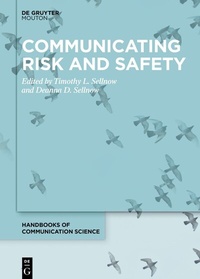
Communicating Risk and Safety
Perspectives on audiences and impact
1st Edition
Published on 31. December 2023
X, 641 pages
978-3-11-075242-7 (ISBN)
Description

The world is wrought with risks that may harm people and cost lives. The news is riddled with reports of natural disasters (wildfires, floods, earthquakes, hurricanes), industrial disasters (chemical spills, water and air pollution), and health pandemics (e.g., SARS, H1NI, COVID19). Effective risk communication is critical to mitigating harms. The body of research in this handbook reveals the challenges of communicating such messages, affirms the need for dialogue, embraces the role of instruction in proactively communicating risk, acknowledges the function of competing risk messages, investigates the growing influence of new media, and constantly reconsiders the ethical imperative for communicating recommendations for enhanced safety.
More details
Series
Language
English
Place of publication
Berlin/Boston
Germany
Publishing group
de Gruyter Mouton
Target group
Professional and scholarly
US School Grade: College Graduate Student
Illustrations
27 ill., 20 tbl.
File size
28,88 MB
ISBN-13
978-3-11-075242-7 (9783110752427)
Schweitzer Classification
Other editions
Additional editions
Timothy L. Sellnow | Deanna D. Sellnow
Communicating Risk and Safety
Book
12/2023
1st Edition
De Gruyter Mouton
€290.00
Shipment within 5-7 days
Timothy L. Sellnow | Deanna D. Sellnow
Communicating Risk and Safety
E-Book
12/2023
1st Edition
De Gruyter Mouton
€290.00
Available for download
Persons
Timothy L. Sellnow
and
Deanna D. Sellnow
, University of Central Florida, Orlando, Florida, USA.
Content
- Intro
- Preface to Handbooks of Communication Science series
- Contents
- 1 Introduction: Unique Challenges and Opportunities in Communicating Risk and Safety
- Section 1: Fundamental Principles and Perspectives When Communicating Risk and Safety
- 2 Communicating Safety and Risk: Advancement of a Field in Constant Uncertainty
- 3 Communicating with Numbers: Challenges and Potential Solutions
- 4 Translating Data into Intelligible Risk and Safety Guidelines
- 5 Disaster Fatigue, Communication, and Resilience: Insights from Natural Hazards, Human-Caused Disasters, and Public Health Crises
- 6 The COVID-19 Pandemic as Exemplar of the Chaos of Mega-Crises
- Section 2: Rhetorical Considerations When Communicating Risk and Safety
- 7 Rhetorical Sensitivity and Crisis and Risk Communication: Extension of a Theory
- 8 Emotions in Risk and Crisis Communication: An Individual and Networked Perspective
- 9 Narratives in Collision: Crisis and Pragmatic Dialogic Learning
- 10 Applying Dialogic Theory to Risk and Problem Solving
- 11 Embracing Dialogue While Cultivating Convergence: Organizational Challenges in Responsibly Communicating Risk
- 12 The Function of Stasis in Risk and Safety Controversies
- Section 3: Ethical Dilemmas When Communicating Risk and Safety
- 13 Risk Communication: A Communication Ethics Perspective
- 14 The Ethic of First and Second Things in Communicating Risk and Safety
- 15 Ethical Obligations in Communicating Risk and Safety: Standards of Dialogue, Uncertainty, Change, and Truthfulness
- Section 4: Cultural Imperatives When Communicating Risk and Safety
- 16 Culture-centered Approach to Risk Communication
- 17 "All Knowledge Is Local": The PEN-3 Model as a Guide to Overcoming Western/ European Bias in Risk Communication about Global Health Concerns in East Africa
- 18 Communities of Practice Approach to Safety Communication
- Section 5: Instructional Perspectives and Compliance-Gaining When Communicating Risk and Safety
- 19 Instruction as Self-Protection
- 20 Mobile Instructional Communication for Public Safety and Community Resilience
- 21 From Risks to Crisis Society: The Drivers of the Public Health Communication Paradigm Shift
- 22 Earthquake Risk Communication of Individual Protective Actions for Big Earthquakes: A Situational Choreography Model Based on Social Communication Engineering
- Section 6: Media and Technological Considerations When Communicating Risk and Safety
- 23 Risk Information Seeking and Processing Model
- 24 Understanding Contemporary Infodemics through the Risk Amplification through Media Spread (RAMS) Model
- 25 Spotting Risks: How to Integrate Social Media Listening to a Framework of Assessing Risks
- 26 Emergent Organizations and Post-Disaster Risk: Volunteerism in the Digital Age
- 27 Communicating and Perceiving Risks of Artificial Intelligence as an Emerging Technology
- Section 7: Future Considerations: Untangling Issues of (Mis)Trust When Communicating Risk and Safety
- 28 The Role of Trust and Distrust in Risk and Safety Communication
- 29 It's Complicated . . . : Exploring Vaccination Attitudes and the Vaccination Infodemic in the UK throughout the COVID-19 Pandemic
- 30 Communicating to Mitigate Behavioral Cyber Risks: The Case of Employee Vulnerability
- 31 Building or Unbuilding Trust? A Reflection on Governments, News Media, and Businesses' Communication during the COVID-19 Pandemic
- Contributors
- Index
