

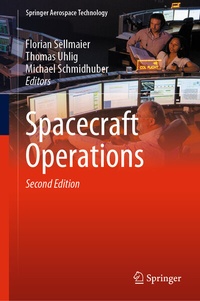
Spacecraft Operations
Description

This book describes the basic concepts of spacecraft operations for both manned and unmanned missions. The first part of the book provides a brief overview of the space segment. The next four parts deal with the classic areas of space flight operations: mission operations, communications and infrastructure, the flight dynamics system, and the mission planning system. This is followed by a part describing the operational tasks of the various subsystems of a classical satellite in Earth orbit. The last part describes the special requirements of other mission types due to the presence of astronauts, the approach of a satellite to another target satellite, or leaving Earth orbit in interplanetary missions and landing on other planets and moons.
The 2nd edition is published seven years after the first edition. It contains four new chapters on flight procedures, the human factors, ground station operation, and software and systems. In addition, several chapters have been extensivelyexpanded. The entire book has been brought up to date and the language has been revised.
This book is based on the "Spacecraft Operations Course" held at the German Space Operations Center. However, the target audience of this book is not only the participants of the course, but also students of technical and scientific courses, as well as technically interested people who want to gain a deeper understanding of spacecraft operations.
More details
Other editions
Additional editions
Persons
Michael Schmidhuber works in the Department for Mission Operations at the German Space Operations Center (GSOC). There he is responsible for satellite operations training. He graduated as an aerospace engineer at the Technical University of Munich in 1994. After working in several positions and affiliations within GSOC, he became a DLR staff member in 2006. The training activities comprise not only staff training but also courses for an external audience in the annual Spacecraft Operations Course at GSOC. Also he is involved in the organization of the bi-annual international SpaceOps Conference.
Thomas Uhlig is Columbus Flight Director at the Columbus Control Center in Oberpfaffenhofen and is leading the training for the European ISS flight controllers. He received his physics diploma and his Ph.D. from the University of Regensburg/Germany, where he worked on electromagnetic imaging of nanostructures. After working as scientist at theArgonne National Laboratory in Chicago he changed into the spaceflight business, where he worked as Payload expert on the Space Shuttle mission STS-122, before he changed in his present position. He was awarded with the Helmholtz price 2005 of the Physikalisch-Technische Bundesanstalt, and is member of the International Astronautical Federation Space Operations Committee. He is author of various scientific articles.
Florian Sellmaier is the head of business development at the German Space Operations Center (GSOC). He received his Ph.D. from the Institute of Astronomy and Astrophysics/Munich in 1996 and also spent some time at CALTECH in Pasadena/USA. After working in the radar and navigations area and as team lead of the Siemens Competence Center for e-Business Applications he joined DLR in 2006. As a project manager he conducted the acquisition and predevelopment of several upcoming mission like OLEV, DEOS and EDRS. He is author of numerous scientific publicationsin the Astrophysics as well as in the Space Operations area.
