

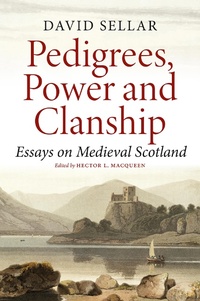
Pedigrees, Power and Clanship
Essays on Medieval Scotland
Published on 2. November 2023
416 pages
978-1-78885-646-1 (ISBN)
Description

This book brings together the major writings of David Sellar (1941-2019) on the genealogies (pedigrees) claimed by some of the major clans of medieval Highland and Island Scotland, especially the descendants of their twelfth-century king Somerled.
The claimed pedigrees in the medieval Gaelic 1467 manuscript and the Irish genealogies are critically analysed in relation to each other, and their historical authenticity tested against other evidence, including the Gaelic or Norse quality of their recorded names. Contemporary literary material is considered alongside later recorded traditions descending from the seanchaidh, whose work was to hand down to posterity the valorous actions, conquests, battles, skirmishes, marriages and relations of the chiefly ancestors by relating and singing them at births, baptisms, marriages, inaugurations, feasts and funerals. The family pedigrees offer crucial insights into the nature of medieval society, supporting and sometimes explaining a family's socio-political position. As an exercise in propaganda, a pedigree was susceptible to fabrication and not to be trusted uncritically.
David Sellar's meticulous analysis reveals the social and political realities of medieval Celtic Scotland, making use of heraldic evidence as well as his legal expertise, in a fluent and reader-friendly style.
The claimed pedigrees in the medieval Gaelic 1467 manuscript and the Irish genealogies are critically analysed in relation to each other, and their historical authenticity tested against other evidence, including the Gaelic or Norse quality of their recorded names. Contemporary literary material is considered alongside later recorded traditions descending from the seanchaidh, whose work was to hand down to posterity the valorous actions, conquests, battles, skirmishes, marriages and relations of the chiefly ancestors by relating and singing them at births, baptisms, marriages, inaugurations, feasts and funerals. The family pedigrees offer crucial insights into the nature of medieval society, supporting and sometimes explaining a family's socio-political position. As an exercise in propaganda, a pedigree was susceptible to fabrication and not to be trusted uncritically.
David Sellar's meticulous analysis reveals the social and political realities of medieval Celtic Scotland, making use of heraldic evidence as well as his legal expertise, in a fluent and reader-friendly style.
More details
Language
English
Place of publication
Edinburgh
United Kingdom
Publishing group
Birlinn General
Target group
College/higher education
Professional and scholarly
File size
11,79 MB
ISBN-13
978-1-78885-646-1 (9781788856461)
Copyright in bibliographic data and cover images is held by Nielsen Book Services Limited or by the publishers or by their respective licensors: all rights reserved.
Schweitzer Classification
Other editions
Additional editions
Book
11/2023
John Donald Short Run Press
€94.28
Article exhausted; check different version
Persons
David Sellar (1942-2019) taught in the Edinburgh University Law School for some 40 years prior to appointment as Lord Lyon King of Arms in 2008. He maintained a steady stream of significant publications on the medieval history of the Highlands and Islands, with a particular interest not only in what could be learned from clan genealogies of the period, but also in the region's literary culture and material remains such as Sueno's Stone. Retiring as Lyon in 2014, he was awarded Membership of the Royal Victorian Order, a dynastic order of knighthood awarded at the monarch's sole discretion for distinguished personal service.
Hector L. MacQueen is Emeritus Professor of Private Law, University of Edinburgh. He was Scottish Law Commissioner 2009-18, President of the Society of Legal Scholars 2012-13, Literary Director of the Stair Society 1999-2017 and has been Vice-President of the Stair Society since 2018. He is author of Common Law and Feudal Society in Medieval Scotland, co-author of Law, Lordship and Tenure: The Fall of the Black Douglases and editor of Continuity, Influences and Integration in Scottish Legal History: Select Essays of David Sellar.
Hector L. MacQueen is Emeritus Professor of Private Law, University of Edinburgh. He was Scottish Law Commissioner 2009-18, President of the Society of Legal Scholars 2012-13, Literary Director of the Stair Society 1999-2017 and has been Vice-President of the Stair Society since 2018. He is author of Common Law and Feudal Society in Medieval Scotland, co-author of Law, Lordship and Tenure: The Fall of the Black Douglases and editor of Continuity, Influences and Integration in Scottish Legal History: Select Essays of David Sellar.
