

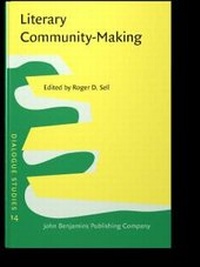
Literary Community-Making
The dialogicality of English texts from the seventeenth century to the present
1st Edition
Published on 12. June 2012
X, 263 pages
978-90-272-7417-5 (ISBN)
Description

The writing and reading of so-called literary texts can be seen as processes which are genuinely communicational. They lead, that is to say, to the growth of communities within which individuals acknowledge not only each other's similarities but differences as well. In this new book, Roger D. Sell and his colleagues apply the communicational perspective to the past four centuries of literary activity in English. Paying detailed attention to texts - both canonical and non-canonical - by Amelia Lanyer, Thomas Coryate, John Boys, Pope, Coleridge, Arnold, Kipling, William Plomer, Auden, Walter Macken, Robert Kroetsch, Rudy Wiebe and Lyn Hejinian, the book shows how the communicational issues of addressivity, commonality, dialogicality and ethics have arisen in widely different historical contexts. At a metascholarly level, it suggests that the communicational criticism of literary texts has significant cultural, social and political roles to play in the post-postmodern era of rampant globalization.
More details
Other editions
Additional editions
Roger D. Sell
Literary Community-Making
The dialogicality of English texts from the seventeenth century to the present
Book
06/2012
John Benjamins Publishing Co
€100.70
Shipment within 10-15 days
Person
Content
- Literary Community-Making
- Editorial page
- Title page
- LCC data
- Table of contents
- List of illustrations and figures
- Contributors
- Chapter 1. Introduction
- 1.1 Scope
- 1.2 Main findings
- 1.3 Looking ahead
- References
- Chapter 2. Creating paratextual communities
- 2.1 Lanyer, Coryate and their paratexts
- 2.2 "Let the Muses your companions be": Lanyer's imagined community
- 2.3 "Travelling wonder of our daies": A writer and his community
- 2.4 Paratexts and communities
- References
- Chapter 3. Laudianism and literary communication
- 3.1 Communicative restriction: Some limiting factors
- 3.2 Subjective contingencies
- 3.3 Affiliations
- 3.4 Laudian self-positionings
- 3.5 Literary communities
- 3.6 Royalist allegiances
- 3.7 Antiquarian circles
- 3.8 Receptive contingencies 1: The later seventeenth century
- 3.9 Receptive contingencies 2: The nineteenth century
- 3.10 Conclusion: Communities and valencies of attraction
- References
- Chapter 4. Pope's community-making through The Dunciad Variorum
- 4.1 The central community of the poem proper
- 4.2 "It Partakes of the Nature of a Secret": Community-making and the apparatus
- References
- Chapter 5. Dialogue versus Silencing
- 5.1 A communicational tyrant?
- 5.2 The invitation to readers of The Rime
- 5.3 Readers' responses
- 5.4 Green values
- 5.5 The conversational readjustment of 1817
- 5.6 The continuing conversation
- References
- Chapter 6. Towards a dialogical approach to Arnold
- 6.1 Dialogical reading
- 6.2 Apparent contradictions
- 6.3 A writer on religious matters
- 6.4 A poet who wrote prose
- 6.5 The writer's communicational afterlife
- References
- Chapter 7. Kipling's soldiers and Kipling's readers
- 7.1 The literary breakthrough
- 7.2 Stories
- 7.3 Poems
- 7.4 Popularity and respectability
- References
- Chapter 8. Addressivity and literary history
- 8.1 Plomer and literary history
- 8.2 Reintroducing Plomer
- 8.3 Plomer's addressivity, textual and personal
- 8.4 The addressivity of The Case Is Altered: Voices from past and present
- 8.5 Plomer and the Victorians
- 8.6 Nostalgia underneath satire: Addressivity and time in "London Ballads and Poems"
- 8.7 Plomer, communicational ethics and literary community-making
- References
- Chapter 9. Within the anti-fascist community
- 9.1 A call to respond to?
- 9.2 A warning to heed?
- 9.3 A text-world to build
- References
- Chapter 10. Literary dialogicality under threat?
- 10.1 A controversial figure
- 10.2 O'Connell the landlord
- 10.3 The forty-shilling freeholders and Catholic emancipation
- 10.4 The campaign for repeal
- 10.5 Dialogicality
- References
- Chapter 11. Robert Kroetsch and Rudy Wiebe
- 11.2 The challenge to hegemonic images
- 11.2 Mediating the experience of "being in the Prairie"
- 11.3 The self, community and space: The Blue Mountains of China
- 11.4 Seed Catalogue: Cabbages, gophers and porcupines
- 11.5 On Alberta: Sweeter than All the World and Alberta
- References
- Chapter 12. "Reading as a relationship"
- 12.1 The invitation to readers
- 12.2 Community or non-community: Language Writing
- 12.3 "Landscape and grammar": Readings towards a language of community
- 12.4 Repetition and the production of a common language
- 12.5 "Coming from the same place": Writing as reading
- References
- Index
