

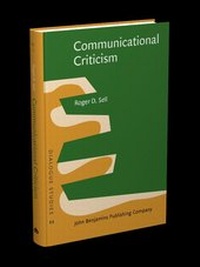
Communicational Criticism
Studies in literature as dialogue
1st Edition
Published on 17. August 2011
XI, 392 pages
978-90-272-8486-0 (ISBN)
Description

Further developing the line of argument put forward in his Literature as Communication (2000) and Mediating Criticism (2001), Roger D. Sell now suggests that when so-called literary texts stand the test of time and appeal to a large and heterogeneous circle of admirers, this is because they are genuinely dialogical in spirit. Their writers, rather than telling other people what to do or think or feel, invite them to compare notes, and about topics which take on different nuances as seen from different points of view. So while such texts obviously reflect the taste and values of their widely various provenances, they also channel a certain respect for the human other to whom they are addressed. So much so, that they win a reciprocal respect from members of their audience. In Sell's new book, this ethical interplay becomes the focus of a post-postmodern critique, which sees literary dialogicality as a possible catalyst to new, non-hegemonic kinds of globalization. The argument is illustrated with major reassessments of Shakespeare, Pope, Wordsworth, Dickens, Churchill, Orwell, and Pinter, and there are also studies of trauma literature for children, and of ethically oriented criticism itself.
More details
Other editions
Additional editions
Book
08/2011
John Benjamins Publishing Co
€104.94
Shipment within 10-15 days
Person
Content
- Communicational Criticism
- Editorial page
- Title page
- LCC data
- Dedication
- Acknowledgements
- Table of contents
- 1. Introduction: Communicational criticism
- 1.1 Literary appreciation in post-postmodern times
- 1.2 Literature as dialogue
- 1.3 Literary community-making
- 1.4 Negative capability and critical discussion
- 1.5 Climates of opinion and literary-critical ethics
- 2. Henry V and the strength and weakness of words
- 2.1 Literary dialogicality over time
- 2.2 Listening for Shakespeare
- 2.3 Temporarily strong words
- 2.4 Immediately weak words
- 2.5 Communication in the longer term
- 3. Pope's three modes of address
- 3.1 A complex profile
- 3.2 Humanist nervousness
- 3.3 Romantic nervousness
- 3.4 Sublimity
- 3.5 Pope today
- 4. Wordsworth's genuineness
- 4.1 Universal or historical?
- 4.2 Hybridity
- 4.3 Community spirit
- 4.4 Ambition and humility
- 4.5 "Home at Grasmere"
- 4.6 The Excursion
- 4.7 "Tintern Abbey"
- 4.8 The Prelude
- 4.9 Puzzlement and doubts, sorrows and fears
- 5. Great Expectations and the Dickens community
- 5.1 Blessings, will-power and pleasure, or their absence
- 5.2 Narratology hitherto
- 5.3 Positionality and ethics
- 5.4 Primary tellability
- 5.5 Secondary tellability
- 5.6 Politeness
- 5.7 Community-making
- 6. The Waste Land and the discourse of mediation
- 6.1 Mediating versus conflictual discourse
- 6.2 Robert Bridges' The Spirit of Man
- 6.3 Conceptualizing mediation
- 6.4 Enhancing dialogue with Eliot
- 7. Churchill's My Early Life and communicational ethics
- 7.1 A Nobel laureate
- 7.2 Simply an egotist?
- 7.3 Mediation between 1930 and 1874-1902
- 7.4 Mediation between today and 1930
- 7.5 Mediation between today and 1874-1902
- 7.6 Mediation between our wisdom of hindsight and Churchill's ignorance of the future
- 7.7 Mediation between Churchill's different selves
- 7.8 Communicational potential
- 8. Orwell's Coming up for Air and the communal negotiation of feelings
- 8.1 Sensibility in Modernist novels
- 8.2 An apparently unpoetical protagonist
- 8.3 A poetical protagonist after all
- 8.4 A poetical and unpoetical author
- 8.5 Realistic observations and social engagement
- 8.6 Deeper and more particularized experience
- 8.7 Communal perspectives
- 9. Lynne Reid Banks's Melusine: A Mystery (1988)
- 9.1 The writer's dilemma
- 9.2 Tactful but honest indirectness
- 9.3 The risk of dishonest overtactfulness
- 9.4 Genuine communication despite age differences
- 10. Communicational ethics and the plays of Harold Pinter
- 10.1 Coercive or genuine?
- 10.2 Different types of play, ideology, and character
- 10.3 Characters' coerciveness as plotted
- 10.4 Genuineness on stage
- 10.5 Pinter's own identity and coerciveness
- 10.6 The genuineness of Pinter's dramaturgy
- 10.7 Towards better communication
- 11. Afterword: Exploring literature's new dialogue
- References
- Index
